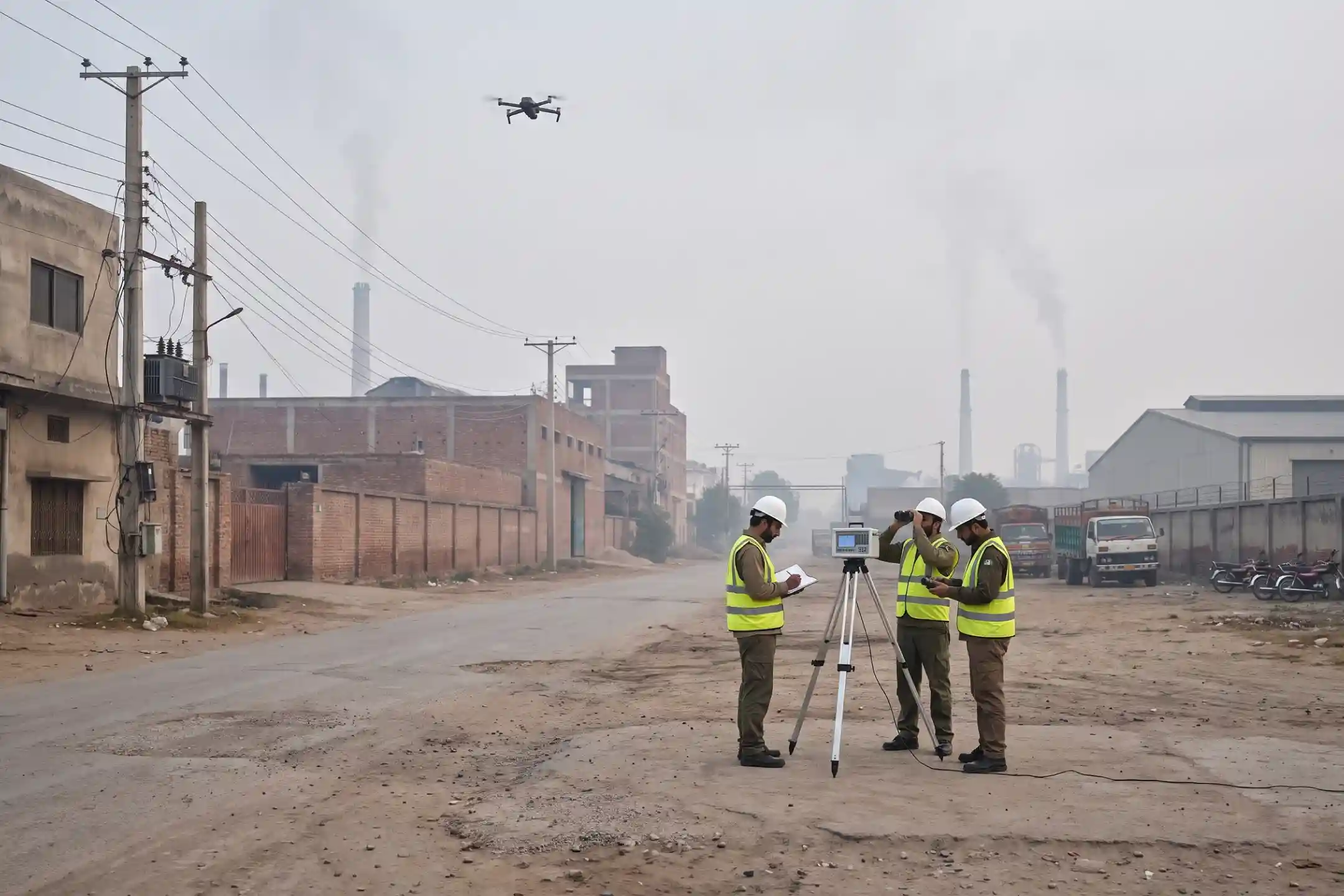
Punjab's environmental authorities have stepped up industrial inspections, night operations and technology-assisted surveillance ahead of Lahore's winter smog period, shifting part of the province's pollution-control effort to the months before severe seasonal conditions typically become a bigger concern.
The campaign is broader than factory inspections alone. Authorities are monitoring multiple pollution sources, while industrial units remain an important part of enforcement under Punjab's existing smog-control framework.
The distinction matters. Inspections, surveillance and enforcement can help authorities identify and act against controllable sources of pollution, but the number of factories inspected or sealed does not by itself show how severe Lahore's winter smog will be or how much air quality will improve.
Punjab's pre-smog enforcement is already underway
The Environment Protection Department has published a Pre-Smog Action Plan 2026 covering July through September, while a separate implementation order activated district anti-smog committees.
Recent enforcement reports show that the system has moved beyond planning and into field operations.
On October 1, Dawn reported that Environment Protection Agency teams had inspected 269 industrial units across Punjab during a 24-hour period. Eleven units were sealed, one FIR was registered and fines totalling Rs1.23 million were imposed, according to the report.
In a separate 24-hour enforcement snapshot reported on October 4, 241 industrial units were inspected across Punjab and five industrial units were sealed.
Those figures describe separate reporting periods and should not be added together as a cumulative seasonal total. The available reports do not provide an authoritative running total for the campaign.
Lahore is part of a province-wide operation
Although many of the latest enforcement figures cover Punjab as a whole, Lahore has been directly included in the industrial inspection drive.
On September 13, Business Recorder reported that EPA teams inspected 243 industrial units across Punjab during the reported 24-hour period, including 28 units in Lahore.
The enforcement effort has also involved thermal drones and day and night squads used to locate suspected pollution sources and support inspections on the ground.
This distinction between Lahore-specific and province-wide figures is important. A Punjab-wide inspection number cannot be treated as the number of factories inspected in Lahore.
From detection to enforcement: how the system works
Technology is increasingly being used to help environmental authorities identify where suspected emissions are coming from.
Thermal drone surveillance can help teams locate suspected pollution sources over a wider area. Business Recorder reported in September that once a pollution source is detected, the system helps enforcement teams identify its location before field staff are dispatched for an on-ground inspection.
In practical terms, the process can be understood as a chain: surveillance helps identify a suspected source, field teams locate and inspect the site, and enforcement can follow where violations are established under the applicable rules.
But detection and proof of a violation are not the same thing. Smoke or another signal detected during surveillance should not automatically be treated as evidence that an industrial operator has broken environmental rules. On-ground inspection and the applicable regulatory process remain important.
Why night enforcement matters before winter
The use of night squads expands monitoring beyond conventional daytime inspections. Combined with drone surveillance, it gives enforcement teams another way to identify suspected pollution sources at different times of the day.
That does not establish that factories are deliberately increasing emissions after dark. The significance of night operations is more straightforward: environmental monitoring is not restricted to normal working hours during the pre-smog campaign.
Punjab's preparations are taking place before Lahore enters the period when seasonal conditions can make its air-pollution problem more difficult to manage. Reducing controllable emissions before those conditions intensify is therefore different from waiting for a severe pollution episode before beginning enforcement.
Industry is only one part of the smog response
Industrial emissions should not be treated as the sole explanation for Lahore's air pollution.
The same pre-smog enforcement effort has covered other pollution sources and activities, including brick kilns, construction dust, plastic-related violations and commercial cooking emissions. Authorities have also monitored stubble-burning hotspots as part of the broader response.
The strategy is also extending to road traffic. On October 6, the EPA urged schools, particularly in Lahore, to promote carpooling among students, parents and staff in an effort to reduce private vehicle movement, congestion and vehicular emissions. The News reported that the agency proposed organising shared rides for people travelling from the same neighbourhoods or along similar routes as part of school anti-smog planning.
This means the industrial campaign is better understood as one component of a wider source-control strategy rather than a complete solution to Lahore's smog problem.
It also means that industrial enforcement figures cannot, on their own, establish how much of Lahore's overall pollution has been removed or how much winter air quality will improve.
What can happen when an industrial unit violates smog rules?
Punjab's smog-control framework gives environmental authorities several enforcement options. Official documentation under Rule 12 of the Punjab Environmental Protection (Smog Prevention and Control) Rules, 2023 lists actions including stopping a pollution-causing activity, suspending work, sealing premises and, where applicable, seizing or impounding goods.
The framework also provides a compliance route under Rule 12(4). An operator affected by enforcement can seek permission to resume operations by submitting evidence of compliance through pollution-control measures or an undertaking to refrain from pollution-causing activities, subject to consideration by the competent authority.
Recent enforcement shows these powers operating alongside inspections, financial penalties and FIRs. The exact action depends on the circumstances and applicable legal process, so an inspection should not be treated as evidence that every unit inspected committed a violation.
What the crackdown cannot tell us yet
The enforcement data provides evidence that Punjab is carrying out inspections and acting against reported violations before the deeper winter period. What it does not yet provide is a reliable measure of how much those actions will change Lahore's winter air quality.
There is no basis in the current enforcement figures alone to calculate a percentage reduction in Lahore's pollution, predict future AQI readings or conclude that the city's smog problem has been solved.
Nor should the number of units inspected be confused with the number found in violation. An inspection establishes that a unit was checked. Any conclusion about non-compliance requires separate evidence.
The real test comes as winter approaches
Punjab's current strategy shows a greater emphasis on identifying and acting against pollution sources before Lahore's most difficult winter period, with industrial inspections now supported by night squads and technology-assisted surveillance.
But the significance of the campaign will ultimately depend on more than the number of inspections conducted or units sealed.
The longer-term test is whether monitoring and enforcement remain consistent as seasonal conditions become less favourable, whether regulated pollution sources maintain compliance, and whether measurable environmental improvements follow from the measures being implemented.