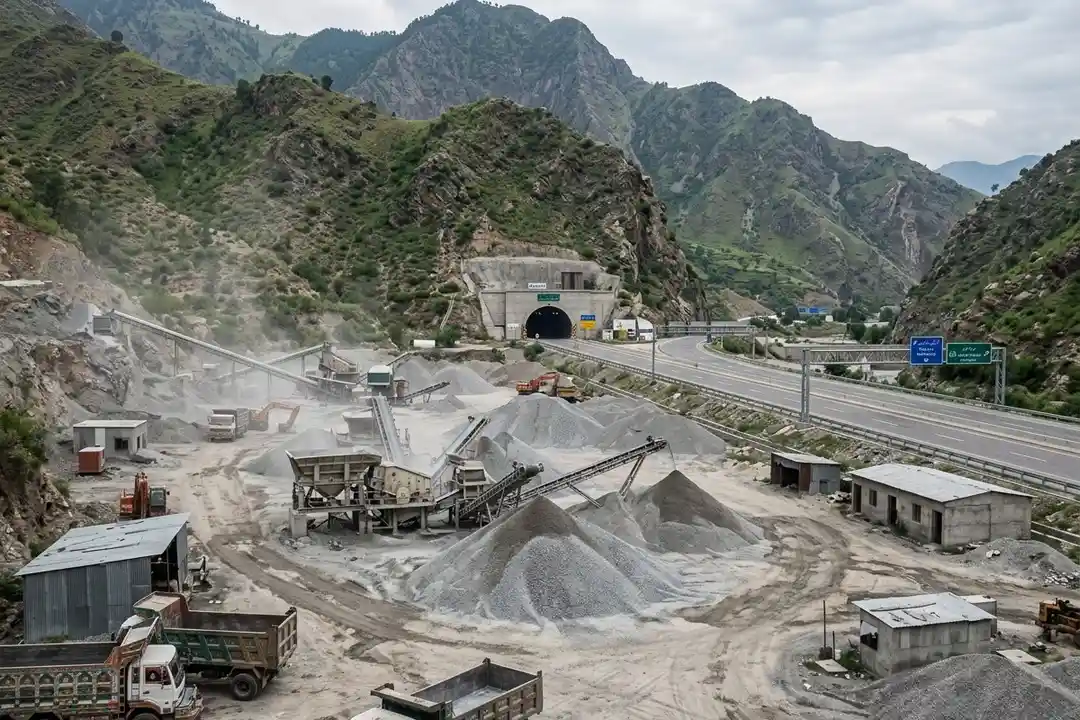
Civil society activists and archaeologists have raised concerns about mining, blasting and stone-crushing activity near the Swat Motorway’s longest tunnel, a branch of the ancient Elephant Road at Shahkot Pass, and the main gas pipeline that supplies the entire Malakand Division, Dawn reported on 24 October 2026.
The report said the archaeology department had informed the Malakand deputy commissioner about the issue in August. Malakand Division Commissioner Iqbal Hussain promised immediate action when contacted and said he had already directed the deputy commissioner to take the necessary steps.
What is happening near the tunnel
Activists say daily heavy blasting to cut rock is the greatest danger, because the quarrying and stone-crushing sites are very close to the tunnel. Nasir Khan warned that cracks could soon appear in the tunnels.
Local residents also fear that vibrations could damage or rupture the SNGPL (Sui Northern Gas Pipelines Limited) pipeline that supplies Malakand Division. If that happened, gas supply across the division would be cut off.
These are warnings based on how close the sites are. No independent engineering assessment confirming damage or measuring vibration levels had been reported at the time of writing.
The archaeological site next to the road
The area includes the Zalamkot-Hathidara complex, which Dr Abdul Samad, Director General of Archaeology and Museums, Khyber Pakhtunkhwa, has called one of the most important remains of the Hindu Shahi period. As Dawn reported in November 2025, the Khyber PATH project, run by the Italian Archaeological Mission of Ca’ Foscari University of Venice with the provincial archaeology directorate, found that the site is part of a larger fortified city that had not been identified before.
The project director, Professor Luca Maria Olivieri, said the stone-paved Hathi-lar, or Elephant Road, formed a crucial segment of the Uttarapatha, the great northern highway of the subcontinent. Dawn said the road once linked eastern Gandhara with Swat, Bajaur, Kunar and Nangarhar.
The same report described the findings so far: the podium of a large Brahmanic temple, a stepped water tank, a masonry well and ancient quarries. More than 200 carved stone blocks were recorded, many weighing up to 250 kilogrammes, and fifteen of the most important pieces were moved to the Swat Museum for conservation.
Abdul Nasir, a local elder and archaeologist, was quoted by Dawn in 2025 saying that Hathidara is among the most significant sites in Malakand district and that illegal digging had caused many artefacts to be lost.
Tourism plans along the motorway
The Khyber PATH project also plans a 125-kilometre heritage tourism trail along the Swat Motorway. According to Dawn’s 2025 report, it would connect sites from Barikot and Zalamkot to Hathi-lar, Palai, Asota, Thareli and Taxila, with the aim of creating jobs and supporting responsible tourism.
Timeline of what is known
- 28 November 2025: Dawn reports the Khyber PATH findings at Zalamkot-Hathidara.
- August 2026: According to the 24 October report, the archaeology department informs the Malakand deputy commissioner about the concerns.
- 24 October 2026: The concerns are reported, and the Malakand commissioner says he has directed the deputy commissioner to take the necessary steps.
What remains unclear
The reports reviewed do not give the exact distances between the quarrying sites, the tunnel and the pipeline. They also do not confirm the legal status of the mining and crushing units. At the time of writing, no statement from the National Highway Authority or SNGPL had been reported, and no independent inspection results had been published.
Activists and archaeologists have urged an immediate halt to the activity to protect both the heritage site and nearby infrastructure. The commissioner’s direction to the deputy commissioner is the clearest official response reported so far.
Sources: Dawn, 24 October 2026; Dawn, 28 November 2025.