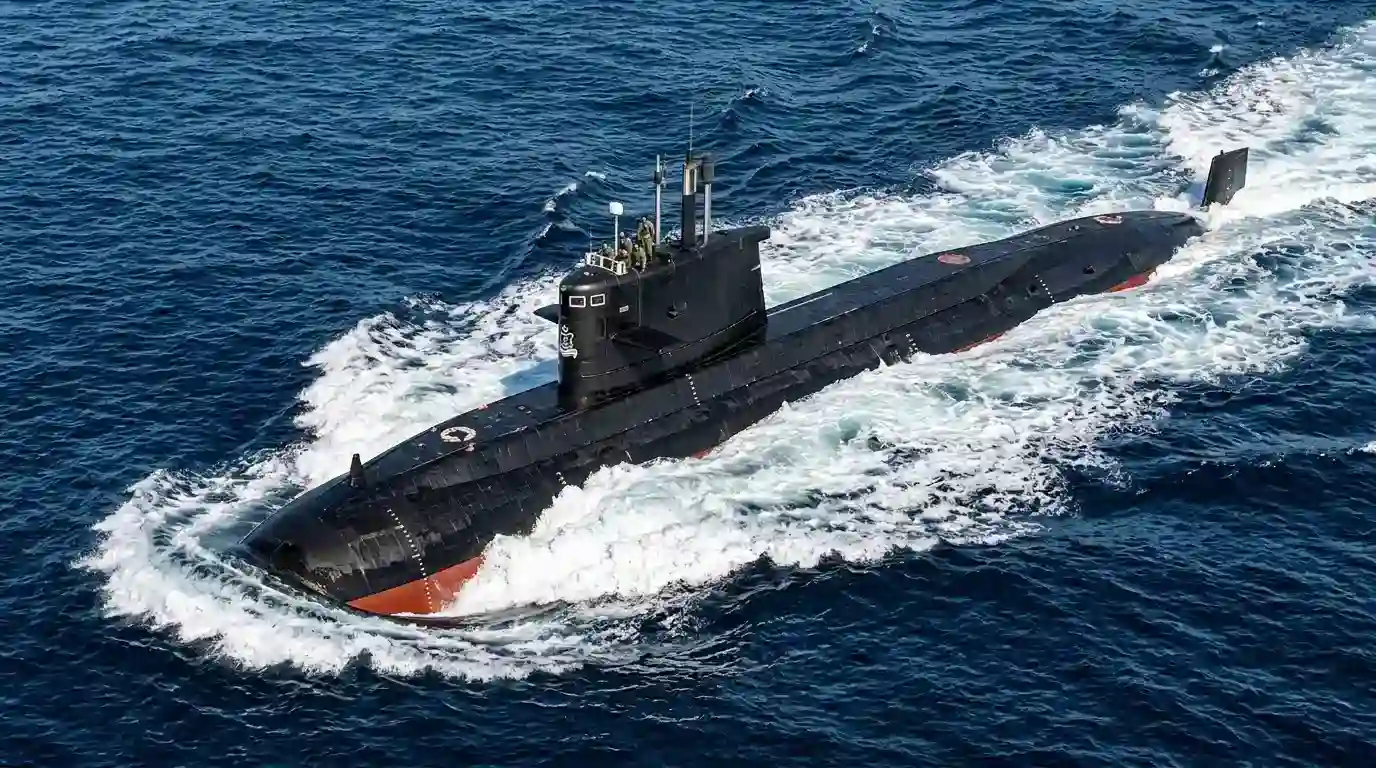
Pakistan Navy's first Hangor-class submarine, PNS/M Hangor, has successfully conducted its maiden live weapon firing in the North Arabian Sea, launching an anti-ship cruise missile at a designated long-range target, according to the Inter-Services Public Relations (ISPR).
The September 27 exercise marked another operational milestone for the newly inducted submarine, which was commissioned earlier this year as the lead vessel in Pakistan's eight-submarine Hangor-class programme with China.
ISPR said the submarine accurately engaged the designated target with the anti-ship cruise missile during the exercise. The military's media wing described the firing as a demonstration of the vessel's operational readiness.
Chief of the Naval Staff Admiral Naveed Ashraf witnessed the firing. According to ISPR, the naval chief praised the submarine's demonstrated combat capability and emphasised the importance of strengthening Pakistan's subsurface warfare capabilities to maintain operational readiness and maritime deterrence.
First live weapon firing after induction
The September exercise was described by ISPR as PNS/M Hangor's maiden live weapon firing, distinguishing it from the submarine's earlier commissioning, sea trials and delivery milestones.
PNS/M Hangor was formally commissioned into the Pakistan Navy on April 30, 2026, during a ceremony in Sanya, China. President Asif Ali Zardari attended as chief guest, while Admiral Naveed Ashraf and senior Pakistani and Chinese naval officials were also present.
At the commissioning ceremony, Pakistani officials said the new submarine would strengthen the Navy's ability to protect maritime interests and sea lines of communication. The Navy also highlighted its advanced sensors, weapons and air-independent propulsion system as central features of the new class.
The submarine later sailed to Pakistan and arrived at Karachi Port on June 11, where it received a traditional naval welcome. Pakistan Navy said at the time that the vessel's arrival represented a major step in its modernisation programme and in defence cooperation between Pakistan and China.
The latest firing therefore represents a different stage in the submarine's entry into operational service: the demonstrated use of one of its weapon capabilities at sea.
What missile did PNS/M Hangor fire?
ISPR identified the weapon used in the exercise only as an "anti-ship cruise missile" and did not publicly name the missile model.
The statement said the missile accurately engaged a designated target at extended range, but it did not disclose the firing distance or provide detailed technical specifications for the weapon.
That distinction is important because several missile systems have been discussed in open-source assessments of the Hangor programme. Pakistan Navy has not publicly disclosed the submarine's complete operational weapons configuration, and the September 27 firing does not by itself establish which specific missile was used beyond ISPR's description of it as an anti-ship cruise missile.
Pakistan's eight-submarine Hangor programme
PNS/M Hangor is the lead vessel in an eight-submarine programme being carried out between Pakistan and China. Under the construction arrangement, four submarines are being built in China while four are being constructed in Pakistan at Karachi Shipyard & Engineering Works under a technology-transfer programme.
The arrangement is significant not only because it expands the number of modern submarines available to Pakistan Navy, but also because the domestic portion of the programme is intended to develop local experience in constructing and supporting advanced conventional submarines.
Karachi Shipyard & Engineering Works says its upgraded submarine-construction facilities are being used for the Pakistani-built Hangor-class vessels. The shipyard previously participated in construction work associated with Pakistan's Agosta 90B submarine programme.
What is the Hangor class?
The Hangor class is a conventionally powered attack-submarine design developed for Pakistan through its defence partnership with China. Open-source defence assessments generally associate the design with China's S26 export submarine family, which itself draws from technologies used in the Type 039A/B Yuan-class family operated by the People's Liberation Army Navy.
However, the precise configuration of Pakistan's submarines should not be treated as identical to China's operational Yuan-class boats. Pakistan Navy has not publicly released a complete specification covering every sensor, combat-management system and weapon fitted to the class.
Karachi Shipyard lists the Hangor class at approximately 76 metres in length, 8.4 metres in breadth and about 2,800 tonnes displacement. The published specifications also give the class a maximum speed of about 20 knots.
Why air-independent propulsion matters
One of the most important publicly confirmed features of the Hangor class is its air-independent propulsion, or AIP, capability.
Conventional diesel-electric submarines normally have to operate their diesel engines periodically to recharge their batteries, a process that can increase the risk of detection. AIP systems allow a submarine to remain submerged for longer periods while reducing its dependence on atmospheric oxygen for propulsion-related power generation.
For a conventional submarine force, that can improve endurance and make it more difficult for an opponent to locate and track a boat during submerged operations.
Pakistan Navy has repeatedly highlighted AIP, modern sensors and enhanced stealth as important features of the Hangor-class programme. The precise performance of those systems, however, remains operational information and has not been fully disclosed publicly.
Torpedoes and missile capability
Open-source technical assessments report that the Hangor design uses six 533mm torpedo tubes capable of deploying heavyweight torpedoes and missile weapons. The September 27 exercise provides a publicly confirmed demonstration that PNS/M Hangor can launch an anti-ship cruise missile.
Beyond that confirmed capability, claims about individual missile models should be treated cautiously unless Pakistan Navy identifies the weapon involved.
The distinction is particularly relevant because submarine-launched weapons can serve different roles. An anti-ship cruise missile is intended primarily to engage surface vessels, while land-attack cruise missiles are designed for targets ashore. ISPR's announcement specifically described the weapon used in this exercise as an anti-ship cruise missile.
Four submarines being built in China and four in Pakistan
The Hangor programme divides construction between the two countries. Four submarines are being produced in China, while the other four are being constructed at Karachi Shipyard & Engineering Works in Pakistan.
Several of the Chinese-built submarines have already reached major construction milestones. PNS/M Shushuk, PNS/M Mangro and PNS/M Ghazi followed the lead submarine through launch and testing stages in China.
The remaining vessels being constructed in Karachi form the technology-transfer portion of the programme. Their construction is intended to expand Pakistan's domestic submarine-building experience while allowing the Navy to operate a common class produced through facilities in both countries.
Pakistan has not publicly provided a sufficiently detailed updated delivery schedule for every remaining vessel to assign firm commissioning dates to each submarine. Their progress is therefore better assessed through officially announced launch, trial and commissioning milestones rather than projected dates.
The Hangor name goes back to the 1971 war
The new submarine also carries a name with a prominent place in Pakistan Navy history.
The original PNS Hangor was a French-built Daphné-class submarine that entered Pakistan Navy service in 1970. During the India-Pakistan war of 1971, it torpedoed the Indian Navy frigate INS Khukri off India's western coast.
INS Khukri sank following the attack, with 18 officers and 176 sailors killed, according to the Indian Navy. The engagement is widely recorded as the first sinking of a warship by a submarine in combat since the Second World War.
The original Hangor remained in Pakistan Navy service until its decommissioning in 2006. The Navy subsequently revived the name for the lead vessel of its new submarine class.
What the latest test establishes
The September 27 exercise provides a publicly confirmed demonstration of PNS/M Hangor's ability to launch an anti-ship cruise missile and engage a target at extended range. It follows the submarine's commissioning in China in April and arrival in Karachi in June.
It does not, however, reveal the submarine's complete weapons inventory, the identity of the missile fired, its exact range or the full operational configuration of the Hangor class. Those details were not disclosed in ISPR's announcement.
For Pakistan Navy, the firing nevertheless represents an important step in bringing the first vessel of the class into operational service as the broader eight-submarine programme continues in China and Pakistan.