Tesla has unveiled a radically redesigned version of its long-awaited Roadster, demonstrating an electric sports car capable of driving upside down, jumping over other vehicles and rotating in the air using technology developed with SpaceX.
The demonstration took place on October 15, 2026, at SpaceX's rocket-testing facility in McGregor, Texas, nearly nine years after Tesla first presented the second-generation Roadster.
The event featured an unusual combination of powerful suction fans and compressed-gas thrusters. Tesla also reported a zero-to-60 mph acceleration run of approximately 0.81 seconds and announced that production is now targeted for 2028.
Despite the extraordinary display, the company has not demonstrated that the Roadster can function as a practical flying car for everyday travel. Its final specifications, pricing, regulatory approvals and customer delivery timetable remain important unanswered questions.
How Tesla's Roadster drove upside down
One of the most remarkable moments came when the Roadster climbed a steep curved ramp and reached an inverted section with its wheels pointing upward.
The vehicle remained against the surface using a fan-powered suction system designed to create a pressure difference beneath the car.
By drawing air from underneath the vehicle, the system generates a force that helps hold the tyres against the driving surface. Unlike conventional aerodynamic downforce, which generally increases with speed, a powered suction system can also provide substantial grip at low speeds.
Similar principles have previously been explored in specialised performance vehicles, but Tesla used the technology in a particularly dramatic demonstration.
According to Road & Track, the Roadster subsequently travelled up the ramp again, left the elevated section and used compressed-gas thrusters to control its movement before landing.
The demonstration showed a working combination of suction-assisted grip and propulsion-controlled movement. It did not establish that such manoeuvres would be safe or permitted on ordinary public roads.
SpaceX thrusters made the Roadster jump and rotate
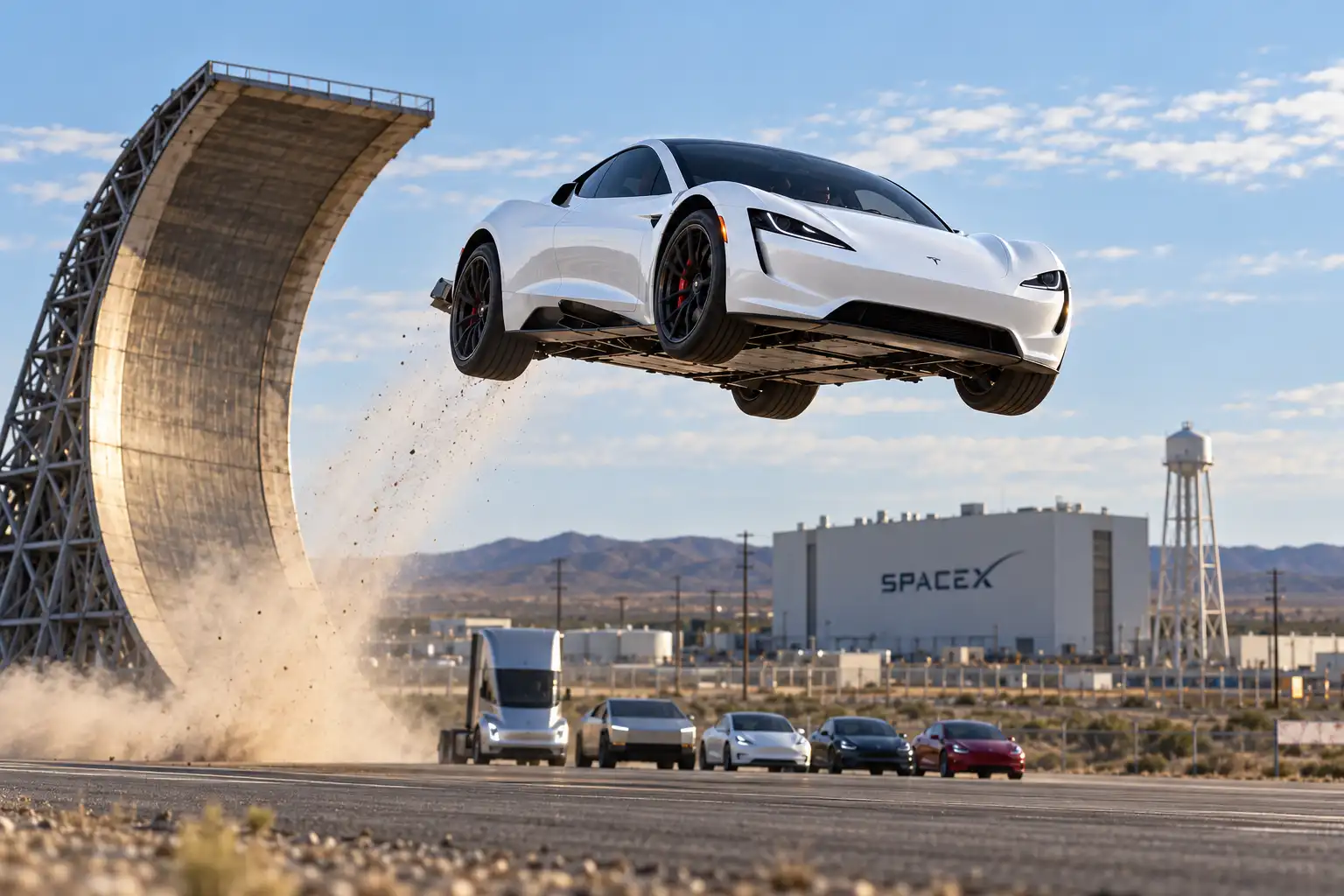
The McGregor event also featured the Roadster jumping over five Tesla vehicles: a Cybercab, Cybertruck, Semi, Model Y and Model 3.
The sports car used its onboard thrusters to lift into the air, rotate and return to the ground. Other demonstration footage showed additional controlled aerial movements.
The system relies on compressed gas released through specially positioned nozzles. When gas is expelled at high pressure, the resulting force can help accelerate the vehicle or change its orientation.
Tesla developed the technology in cooperation with SpaceX engineers. Although the company has described the hardware using rocket-related terminology, the demonstrated system operates with compressed gas rather than conventional combustion-powered rocket propulsion.
This distinction matters because the Roadster is not using the same type of engine that launches spacecraft into orbit.
Several technical questions remain unresolved for customer use, including how often the thrusters can operate, how quickly the gas supply can be replenished, and what restrictions would apply near other vehicles or pedestrians.
Can the new Tesla Roadster really fly?
Tesla has demonstrated that the Roadster can briefly leave the ground, change its orientation and land using onboard propulsion assistance.
However, that does not establish that it can operate like a conventional aircraft.
The company has not demonstrated routine sustained flight over meaningful distances, practical airborne travel between destinations or widespread approval for aerial use.
The movements shown at McGregor were performed in controlled conditions at a dedicated test facility.
It is therefore more accurate to describe the vehicle as a high-performance sports car capable of specialised airborne manoeuvres than as a fully developed flying car.
The distinction is particularly important for potential customers who may assume that every Roadster will be able to perform the stunts shown during the launch.
Tesla reports 0–60 mph in just 0.81 seconds
Acceleration was another major focus of the unveiling.
Tesla reported that the Roadster completed a zero-to-60 mph run in approximately 0.81 seconds, equivalent to reaching around 97 kilometres per hour from a standstill.
The reported demonstration involved propulsion assistance beyond a conventional electric drivetrain.
The figure is based on Tesla's presentation. It has not yet been independently established through published standardised testing of a production-ready customer vehicle.
That qualification is essential. A specially prepared demonstration vehicle can operate under conditions that differ from those encountered during ordinary ownership.
Independent testing would need to establish repeatability, operating conditions and which configuration can deliver the claimed performance.
Reports from the unveiling also described a potential top speed above 230 mph and range exceeding 300 miles. Those figures should be treated as reported specifications or targets, not independently validated results for every Roadster configuration.
Performance, Thrust and Rocket: The key differences
Tesla is presenting the redesigned Roadster with a core Performance configuration and more specialised Thrust and Rocket options.
The Performance Roadster provides the foundation for the new electric sports car.
The optional Thrust configuration adds specialised equipment, including compressed-gas propulsion technology, to deliver more extreme performance.
Tesla presents Thrust as intended for road use, although that does not establish approval in every country where customers might eventually seek to register the vehicle.
The Rocket configuration is considerably more extreme. It is described as invite-only and is associated with the vehicle's most dramatic airborne capabilities.
Importantly, Tesla identifies Rocket as not approved for public-road use.
This is a major distinction between the most spectacular launch footage and what a typical customer might legally operate.
Final package availability, market-specific restrictions and complete equipment details remain subject to further information from Tesla.
How much will the new Tesla Roadster cost?
Tesla has not established a complete final purchase-price list for the redesigned Roadster and its specialised configurations.
The Roadster project has previously involved substantial reservation deposits. Customers were originally able to reserve the vehicle with a $50,000 commitment, while the earlier Founders Series programme involved a $250,000 payment.
These reservation arrangements must not be confused with confirmed final prices for the newly demonstrated vehicle.
The eventual cost will depend on Tesla's official pricing, chosen configuration and applicable purchasing terms.
What changed from the original 2017 Roadster?
Tesla first announced the second-generation Roadster in November 2017, promising performance that would challenge the world's fastest production cars.
The original concept was advertised with a zero-to-60 mph acceleration time of 1.9 seconds, a top speed above 250 mph and approximately 620 miles of driving range.
Those figures were associated with the earlier concept. They should not automatically be applied to the redesigned Roadster presented in October 2026.
The new vehicle places far greater emphasis on active aerodynamic systems, powerful suction fans and SpaceX-developed thrusters.
Its design and proposed capabilities have evolved considerably since the initial presentation.
Some official Tesla Roadster pages continued to show older specifications, while reporting from the latest event cited different range and performance figures.
Until Tesla publishes complete, configuration-specific specifications and those figures undergo independent testing, the historical and newer numbers should not be combined into a single definitive specification sheet.
Why the 2028 production target deserves scrutiny
The Roadster's development history makes the latest production timetable especially important.
After the second-generation car was announced in 2017, Tesla repeatedly pushed back its expected arrival.
The company directed considerable attention toward other vehicles and technologies, including the Model 3, Model Y, Cybertruck and autonomous-driving development.
The McGregor demonstration represents meaningful technical progress because Tesla displayed a functioning vehicle performing manoeuvres that previously existed mainly as ambitious plans.
But demonstrating a prototype is not equivalent to manufacturing customer vehicles at scale.
Tesla must still finalise production engineering, establish manufacturing processes, demonstrate reliability and address applicable safety and regulatory requirements.
The Rocket configuration, which is not approved for public-road use, introduces additional limitations that customers will need to understand.
Elon Musk has now identified 2028 as the target for the beginning of production, nearly eleven years after the vehicle's original announcement.
That is a company projection, not a guaranteed delivery date.
Why the Roadster matters to Tesla's wider strategy
The Roadster arrives as Tesla increasingly promotes technologies beyond conventional electric cars.
Autonomous driving, robotaxis, artificial intelligence and the Optimus humanoid robot have become increasingly prominent in the company's long-term strategy.
Against that background, the Roadster serves a different role from Tesla's mass-market vehicles.
It is intended to demonstrate engineering capability, extreme performance and the technological ambitions of the Tesla brand.
Musk has acknowledged that the Roadster is unlikely to transform the company's overall revenue.
Its importance may instead lie in attracting attention and demonstrating technologies that distinguish Tesla from competing automakers.
Whether this technical showcase becomes a commercially successful product remains uncertain.
Will the Tesla Roadster be available in Pakistan?
There is no confirmed official Pakistan launch plan, local retail price or customer delivery timetable for the redesigned Roadster.
If the vehicle becomes available through private imports, the final cost would depend on its international purchase price, applicable import taxes, registration requirements and other expenses.
Buyers would also need to consider servicing arrangements and whether a particular configuration could legally be registered or operated locally.
The Rocket configuration's lack of public-road approval would be an additional consideration.
Without definitive pricing and regulatory information, any precise Pakistani price would be speculative.
The real test comes after the demonstration
Tesla's new Roadster is one of the most unusual electric sports car concepts demonstrated in recent years.
The McGregor event showed a prototype driving upside down, jumping over other vehicles and performing controlled aerial movements using compressed-gas thrusters.
However, its extraordinary appearance should not obscure the challenges ahead.
Independent performance testing, final specifications, safety assessments, official pricing and evidence of production progress will ultimately determine whether Tesla fulfils its latest Roadster promises.
For now, the company has delivered an impressive demonstration, but not a proven everyday flying car. The next milestone is turning that demonstration into a vehicle customers can actually receive in 2028 or beyond.
Sources
- Reuters — Tesla's redesigned Roadster and production target
- TechCrunch — Roadster unveiling and demonstrations
- Road & Track — Roadster acceleration and aerial demonstrations
- The Information — Roadster configurations and regulatory restrictions
- Tesla — Official Roadster specifications and configurations