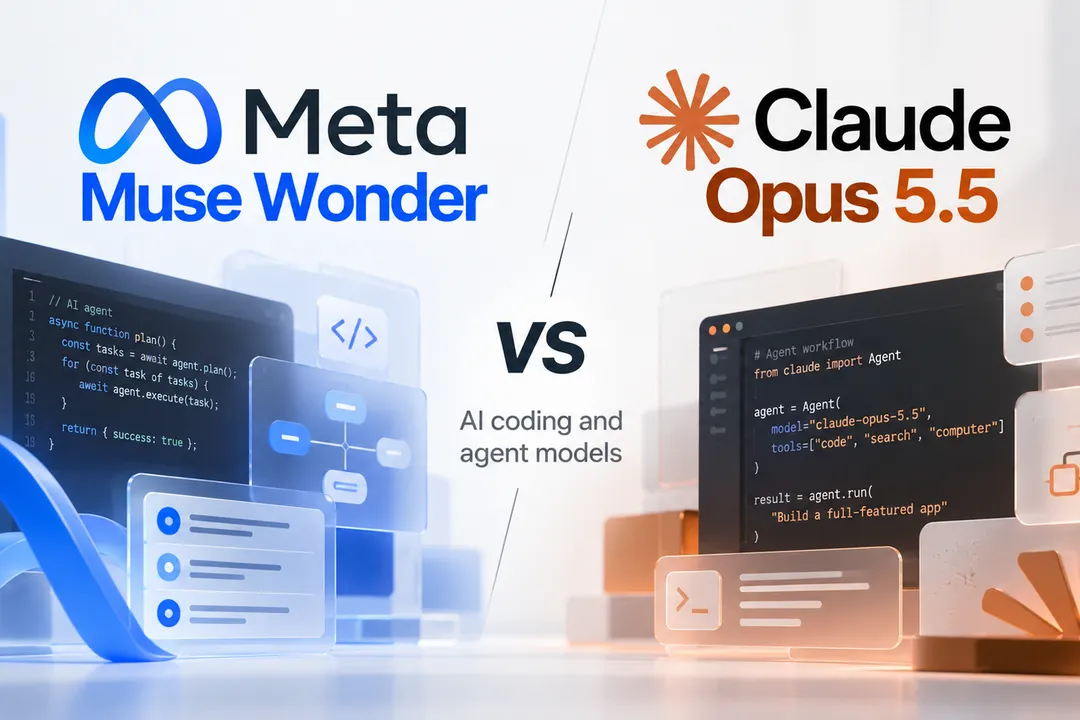
Meta has launched Muse Wonder and Muse Wonder Full, two artificial intelligence models aimed at coding, research and long-running AI-agent tasks, putting the company in closer competition with Anthropic's Claude Opus 5.5. Announced on October 12, 2026, the models arrive weeks after Anthropic introduced Opus 5.5 on September 22. But Meta's two models are not equally accessible: developers can use the standard Muse Wonder through an API, while the more capable Wonder Full requires certain Muse Code subscriptions.
That difference matters when weighing the launch against Claude. Meta's announcement describes systems intended to complete complicated tasks over time, including building applications and handling information across conversations. Its published tests show strengths in extended software-engineering work, but Anthropic's flagship model performs better on several other measures. Neither company's claims amount to proof of one universal winner.
What are Muse Wonder and Muse Wonder Full?
Muse Wonder is Meta's new developer-accessible model. Muse Wonder Full is a separate, higher-capability version for more demanding work. According to the official model card, both support a context window of up to one million tokens and accept text, images, video and audio as inputs, while producing text output. A large context window gives an AI system room to work with extensive documents or code, but does not guarantee that it will correctly understand or remember everything provided.
Meta highlights two features named Active Memory and Active Focus. Active Memory is intended to carry useful details between conversations and retrieve them when relevant. Active Focus is intended to help the models keep working when complicated tasks encounter problems, try a different approach and seek clarification or approval when necessary. These are company-described capabilities, not a promise of flawless memory, uninterrupted operation in every environment or error-free decisions.
For example, a developer could ask an agent to inspect a codebase, identify a bug, make a change and run tests. A longer assignment might involve several components and repeated checks. The model still needs appropriate tools, permissions and supervision to perform those steps. Meta's own model card warns that multi-step reasoning errors remain possible and that performance varies according to configuration, prompts and tools.
How are Muse Code, the Model API and the consumer Muse assistant different?
Muse Code is a coding tool, not a third Wonder model. Meta positions it as a terminal-based agent capable of working on code repositories, coordinating subtasks and using its underlying models to edit and test software. The standard Muse Wonder can be accessed through Meta's Model API or through Muse Code. Wonder Full is limited to the Power Usage and Maximum Usage Muse Code subscription tiers, rather than the standard pay-as-you-go Model API.
That means buying API tokens for Muse Wonder does not automatically provide Wonder Full. Nor does setting ordinary Wonder to a higher reasoning level make it the separate Full model. Meta also says subscriptions apply to Muse Code's own connected credentials; additional API keys are billed separately on a pay-as-you-go basis.
The consumer-facing Muse assistant is another product. Meta says Wonder-powered experiences will appear there later, with subscribers first in line. It has not announced a universal date for all consumer accounts. This launch should therefore not be described as an immediate free upgrade for every person using Meta's AI services.
Muse Wonder vs Claude Opus 5.5: what do the benchmarks show?
Meta's October 12 scorecard contains results from several evaluation groups, including third-party testing and Meta-run comparisons. The following selected figures are published benchmark scores, not tests performed by Origin Pakistan. Higher numbers indicate better results within the same benchmark only.
| Benchmark | Muse Wonder | Wonder Full | Claude Opus 5.5 |
|---|---|---|---|
| DeepSWE 1.1 — extended coding | 78.8 | 79.0 | 74.2 |
| SWE-Marathon — long software projects | 53.1 | 57.5 | 46.3 |
| Terminal-Bench 4.0-AA — terminal tasks | 52.0 | 57.1 | 59.6 |
| ProgramBench — creating programs | 50.0 | 59.0 | 70.5 |
| OSWorld V2.1 — computer use, partial score | 72.6 | 78.4 | 81.8 |
| Artificial Analysis Intelligence Index v4.3 | 52 | 56 | 58 |
Source: Meta's October 12 scorecard. The figures show that Muse Wonder and Wonder Full scored ahead on DeepSWE, which evaluates difficult software changes across existing repositories. On Terminal-Bench and ProgramBench, however, Claude Opus 5.5 scored higher than both Meta models. The Artificial Analysis Intelligence Index also placed Opus 5.5 ahead in the reported comparison.
There are important methodological limits. Meta's model card says the DeepSWE figures for Wonder, Wonder Full and Opus 5.5 come from Datacurve, while the SWE-Marathon figures are drawn from Abundant AI. Not every SWE-Marathon entry uses the same coding agent: the leaderboard's GPT-6 Astra and Claude Fable 5.1 runs use Codex and Claude Code, respectively. Wonder Full's result was reported at xhigh reasoning effort. The scorecard also draws on internal evaluations and provider-reported results, and Meta cautions that its internal runs of competitors may not use each model's best possible setup.
Anthropic also reports a 66.4% Opus 5.5 result on its own Terminal-Bench 4.0 setup. That is different from the 59.6 Artificial Analysis result used in Meta's Terminal-Bench 4.0-AA comparison. They come from different reported evaluation setups and should not be substituted for one another. Scores from different tests cannot be added together or treated as percentages of general intelligence. Meta's MemoryBench, if mentioned, must be identified as an internal test. The fair conclusion is narrower: the Wonder family looks competitive on sustained coding tasks, while Opus 5.5 leads in several other published comparisons.
What do Muse Wonder, Muse Code and Claude Opus 5.5 cost?
Meta lists standard Muse Wonder at $4 per million input tokens and $20 per million output tokens through its API. Cached input is listed at $0.20 per million tokens. Anthropic publishes the same three standard rates for Claude Opus 5.5. These are US-dollar standard API list rates, not monthly subscriptions; special access modes and other service fees may have different rates. For example, Anthropic lists Opus 5.5 fast mode at $8 input and $40 output per million tokens. These prices do not measure how many tokens or how much time each model needs to finish a task.
| Service | Published price | Key limitation |
|---|---|---|
| Muse Wonder API | $4 input / $20 output per 1M tokens | Standard Wonder, not Full |
| Claude Opus 5.5 API | $4 input / $20 output per 1M tokens | Anthropic API terms apply |
| Muse Code Everyday | $5 per month | Usage limits; standard Wonder |
| Muse Code High | $15 per month | Higher usage; standard Wonder |
| Muse Code Power | $50 per month | Includes Wonder Full |
| Muse Code Maximum | $200 per month | Includes Wonder Full; higher limits |
Meta's API pricing page and Muse Code subscription guide explain the difference. A $50 monthly subscription cannot be compared directly with a per-token API rate: the subscription is for use inside Muse Code, and its allowance is capped. Meta says benefits and availability can vary by region. Origin Pakistan has not independently verified payment support or account eligibility in Pakistan.
Does Muse Code use private code or conversations to train Meta's AI?
There is a significant privacy distinction between the subscription and API routes. Meta says Muse Code subscriptions default to Contributor mode. In that mode, users receive higher usage allowances in exchange for permitting Meta to use content such as submitted prompts, code, files, contextual information and generated responses to train future Meta models.
According to Meta's Contributor mode guidance, subscribers can switch the setting off using /settings in Muse Code. Meta says content submitted after the change is not used for future model training unless the setting is re-enabled. Turning it off changes the usage allowance but does not automatically cancel the subscription. Meta also warns that users must not submit sensitive, confidential or personal information to its discounted services and should use Standard Services when processing personal information. This warning matters for private client repositories. The setting change concerns future submissions; it is not a promise that content previously submitted is retroactively deleted.
The standard Muse Wonder pay-as-you-go API has a different data-use arrangement. Meta states that content in Standard mode is not used for model training; Contributor mode is not offered for Wonder on the pay-as-you-go Model API. Developers handling confidential client repositories or personal information should use an appropriately permitted service and inspect its current terms, permissions, retention rules and settings first. A promise not to train on content does not by itself establish zero data retention, and not every Meta AI product has the same defaults.
Is Muse Wonder better than Claude Opus 5.5?
The available evidence does not establish a single winner. A developer concentrating on lengthy software changes may find Meta's reported DeepSWE performance relevant. Someone evaluating terminal operations or program reconstruction will see stronger published Opus 5.5 scores. Actual quality also depends on the surrounding coding agent, prompts, testing process, cost and whether the chosen model is available through the required interface.
Meta is also promoting the Wonder family for professional research and personal agents. These uses may involve sensitive documents and decisions, so the company says safeguards and additional human review remain necessary. Meta's research explanation describes Active Memory and Active Focus as intended improvements rather than demonstrations that a model cannot lose context or make mistakes.
For now, Muse Wonder is available to developers, Muse Wonder Full is tied to qualifying Muse Code plans, and the wider consumer Muse rollout remains to be completed. Neither regional availability in Pakistan nor an independent Origin Pakistan hands-on performance comparison has been established. The strongest takeaway from the launch is expanded competition in AI coding and agents, not proof that one company's model is best at every task.