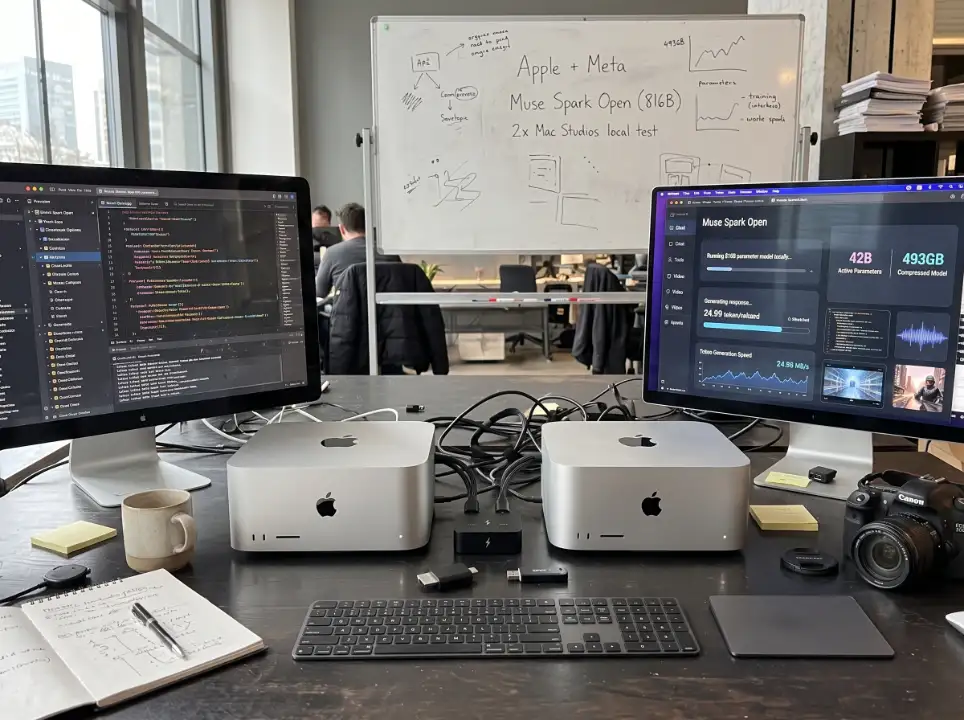
Apple and Meta have demonstrated that an enormous artificial intelligence model can run locally across two high-end desktop computers, offering developers another way to use powerful AI without relying entirely on remote cloud servers.
Meta released Muse Spark Open on October 15, 2026. The model contains 816 billion total parameters and is designed for complex coding, reasoning and tasks involving multiple steps. Working with Apple, Meta demonstrated how it can operate across two M5 Ultra Mac Studios, each equipped with 512GB of unified memory.
The collaboration is a significant development for local AI computing. But it comes with an expensive catch: according to The Wall Street Journal, the necessary high-memory hardware costs more than $40,000.
For now, the achievement is most relevant to developers, researchers and organisations with substantial computing budgets. It does not mean that an ordinary MacBook or entry-level Mac Studio can run the entire model.
What is Meta's Muse Spark Open?
Muse Spark Open is an open-weight AI model developed by Meta Superintelligence Labs. Meta describes it as the most capable US open-weight model released to date, although that is the company's assessment rather than an independently established ranking.
According to Meta's official announcement, the model is designed for software engineering, multi-step reasoning and AI agents that can use tools to complete complicated tasks.
It can process text, images, audio and video, while producing text-based output. Its published model card also describes applications involving screenshots, documents, charts and software-development workflows.
The model contains 816 billion parameters, numerical values learned during training that help an AI system process information and generate responses.
However, that does not mean all 816 billion parameters are involved in every calculation.
Muse Spark Open uses a Mixture-of-Experts architecture, which divides parts of the model into specialised groups. Approximately 42 billion parameters are active for each token processed.
A token is a small unit of information, often part of a word or a short sequence of characters. By activating selected components rather than every component at once, the model can reduce the computation required to process each token.
The complete model remains extremely large, which is why storing and running it still requires so much memory.
Meta also lists a context window of up to one million tokens. This describes how much information the model is designed to consider in one interaction, although practical speed and memory use depend on the deployment configuration.
How two Mac Studios run such a large AI model
The demonstration relies on Apple's M5 Ultra chip, its unified memory architecture and MLX, an open-source machine-learning framework designed for Apple silicon.
A high-end M5 Ultra Mac Studio can be configured with 512GB of unified memory. This allows its CPU and integrated GPU to access a shared memory system, an important advantage when handling large AI workloads.
But one such computer is still not enough for Muse Spark Open under the conditions Apple tested.
In its October 15 technical report, Apple explained that the model's parameters require more than 1.6TB of memory in their native BF16 format.
Using a four-bit compression technique called NVFP4, Apple reduced the memory footprint of the model's parameters to approximately 493GB.
That figure is close to the memory capacity of a single 512GB Mac Studio. However, the computer also needs additional memory for calculations and other operations while generating answers.
Apple therefore concluded that the tested model could not fit on one machine.
The solution is to connect multiple Mac Studios and divide the work between them.
With one approach, called pipeline parallelism, one computer processes an earlier portion of the model before passing information to another computer. Another approach, tensor parallelism, distributes calculations within the model's layers across the connected systems.
Apple uses Thunderbolt 5 connections with Remote Direct Memory Access, or RDMA, to transfer information rapidly between machines.
The computers work together through MLX, allowing the large model to run locally without moving its entire workload to an external data centre.
Apple's M5 Ultra also provides memory bandwidth of up to 1.2TB per second, helping the GPU access model data quickly.
Although the connected computers cooperate closely, they do not literally become one conventional processor. The software divides the model and coordinates the calculations.
Apple's performance results: Two Macs versus four
Apple published benchmark results showing the difference between running Muse Spark Open across two Mac Studios and scaling the system to four.
At an input context of 8,192 tokens, the two-machine pipeline configuration generated approximately 15.74 tokens per second.
With two machines using tensor parallelism, the result increased to 24.99 tokens per second.
Using four M5 Ultra Mac Studios with tensor parallelism, Apple measured 36.73 tokens per second.
The numbers describe the rate at which the model generated output. Apple measured decoding over 128 output tokens following the supplied input context.
The distinction between two and four computers is important. The 36.73-token result was achieved with four machines, not two.
Apple also measured the delay before the model generated its first token.
For the same 8,192-token context, the two-machine tensor configuration took approximately 8.2 seconds to produce the first token, compared with 4.8 seconds on the four-machine system.
These figures demonstrate the trade-off between hardware requirements and response speed. Running a large AI model locally does not necessarily mean receiving an immediate answer.
All of these results come from Apple's published testing and have not been independently reproduced for this report.
They also should not be confused with the model's one-million-token context capability. Apple's published performance comparisons examined workloads with 8,192-token and 65,536-token contexts, rather than demonstrating the quoted speeds at the maximum supported context.
Why running Muse Spark Open locally is so expensive
The Mac Studio is relatively compact, but the hardware used for this demonstration is far from an ordinary desktop configuration.
Apple announced the M5 Ultra Mac Studio in August 2026 with a starting price of $5,499 in the United States.
That figure is the base price for one M5 Ultra machine. It does not represent the cost of a Mac Studio configured with 512GB of memory.
The Wall Street Journal reported that the high-memory hardware required for the Muse Spark Open setup costs more than $40,000.
Apple also announced that Mac Studios equipped with 512GB of unified memory would become available in late October 2026. At the time of the October 15 demonstration, widespread retail availability of that particular configuration had not been established.
Beyond the initial purchase price, organisations must consider electricity, storage, technical support, maintenance and the expertise needed to operate the system.
Local AI may reduce dependence on paid cloud services, particularly for workloads used repeatedly over long periods.
However, that does not automatically make buying the hardware more economical. The comparison depends on usage, performance requirements, infrastructure costs and the price of alternative hosted services.
What can developers do with Muse Spark Open?
Meta is positioning Muse Spark Open primarily for coding, long-running AI agents and complicated tasks that require several steps.
AI agents can be connected to tools that inspect files, write code, test software and respond to failures. With appropriate permissions, they can carry out a series of actions rather than simply answering one question.
Meta reported testing the model with Muse Code, its coding tool, on Ice Cubes, an open-source iOS application for the Mastodon social network.
According to the company, the system handled software changes, bug fixes, new features and an application build.
Another demonstration involved DaVinci Resolve, a professional video-editing application.
Meta said its AI system reviewed footage frame by frame, identified useful moments and prepared vertical crops suitable for short-form video.
The company described these workflows as running entirely on local Mac Studio hardware.
These demonstrations provide examples of what the system can assist with. They are company-reported results and do not prove that Muse Spark Open can reliably complete every software-development or video-editing task without mistakes.
Human review remains especially important when AI systems are given access to files, applications or tools capable of making changes.
Why are Apple and Meta working together?
The collaboration is notable because Apple and Meta have disagreed over privacy, advertising tracking and other important technology issues for years.
Apple's restrictions on cross-app tracking previously affected Meta's advertising business, making the companies prominent opponents in debates about user data and digital advertising.
But their interests overlap when it comes to enabling developers to run advanced AI systems.
For Meta, support for Apple's hardware creates another way to distribute Muse Spark Open and expand the number of developers who can work with the model.
For Apple, demonstrating a model of this size on Mac Studio highlights the capabilities of its processors, high-memory computers and MLX software.
The Verge reported that Meta CEO Mark Zuckerberg and Apple CEO John Ternus publicly welcomed the collaboration.
However, neither company announced that Muse Spark Open would replace Siri or become the default AI assistant on consumer Macs.
The announced work concerns running Meta's model on compatible hardware and software, not the integration of the companies' consumer AI products.
Is Muse Spark Open free and open source?
Meta has released Muse Spark Open as an open-weight model, meaning developers can obtain the trained model files and deploy them under the terms of its license.
But open-weight availability does not mean the model can be used without conditions or that operating it is free.
The Muse Model License permits many forms of use, modification and distribution without a license fee, subject to specified requirements.
For example, developers must include the relevant license and usage policy when distributing covered software or derivatives. Products and services using the model must also display the required "Built with Muse Spark Open" attribution in an approved location.
Additional terms apply to qualifying Model-as-a-Service businesses.
Under the license, providers in that category whose aggregate gross revenue, including affiliates, exceeds $20 million over any consecutive 12-month period must notify Meta and enter a separate agreement before offering the model as part of that business.
This specific requirement does not apply to ordinary internal use, research or commercial activities that are not Model as a Service.
Developers should review the full license and usage policy rather than assuming that open-weight means unrestricted use.
Does local AI guarantee complete privacy?
Local inference can offer important privacy advantages because prompts, documents and model responses may be processed on hardware controlled by the user or organisation.
That can reduce the need to transmit sensitive information to an external AI provider.
However, privacy also depends on the applications, connected tools, network settings and security practices surrounding the model.
A local AI system configured to use external APIs or online services may still transfer some information outside the computer.
Meta's model documentation also recommends additional safeguards for applications that allow the AI to interact with external tools or perform actions.
Running a model locally therefore gives users more potential control over their data, but is not by itself a guarantee of complete privacy or security.
Can developers use the model without buying Mac Studios?
Yes. The Apple hardware demonstration is one option for using Muse Spark Open, not the only one.
Meta says the model is available through hosted AI providers including Baseten, Fireworks AI, Groq, Modal, Nebius, OpenRouter and Together AI.
These services can provide access to the model without requiring customers to purchase and maintain the full local computing setup. Prices, availability and usage conditions vary by provider.
The model weights are also available through Hugging Face and other supported platforms.
For developers who want to operate it on non-Apple infrastructure, Meta's model card specifies substantial GPU-memory requirements, including at least 700GB for the NVFP4 version and 2TB for BF16 under its documented deployment guidance.
These requirements are separate from Apple's specially optimised two-Mac MLX configuration.
Either way, using the entire 816-billion-parameter model locally remains a demanding computing task.
What does this development mean for Pakistan?
For Pakistani software developers, students and technology companies, Muse Spark Open is relevant because it gives them another model to study, test and potentially integrate into their work.
Developers who cannot afford the high-end local setup may still explore its documentation, examine supported hosted services or experiment with smaller AI models.
Businesses dealing with sensitive internal information may be interested in the longer-term possibility of running capable AI systems on their own infrastructure.
However, there is no confirmed official Pakistan price or delivery schedule for the exact pair of 512GB M5 Ultra Mac Studios used in the demonstration.
Potential import costs, electricity, maintenance and specialist technical requirements would also affect the total cost of operating such a system locally.
For most individual developers, smaller local AI models or hosted services are likely to be more practical than buying two expensive workstations exclusively for Muse Spark Open.
What happens next for local AI?
The Apple-Meta collaboration demonstrates how advances in chip design, memory capacity, model compression and distributed computing can make very large AI systems accessible outside traditional cloud infrastructure.
It also exposes the remaining limitations. The hardware is expensive, local deployment requires technical expertise, and performance varies depending on how the model is configured and used.
Independent testing, broader availability of high-memory hardware and real-world developer experience will help determine whether this approach becomes more widely adopted.
For now, Muse Spark Open represents a significant engineering achievement. It does not mean an affordable everyday computer can suddenly perform the work of a large AI computing cluster.
Sources and further reading
- Meta AI Research — Muse Spark Open announcement, October 15, 2026
- Apple Machine Learning Research — MLX distributed inference and benchmarks
- Apple Newsroom — M5 Ultra Mac Studio specifications and availability
- Meta — Official Muse Spark Open model card
- Muse Model License — Official terms
- The Wall Street Journal — Apple and Meta partnership and hardware costs
- The Verge — Apple and Meta collaboration