The death toll from the catastrophic August 26 Himalayan flood rose above 1,450 in Nepal by late September as recovery teams continued finding and identifying victims weeks after the disaster. Reuters reported at least 1,450 deaths, while subsequent Associated Press reporting put the Nepal toll at 1,453, with about 5,550 people still listed as missing.
The later figures significantly exceeded the casualty counts reported in early September and show why the first estimates should not be treated as the final toll.
Casualty-count note: Figures from this disaster have changed repeatedly as bodies were recovered, missing-person records were reconciled and information arrived from remote areas. Nepal and China's Tibet region also maintain separate reporting systems. Their figures should therefore be dated and attributed rather than presented as a single jointly issued cross-border total.
How Nepal's reported toll changed
On September 4, Nepal's National Disaster Risk Reduction and Management Authority reported 1,287 recovered bodies and 5,083 people missing.
The September 4 Bernama-Xinhua report citing Nepal's disaster authority recorded those figures as of 12:30pm local time.
A consolidated disaster summary published by Rural Reconstruction Nepal using NDRRMA situation reports showed how quickly the numbers were changing even on that day. Its September 4 status summary recorded 1,294 bodies recovered by 6pm, compared with 1,287 at 12:30pm.
Those early September figures should therefore be understood as dated snapshots rather than the final toll.
Later reporting put the death toll above 1,450
By September 25, Reuters reported that at least 1,450 people had died in Nepal following the disaster, while thousands remained missing.
The scale of the disaster also created an identification crisis. Many recovered bodies remained unidentified weeks after the flood, despite Nepal undertaking large-scale DNA identification efforts.
Later Associated Press reporting put the Nepal toll at 1,453 dead and approximately 5,550 missing.
Because recovery and identification work remained active, these later numbers should also be treated as the latest reported figures at their respective publication times rather than permanent final totals.
What happened in Tibet?
China reported a separate casualty count for the Tibetan side of the disaster.
September 4 reporting based on Chinese state media cited 21 deaths and 541 people missing in Tibet.
Those figures were separate from Nepal's disaster-authority totals. They should not be substituted for Nepal's figures or combined with them without making clear that the numbers came from different authorities and reporting times.
The earlier version of this article cited 31 deaths and 531 missing in Tibet. That figure has been removed because the September 4 reporting reviewed for this update instead consistently records 21 deaths and 541 missing.
What triggered the August 26 disaster?
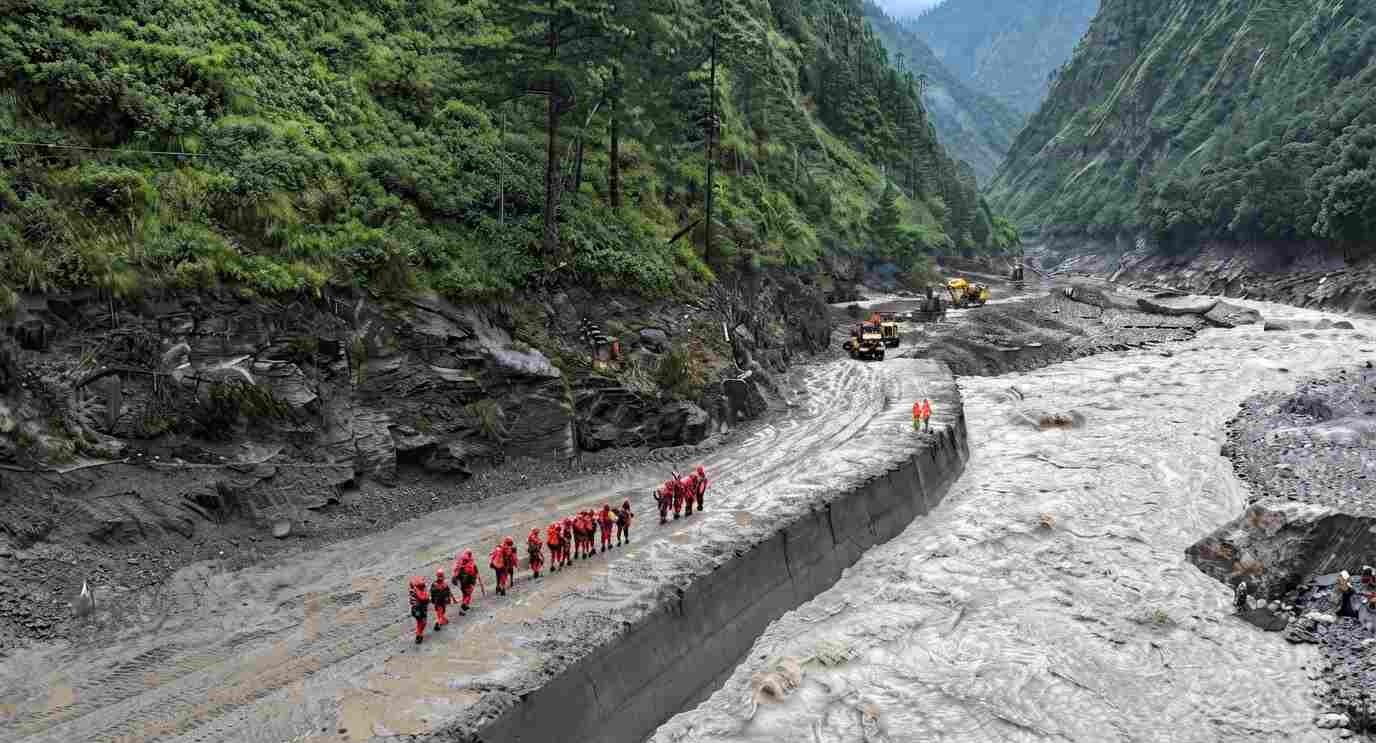
The disaster began on August 26 after a massive collapse of glacier, rock and ice high in the Himalayan border region sent debris into the river system feeding Nepal's Bhotekoshi and Trishuli rivers.
The precise sequence initially caused uncertainty.
The Kathmandu Post reported that early accounts suggested an earthquake might have triggered the disaster. Subsequent satellite analysis indicated that a large section of glacier and rock collapsed from an altitude of about 5,200 metres and fell roughly 1,200 metres into the valley.
The collapse generated a seismic signal and sent ice and debris into the Lhende valley. Scientists said the material apparently blocked the river before a massive surge of water and debris travelled downstream through the Bhotekoshi and Trishuli systems.
The available scientific assessment therefore supports describing the event as a cascading glacier-and-rock collapse and flood rather than simply stating that an ordinary earthquake caused the disaster.
Destruction extended far downstream
The flood affected communities and infrastructure far beyond the immediate border area.
Bodies were recovered in multiple Nepalese districts as the flood moved through connected river systems. Roads, bridges, homes, government buildings and hydropower infrastructure were also damaged.
NDRRMA figures cited in early September reported thousands of damaged homes and dozens of destroyed or unusable bridges.
Recovery teams faced particular difficulties at hydropower facilities where workers had been trapped or reported missing.
Workers were rescued from a hydropower tunnel
One significant rescue occurred at the Trishuli 3A Hydropower Project.
Radio Nepal reported on September 4 that two workers had been rescued alive from a tunnel at the project as search and rescue operations continued.
The rescue demonstrated why missing-person totals could not automatically be treated as death counts. Some people initially listed as missing were subsequently found alive, while other cases required identification of recovered remains.
Why the missing-person figure requires caution
Missing-person totals following a disaster of this scale can change for several reasons.
People may be located alive, duplicate reports can be reconciled, previously inaccessible areas may establish contact, and recovered remains may later be matched to people already recorded as missing.
For that reason, the number of people reported missing should not be added to the confirmed death toll and presented as an expected final death count.
The same caution applies to combining Nepalese and Tibetan numbers. A cross-border arithmetic total may help describe the scale of the disaster, but it is not an official jointly verified casualty figure unless the relevant authorities publish it as such.
Recovery became an international issue
By late September, Nepal had moved from immediate rescue operations toward the much larger challenge of recovery and reconstruction.
Reuters reported that Nepal sought international grant-based assistance for rebuilding after the disaster, arguing that reconstruction costs represented a major burden for the country's economy.
The disaster also renewed calls for stronger regional monitoring of glaciers and glacial lakes, improved early-warning systems and better cross-border sharing of environmental and satellite information across the Himalayan region.
What the latest figures mean
The most important distinction is between the early casualty snapshot and the later recovery record.
The 1,287 bodies and 5,083 missing people reported by Nepal's disaster authority on September 4 were valid figures for that point in the response, but they were subsequently overtaken as recovery operations continued.
By late September, reporting placed Nepal's confirmed death toll above 1,450. Thousands of people remained missing, and victim identification was still continuing.
The final human cost therefore remained subject to revision, and casualty figures should be accompanied by their reporting date and source rather than presenting an older count as current.
Update, October 2, 2026: This article has been updated to replace the September 4 Nepal casualty snapshot as the lead figure with later September reporting showing more than 1,450 confirmed deaths. The Tibet figure has also been corrected from 31 dead and 531 missing to the September 4 state-media figure of 21 dead and 541 missing. Early and later casualty figures are explicitly dated and kept separate by jurisdiction.