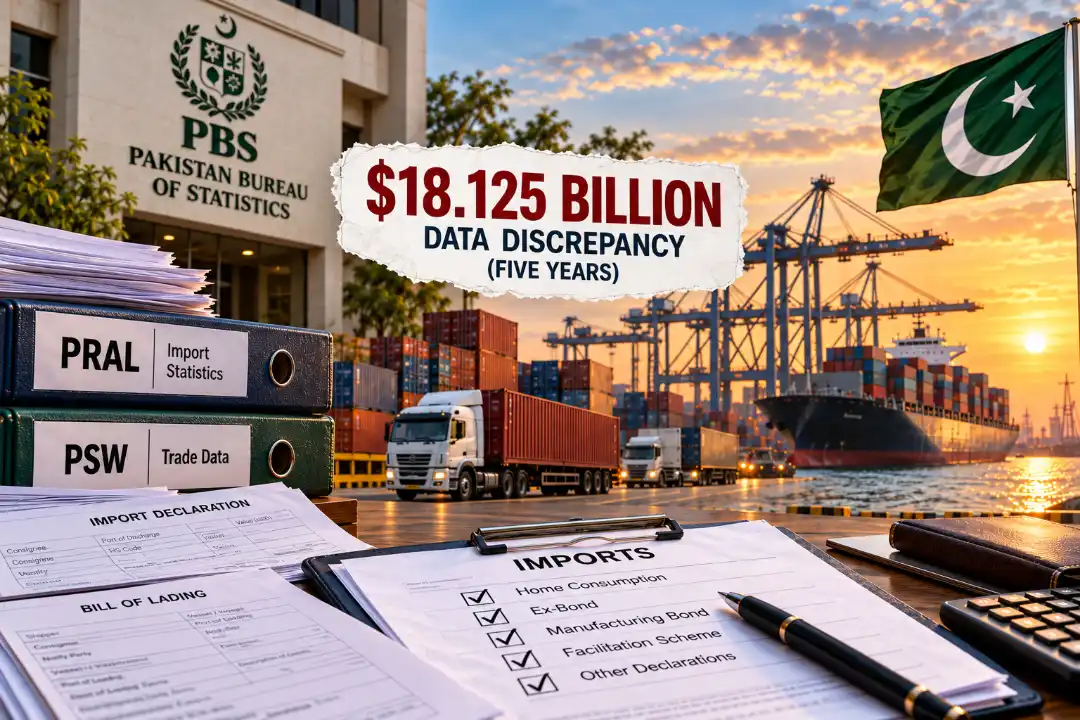
ISLAMABAD — Pakistan has reconciled a reported $18.125 billion discrepancy between two government trade-data systems covering five fiscal years, after an investigation found that certain customs transactions had been left out of the information used to compile official import statistics.
The gap, spanning FY2020–21 to FY2024–25, emerged during a review of records supplied through Pakistan Revenue Automation Limited (PRAL) and Pakistan Single Window (PSW). According to The News, which reported the findings on October 19, an official committee examined the differences and its report was shared with the International Monetary Fund (IMF).
However, the $18.125 billion difference reported between the datasets should not be confused with the final revision to Pakistan's published imports. The Pakistan Bureau of Statistics (PBS) says its reconciliation increased recorded imports by approximately $14.863 billion over the five years.
The correction also widened Pakistan's historical merchandise trade deficit, particularly in FY2024–25, when revised imports rose by more than $6 billion.
What Caused the Gap Between PRAL and PSW?
Pakistan's import statistics are compiled from customs records showing what goods enter the country, their declared values, quantities and countries of origin.
Until April 2025, PBS received much of this information through PRAL, which transmitted processed customs data from the WeBOC system. In May 2025, PSW began providing trade data to PBS, allowing officials to compare the newer records with the information previously used for statistical reporting.
The comparison exposed a problem in the older data-extraction process.
According to PBS's comprehensive report published in August 2026, the historical PRAL feed contained only seven Goods Declaration categories. Transactions recorded under eight additional categories were not included in the datasets provided to PBS.
A Goods Declaration is a customs record identifying goods being imported or exported. When some declaration categories are missing from a statistical data feed, the resulting national trade figures may not include all the transactions recorded in the customs system.
PBS traced the omission to an outdated programmed query used to extract import records from WeBOC. The largest ordinary import categories, including Home Consumption and Ex-Bond, were broadly covered by both systems. The significant differences came mainly from special customs arrangements that the older feed did not fully capture.
The bureau described the issue primarily as a consequence of changing data systems, processing arrangements and incomplete reporting coverage. It considered deliberate manipulation highly unlikely, although that was the agency's assessment rather than a separate legal finding.
How the Discrepancy Reached More Than $18 Billion
The annual differences reported by The News were $1.4 billion in FY2020–21, $2.527 billion in FY2021–22 and $2.402 billion in FY2022–23.
The reported gap subsequently increased to $5.572 billion in FY2023–24 and $6.224 billion in FY2024–25. Together, those figures total $18.125 billion.
The official PBS statistical revision followed a different calculation. Its detailed tables show upward adjustments of approximately $919 million, $1.017 billion, $1.680 billion, $5.102 billion and $6.144 billion for the five respective fiscal years.
PBS puts the cumulative increase in recorded imports at approximately $14.863 billion.
The published material does not provide a complete reconciliation explaining why the $18.125 billion figure reported for the differences between datasets exceeds the final official import revision. The figures therefore describe related, but distinct, measurements.
The composition of the differences also changed over time. In earlier years, Manufacturing Bond declarations contributed significantly to the gap. In FY2020–21, PBS recorded a $460 million difference under that category, rising to $593 million in FY2021–22.
By FY2023–24 and FY2024–25, the Facilitation Scheme had become the dominant source of the missing statistical coverage. In the final year, it accounted for approximately $6.082 billion of the $6.144 billion official import revision.
Pakistan's Historical Trade Deficit Becomes Larger
The effect is particularly visible in the FY2024–25 figures.
Before reconciliation, PBS had reported merchandise imports of $58.363 billion. The revised total stands at $64.507 billion, an increase of $6.144 billion.
With exports remaining at the previously reported $32.040 billion, Pakistan's recorded merchandise trade deficit for the year increased from $26.323 billion to $32.467 billion.
The merchandise trade deficit measures the gap between imports and exports of goods. Because the revised statistics include imports previously omitted from published records, the historical deficit is larger than originally reported.
But this is a statistical correction to past trade activity. It does not mean Pakistan imported an additional $14.863 billion of goods in October 2026, nor does it establish that an equivalent amount of public money went missing.
The changes matter because import figures are used to evaluate Pakistan's external trade position, import dependence and foreign-exchange requirements. They also influence the interpretation of historical economic performance.
However, a revision to the merchandise trade deficit does not automatically translate into an equal adjustment to the current-account deficit, which includes services, income and transfers as well as trade in goods.
Textiles and Industrial Imports Were Most Affected
PBS's commodity-level analysis shows that the additional import values were concentrated in a relatively small number of sectors.
For FY2024–25, the Textile Group recorded the largest upward adjustment, at $3.151 billion. Raw cotton accounted for $1.428 billion of that figure, alongside other textile materials used by manufacturers.
Agricultural and other chemicals contributed $860 million to the revision, while metals accounted for $833 million and machinery for $670 million.
The geographical breakdown of Facilitation Scheme imports also shows a concentration among a limited number of trading partners.
China was the largest source of imports within that customs category in FY2024–25, with $2.085 billion, followed by the United States at $874 million and Brazil at $501 million.
These amounts relate specifically to Facilitation Scheme imports and should not be interpreted as the overall value of Pakistan's imports from those countries or its bilateral trade deficits with them.
How the Investigation Began
The wider investigation started before the latest October reporting.
Questions over Pakistan's trade statistics intensified in 2025 after differences were identified between Pakistan's reported imports from China and China's recorded exports to Pakistan.
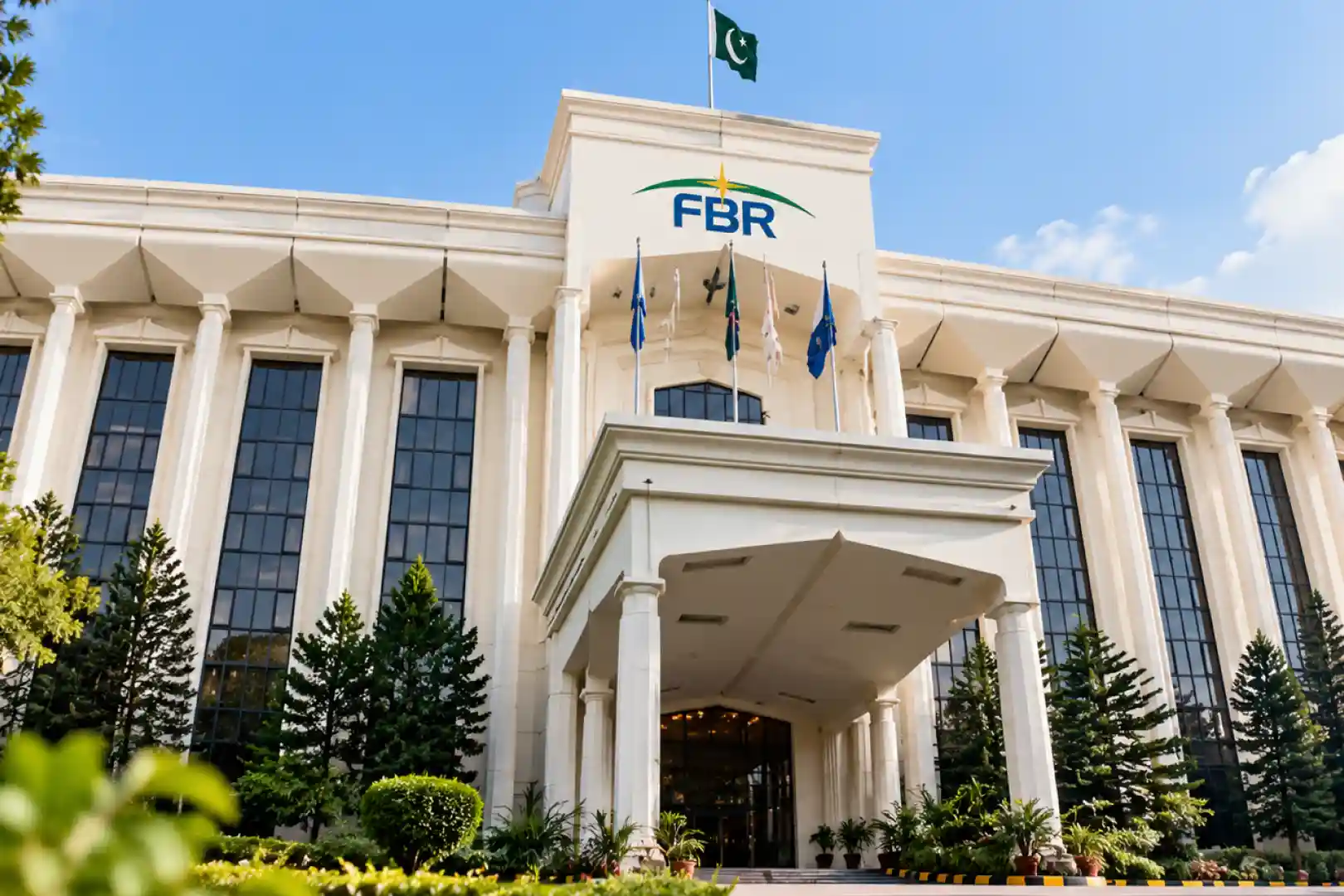
On March 26, 2025, the Prime Minister's Office directed the Federal Board of Revenue (FBR) to investigate the bilateral trade-data gaps. FBR established an expert committee on April 10, involving government officials, trade specialists, business representatives and academic institutions.
The committee examined customs records and the possible role of under-invoicing, misdeclaration and differences in reporting methods. Its investigation found that incomplete coverage of certain declaration categories, classification practices and data processing contributed to the gaps.
In November 2025, the finance minister established a separate committee to review the transition from PRAL to PSW and improve consistency in official trade reporting.
Further technical meetings between PBS, PSW and FBR took place in January, April, May and August 2026.
By August, PBS said it had regenerated 1,380 statistical reports covering the 60 months under review. The bureau identified 60 monthly Advance Release reports as the priority set for public dissemination.
What the IMF Report Says and What Happens Next
The IMF had acknowledged the trade-data reconciliation before October's news coverage.
In its May 2026 country report on Pakistan, the Fund stated that PBS had already prepared revised quarterly and annual import statistics for 2020–25 and planned to complete revised monthly figures for public dissemination by the end of August 2026.
The IMF document also described efforts to standardize data-extraction criteria and establish regular consultations so that changes to customs records would be reflected consistently in official statistics.
In its August report, PBS said the monthly revisions had been completed and all three related IMF commitments had been substantively met.
The adopted framework makes PSW the primary source of merchandise trade data, with reconciliation involving FBR and quarterly validation intended to reduce future inconsistencies.
Some technical issues remained open when the August report was published. A proposed automated data-extraction mechanism still required formal FBR approval, while the treatment of Export Processing Zone imports and batch-processed consignments remained under review. PBS described their remaining quantitative impact as minimal.
The correction offers a more complete account of Pakistan's imports over the five years, but it also demonstrates the consequences of relying on data-extraction arrangements that are not updated as customs procedures change. Preventing another discrepancy will depend on whether the relevant agencies consistently capture, reconcile and publish the same underlying trade information.