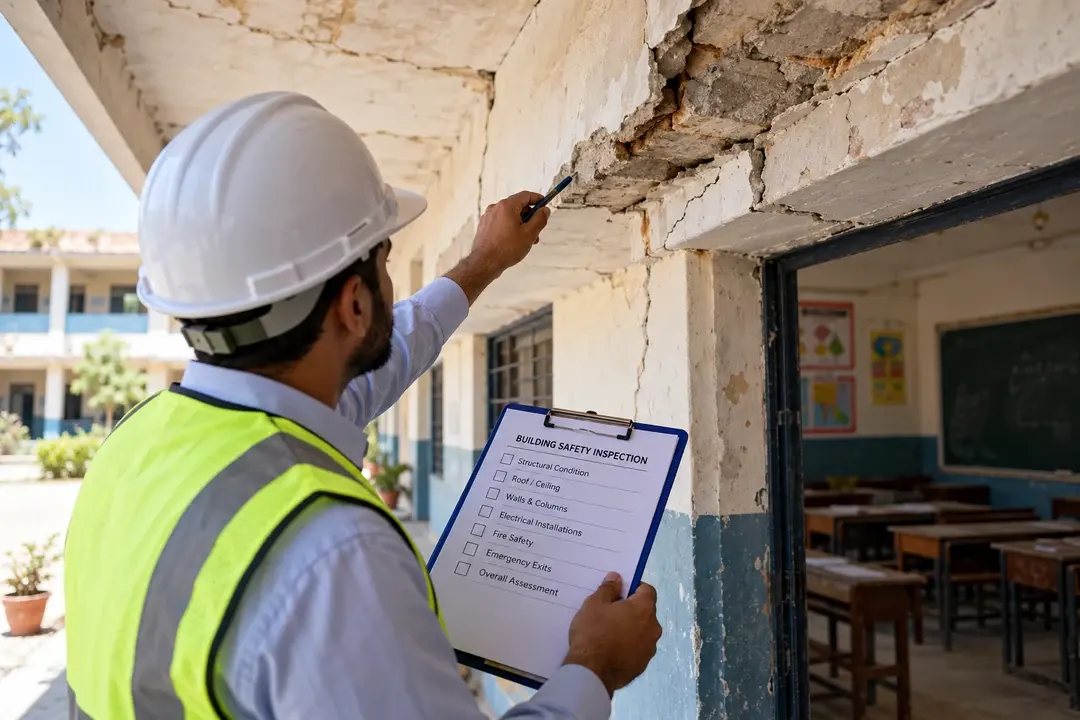
Sindh has ordered private schools across the province to obtain valid building fitness certificates and suspend classes in unsafe premises after a deadly school roof collapse in Peshawar raised urgent concerns about the safety of educational buildings.
The instructions were issued on October 16 through the Directorate of Inspection and Registration of Private Institutions. According to published accounts of the directive, school administrations must address structural hazards, inspect electrical and gas installations, maintain appropriate emergency arrangements and cooperate with official inspections.
The order followed the October 15 collapse at Al-Khair Education Center in Peshawar. Reuters reported that 34 children and one female teacher died. Khyber Pakhtunkhwa and Punjab have also announced school safety inspections, but their measures differ from Sindh's reported requirement for building fitness certificates.
What has Sindh ordered private schools to do?
According to The Express Tribune, the Sindh School Education and Literacy Department issued its instructions through a letter dated October 16, signed by Rafia Javed, Additional Director Registration.
The directive requires owners, principals and administrators of privately managed schools to ensure that their buildings are suitable for educational activities and to obtain valid building fitness certificates from the relevant building control authorities.
School managements must identify structural defects and carry out necessary repairs without delay. Where a roof, wall or another part of the premises is considered unsafe, that section must remain closed until the required work has been completed and it is considered safe for use.
The instructions also cover hazards that may not be related directly to the building's structural strength. These include electrical wiring, switchboards, gas connections and installations in laboratories, kitchens and generator rooms.
Schools have been directed to maintain appropriate fire safety and emergency arrangements under the applicable requirements.
Vitals News, reporting details of the circular, said private institutions must keep their building fitness certificates available for official inspection committees. Regular and surprise inspections are expected to check compliance.
The original signed circular was not independently obtained for this report. The requirements described here are based on contemporary reporting of the directive.
Can schools continue classes in unsafe buildings?
The reported Sindh instructions make clear that teaching activities must stop where a school building poses a danger to students, teachers or other staff.
If the risk is limited to a particular room or section, that area must not be used until repairs and the necessary safety assessment have been completed.
Administrators have also been instructed to promptly inform the relevant directorate when their buildings are damaged, structurally weak, dilapidated or otherwise hazardous.
According to the published reports, the directorate may assist in transferring students from affected schools to nearby safe institutions so their education can continue.
Serious violations may result in legal or administrative action, including the closure or sealing of premises where permitted by the applicable rules. Unregistered schools have also been told to complete the relevant registration process.
The reports call for immediate safety compliance, but they do not establish one fixed deadline for every private school in Sindh to obtain a new certificate. A standard certificate fee and renewal period have not been independently verified either.
What happened in the Peshawar school roof collapse?
On Thursday, October 15, a roof collapsed during morning classes at Al-Khair Education Center, a private school in Peshawar's Dir Colony area.
Reuters reported on October 16 that 34 children and one female teacher were killed. The news agency said 45 children were injured, with most discharged after treatment while three remained in critical condition at the time of its report.
Police arrested the school owner and opened an investigation. Peshawar's police chief, Mian Saeed Ahmed, said the roof had been overloaded by additional construction on an already weak structure.
The Associated Press also reported that some relatives of the victims said they had previously warned the school administration about rainwater entering classrooms and concerns over the building's condition.
Those accounts have raised questions about whether earlier warning signs received adequate attention and whether school buildings were being assessed by qualified professionals.
However, the final technical cause of the collapse and any criminal responsibility remain subject to investigation and legal proceedings. An arrest does not establish guilt.
What is a school building fitness certificate?
A building fitness certificate is documentation issued under a relevant regulatory process indicating that a building has been assessed against applicable requirements for safe or suitable use.
Depending on the rules and the condition of the premises, a technical assessment may involve roofs, walls, beams, columns, foundations, staircases and other important structural components.
The issuing authority, inspection procedure and required documents can vary by jurisdiction. School owners should therefore verify the exact process with the relevant building control and education authorities.
Importantly, a school's registration certificate and its building fitness certificate are not the same thing.
Registration generally concerns permission to operate an educational institution. It does not automatically prove that a qualified structural professional has recently inspected the building and found it suitable for use.
Likewise, a fitness certificate should not be treated as a permanent guarantee of safety. New cracks, leaking roofs, alterations, additional construction or other changes may require further inspection and repairs.
KP orders private-school inspections after the tragedy
Khyber Pakhtunkhwa, where the collapse occurred, has directed district-level committees to inspect private educational institutions across the province.
According to the Associated Press, which reviewed the government order, the committees must examine school buildings and submit their findings and recommendations within three days.
The exercise covers both school-owned buildings and rented premises. Inspection teams are expected to assess roofs, ceilings, walls, beams, columns, foundations, staircases and other key structural elements.
Buildings are to be classified according to whether they are safe, need repairs or improvements, or may be unsafe and require urgent technical assessment.
It is important to distinguish this three-day reporting instruction from a certificate deadline. The order does not establish that every private school in KP must obtain a new fitness certificate within three days.
KP is preparing stronger school building safety regulations
Alongside the inspection drive, KP's Elementary and Secondary Education Department has directed the Private Schools Regulatory Authority, or PSRA, to prepare stronger building safety regulations.
According to Dawn, the proposed rules address structural fitness, building standards, classroom overcrowding, emergency exits, evacuation procedures, inspections and enforcement.
A draft and recommendations were requested within one week of the department's direction.
However, a request to prepare new regulations is not the same as those regulations already being enacted. Schools should check subsequent official notifications before treating proposed requirements as final.
Dawn also reported concerns about the technical capacity of the PSRA to assess building strength without qualified engineering expertise.
That distinction is particularly relevant because structural safety cannot be established merely by checking school registration documents.
Separate inspection timetable for KP government schools
The KP government has issued a separate order covering government school buildings.
Under that exercise, the Communication and Works Department has been asked to provide technical teams in each district to examine structural conditions and identify buildings requiring attention.
According to Pakistan Today, district-wise inspection reports are due by noon on October 26, 2026.
That deadline applies to the government-school inspection exercise and should not be confused with the three-day reporting instruction for KP private schools.
KP Governor Faisal Karim Kundi has separately ordered stricter enforcement of school safety requirements and a report on stronger legislation within 15 days.
An official Governor House statement said the Peshawar school had been registered in 2026 but that its management had failed to comply with prescribed standard operating procedures. This was the government's account and does not replace the ongoing investigation into the collapse.
Punjab directs inspections of private educational institutions
Punjab has also ordered checks of private educational institutions in response to the Peshawar tragedy.
According to The News, Chief Minister Maryam Nawaz Sharif directed the Education Department, deputy commissioners and local government officials to ensure that inspections are carried out.
In Rawalpindi, the district administration instructed education, municipal and emergency officials to examine private school buildings and identify structures that may be dangerous or in poor condition.
The reporting confirms a provincial inspection initiative. It does not, by itself, establish that Punjab has introduced the same new certificate requirement reported in Sindh.
What should parents ask their children's schools?
For parents, the new safety measures highlight the importance of asking how a school's building has been assessed and whether known problems have been addressed.
Families can ask whether the school has a valid fitness certificate or a recent safety inspection report where required, and whether qualified professionals have recommended any repairs or restrictions.
They can also ask about visible structural concerns, such as leaking roofs, significant cracks, falling plaster, damaged staircases and any sections that have been closed for repairs.
Electrical hazards, blocked emergency exits, crowded classrooms and the school's evacuation arrangements are also reasonable safety questions.
Concerns should be raised promptly with the school administration, preferably in writing. If a satisfactory response is not provided, families can contact the relevant education department or private-school regulator for guidance.
If an area appears to present an immediate danger, children and staff should stay away from it while emergency authorities or qualified technical professionals are contacted.
Parents should not be expected to certify a building's structural safety themselves. Visible damage can justify requesting an expert assessment, but it does not establish the precise seriousness or cause of a defect without technical examination.
What should private school owners do now?
Private school administrations in Sindh should verify the reported October 16 requirements with the relevant education directorate and building control authority.
They should review existing documentation, arrange qualified assessment where defects are suspected, take unsafe areas out of use and keep records of inspections, maintenance and necessary repairs.
Electrical and gas installations, emergency exits, fire safety arrangements and any additional construction should also be reviewed under the applicable requirements.
Schools in KP and Punjab should cooperate with their respective provincial inspection programmes and follow the instructions issued by the competent authorities in their districts.
School owners should not assume that one fee, application process or deadline applies throughout Pakistan. The verified requirements differ among provinces.
Are building fitness certificates now mandatory nationwide?
No single nationwide school-building fitness certificate mandate has been established by the sources reviewed for this report.
Sindh's reported directive requires private schools to obtain valid certificates, while KP and Punjab have ordered separate inspections. KP is also working on additional rules for private educational institutions.
The Peshawar tragedy has renewed scrutiny of how schools are registered, inspected and maintained. The effectiveness of the new measures will depend not only on documentation but also on competent assessments, timely repairs and action when buildings are found to be unsafe.
Parents and school administrations should follow verified notices from their respective provincial authorities as the inspection programmes continue.
Sources and further reading
- The Express Tribune — Sindh school fitness certificate directive, October 17, 2026
- Vitals News — Sindh school safety instructions, October 16, 2026
- Reuters — Peshawar school collapse and investigation, October 16, 2026
- Associated Press — KP private-school inspections and families' accounts, October 16, 2026
- Dawn — KP school regulatory issues and proposed rules, October 17, 2026
- Pakistan Today — KP government-school technical inspections, October 16, 2026
- KP Governor House — School safety directions and legislation report, October 16, 2026
- The News — Punjab private-school inspection orders, October 17, 2026