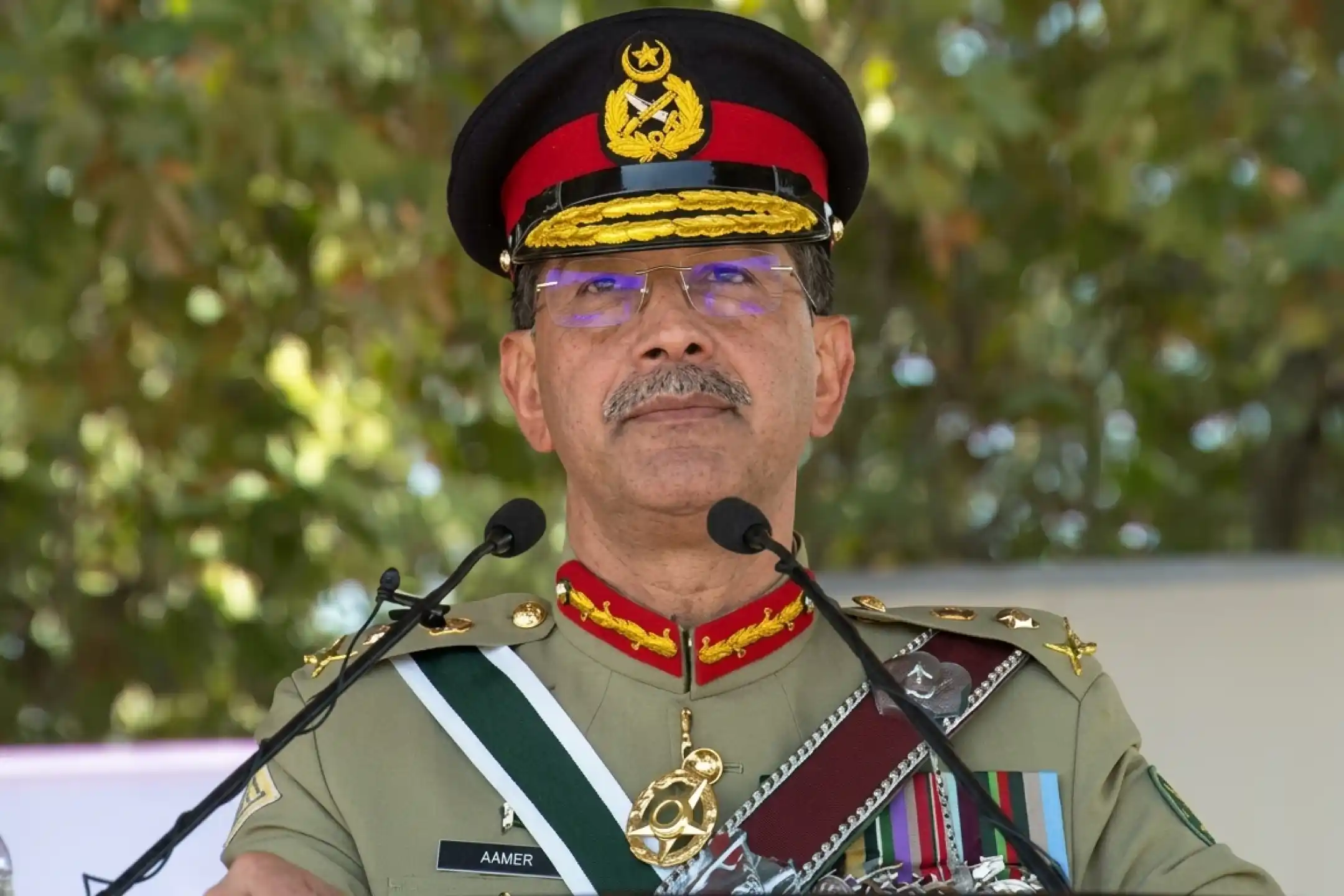
Pakistan's Commander National Strategic Command, General Syed Aamer Raza, warned on Saturday, October 17, that any hostile military miscalculation against the country would bring a response beyond the expectations of those responsible. His remarks came during a passing-out parade at the Pakistan Military Academy (PMA), Kakul, amid renewed security warnings exchanged by Pakistan and India.
General Raza said Pakistan's armed forces were prepared to defend the country's territory and sovereignty. At the same time, he emphasised the dangers of armed conflict between nuclear-armed states and said Pakistan's commitment to peace should not be mistaken for weakness.
The warning followed remarks by Indian Defence Minister Rajnath Singh on October 15 and a response from Pakistan's Foreign Office on October 16. The statements underline continuing tensions between the neighbours, but none of the announcements examined for this report confirmed a new military operation.
General Aamer Raza warns against military miscalculation
General Raza was the chief guest and reviewing officer at the passing-out parade at PMA Kakul. His address covered national defence, regional stability, modern warfare and the responsibilities of newly trained military officers.
In remarks reported by Dawn, he warned: "Any miscalculation will be met with a response far beyond the imagination or calculation of the initiator."
The commander maintained that Pakistan would not tolerate cross-border aggression or violations of its territorial integrity. He described the armed forces as ready to protect the country and cautioned adversaries against underestimating Pakistan's military resolve.
His remarks combined a warning about the consequences of aggression with an appeal for restraint. He presented military preparedness as a means of defending sovereignty while reiterating Pakistan's stated preference for peace and stability.
Why did General Raza mention nuclear-armed countries?
One of the central themes of the address was the danger of military confrontation in a region where both Pakistan and India possess nuclear weapons.
General Raza argued that war should have no place in such an environment. His warning reflected the risk that a conventional confrontation between the neighbouring states could develop into a more serious crisis.
According to The News, he also stressed restraint and dialogue, saying Pakistan's commitment to peace must not be understood as a lack of resolve.
The speech did not announce nuclear-weapons use, a new nuclear alert or a change in Pakistan's nuclear doctrine. The reference to a nuclear environment formed part of his warning about the consequences of military escalation.
What did Indian Defence Minister Rajnath Singh say?
The latest exchange followed remarks by Indian Defence Minister Rajnath Singh at a defence conclave in New Delhi on Thursday, October 15.
According to an official statement from India's Ministry of Defence, Singh warned that any further terrorist attack originating from Pakistan would draw an even stronger Indian response.
He cited Operation Sindoor, the Balakot airstrike and earlier military actions as examples of what his government regards as a more proactive approach to terrorism.
Singh also said India remained committed to peace while maintaining the capability to safeguard its sovereignty and national interests.
His warning was conditional on a future terrorist incident. He did not announce that India had begun another military operation against Pakistan in his October 15 address.
India has accused Pakistan-based militant groups of involvement in attacks on Indian territory. Pakistan rejects allegations that it supports cross-border terrorism. The two governments continue to disagree over responsibility for particular incidents and the outcomes of previous military operations.
Pakistan's Foreign Office rejects Indian warning
Pakistan's Foreign Office responded on Friday, October 16, condemning Singh's remarks as provocative and warning against actions that could threaten regional stability.
Foreign Office spokesperson Sajjad Haider Khan said Pakistan remained prepared to defend its sovereignty and territorial integrity, according to Radio Pakistan's account of the briefing.
He referred to the military confrontation between Pakistan and India in May 2025, arguing that Pakistan had demonstrated its defensive capabilities during that crisis.
The spokesperson urged India to abandon threatening rhetoric and act responsibly to avoid another confrontation. He also said Pakistan's preference for peace and restraint should not be interpreted as weakness.
General Raza's address at Kakul came the following day. The sequence places his remarks within a renewed exchange of public warnings, although it does not establish that either country had decided to initiate fresh hostilities.
Commander raises concerns about propaganda and proxy violence
General Raza also accused hostile actors of attempting to weaken public confidence in Pakistan's armed forces through disinformation and propaganda.
He alleged that adversaries were seeking to exploit internal divisions and destabilise the country through proxy violence and other indirect methods.
Referring to the May 2025 confrontation, he characterised India's Operation Sindoor as unsuccessful and claimed that hostile elements had subsequently intensified efforts to undermine Pakistan from within.
These statements were the commander's allegations and military assessment. India has presented Operation Sindoor differently, describing the operation as evidence of its ability to act against what it identifies as terrorist threats. The opposing assessments should not be treated as independently verified conclusions about the operation's outcome.
General Raza also discussed the changing nature of warfare, including the influence of new technologies and information-based threats. He urged military personnel to adapt their training and capabilities to emerging security challenges.
Who is General Syed Aamer Raza?
General Syed Aamer Raza holds the appointment of Commander National Strategic Command, a senior position within Pakistan's military command structure.
On July 24, 2026, Prime Minister Shehbaz Sharif announced Raza's promotion to four-star general and his appointment as Commander National Strategic Command, according to the Pakistan Press Information Department.
Before the promotion, he served as Chief of the General Staff of the Pakistan Army.
His correct rank at the October 17 ceremony was therefore General, rather than Lieutenant General. In reporting on this speech, CNSC refers to his position as Commander National Strategic Command, not a resolution issued by a civilian security committee.
How the May 2025 conflict shapes current tensions
The latest warnings come against the background of a brief but serious military confrontation between Pakistan and India in May 2025.
The crisis followed an April 22 attack in Indian-administered Kashmir that killed 26 people. India blamed Pakistan-based militant groups, while Pakistan denied involvement.
India subsequently launched strikes against locations it described as militant infrastructure in Pakistan. Pakistan disputed India's description of the targets, and the confrontation escalated into several days of military exchanges.
The two countries agreed to a ceasefire on May 10, 2025, although accusations of violations emerged after the announcement. Reuters reported the ceasefire, the preceding fighting and the disagreements over its implementation.
The episode remains central to current security rhetoric. Officials in both countries continue to refer to the confrontation when explaining their military policies, while disputing important claims about its outcome.
PMA Kakul ceremony and Pakistan's wider security message
General Raza addressed cadets graduating from the 154th PMA Long Course, 39th Technical Graduate Course, 73rd Integrated Course and 28th Lady Cadet Course.
He congratulated the cadets and their families, encouraging the new officers to demonstrate professional competence, discipline and commitment as they entered military service.
The commander also discussed changing international conditions, particularly the conflict in the Middle East. He referred to what he called the Islamabad Accord and the Makkah Accord as examples of Pakistan's diplomatic efforts towards regional stability.
He expressed solidarity with Palestinians affected by the conflict and reiterated Pakistan's stated diplomatic, moral and political support for the Palestinian people.
These remarks formed part of a broader address linking national defence with diplomacy, regional developments and the changing demands of modern military service.
Has a new Pakistan-India military operation been announced?
The confirmed development on October 17 is General Raza's public warning, following separate statements from senior Indian and Pakistani officials.
His speech reinforced Pakistan's stated readiness to defend its territory while also stressing the dangers of war between nuclear-armed neighbours.
The statements reviewed for this report did not announce a new military strike, the start of fresh hostilities or a change in Pakistan's nuclear doctrine. Any subsequent military or diplomatic development would require separate confirmation.
Sources and further reading
- Dawn — General Aamer Raza's address at PMA Kakul, October 17, 2026
- The News — General Raza's strategic and regional security remarks
- HUM News — General Raza's PMA speech, October 17, 2026
- Government of India, Ministry of Defence — Rajnath Singh's October 15 remarks
- Radio Pakistan — Foreign Office response, October 16, 2026
- Pakistan Press Information Department — General Raza's promotion and appointment, July 24, 2026
- Reuters — May 2025 India-Pakistan conflict and ceasefire