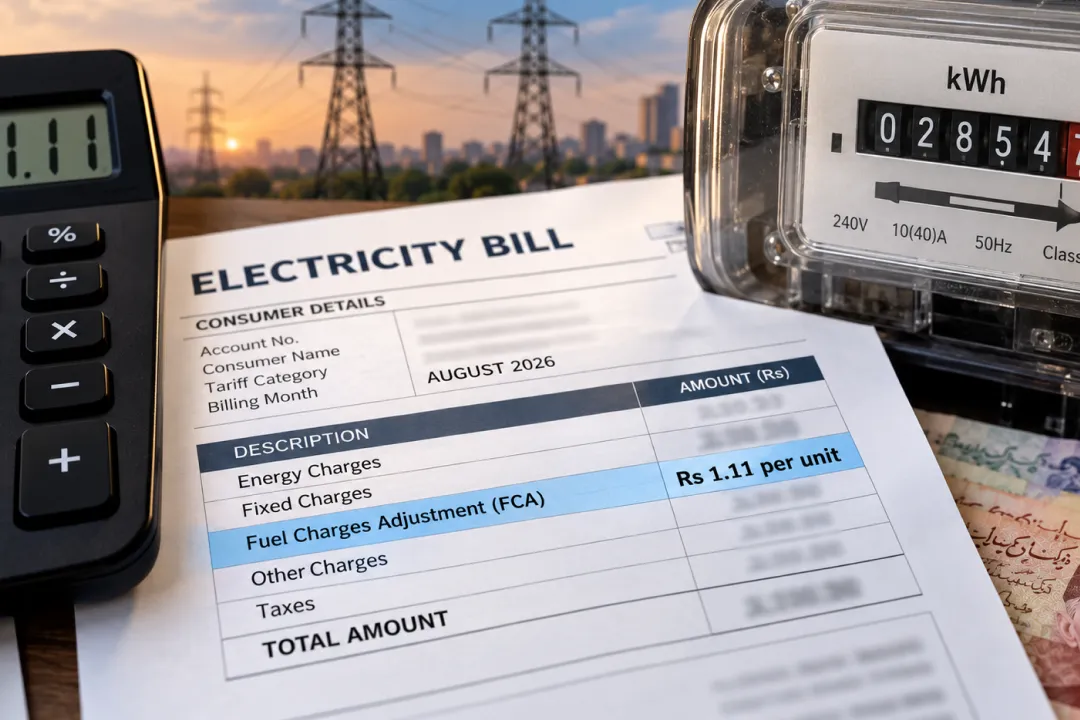
Pakistan's National Electric Power Regulatory Authority (NEPRA) has approved a fuel charges adjustment of Rs 1.1086 per electricity unit, approximately Rs 1.11, for recovery through October 2026 electricity bills.
The adjustment relates to electricity consumed in August 2026 and applies to eligible customers of ex-WAPDA distribution companies and K-Electric, subject to exemptions specified by the regulator.
The Central Power Purchasing Agency (CPPA-G) had requested a higher adjustment of Rs 1.7267 per unit. However, NEPRA reduced the amount after reviewing the submitted fuel costs and making adjustments totalling approximately Rs 17.28 billion.
The charge is a monthly fuel charges adjustment (FCA), not a permanent increase in Pakistan's basic electricity tariff. The amount payable depends on the electricity units billed for August and the consumer's applicable tariff category.
Who will pay the Rs 1.11 electricity adjustment?
According to NEPRA's October 7 decision and notification, the positive fuel charges adjustment applies to eligible consumer categories served by ex-WAPDA distribution companies and K-Electric.
These include customers of Lahore Electric Supply Company (LESCO), Islamabad Electric Supply Company (IESCO), Faisalabad Electric Supply Company (FESCO) and other ex-WAPDA distribution companies.
K-Electric customers in Karachi are also covered, subject to the notification's conditions and exemptions.
NEPRA has excluded three consumer categories from this adjustment:
- Lifeline electricity consumers.
- Electric vehicle charging stations.
- Prepaid electricity consumers who have opted for the prepaid tariff.
The adjustment also applies to eligible electricity consumption under the Incremental Consumption Package.
Consumers should not confuse lifeline consumers with all protected residential consumers. The notification does not provide a blanket exemption for every household using 200 units or fewer.
How much extra will consumers pay in October?
The additional fuel adjustment is calculated using the electricity units billed for August 2026, rather than electricity consumed during October.
For a non-exempt consumer, multiplying August consumption by Rs 1.1086 gives the additional FCA before applicable taxes and other charges.
| August electricity consumption | Additional FCA before taxes |
|---|---|
| 100 units | Rs 110.86 |
| 200 units | Rs 221.72 |
| 300 units | Rs 332.58 |
| 500 units | Rs 554.30 |
| 1,000 units | Rs 1,108.60 |
For example, a household billed for 300 units in August would face an additional FCA of Rs 332.58 before taxes, provided the account is not exempt.
A consumer billed for 500 units would face an adjustment of Rs 554.30 before taxes.
These figures are estimates of the fuel adjustment alone, not final electricity bill totals. Actual bills may include taxes, fixed charges, quarterly adjustments and other applicable amounts.
Why did NEPRA approve Rs 1.11 instead of Rs 1.73?
CPPA-G initially requested a positive fuel charges adjustment of Rs 1.7267 per unit for August 2026.
The agency claimed an average actual fuel cost of Rs 8.8265 per kilowatt-hour, compared with a reference fuel cost of Rs 7.0998 per kilowatt-hour already incorporated into the applicable tariff.
After reviewing the submitted calculations, NEPRA assessed the allowable actual fuel cost at Rs 8.2084 per kilowatt-hour.
This resulted in an approved adjustment of Rs 1.1086 per unit, approximately 62 paisa less than CPPA-G had requested.
| Fuel cost component | Rs per unit |
|---|---|
| Reference fuel cost | 7.0998 |
| Actual fuel cost claimed by CPPA-G | 8.8265 |
| Adjustment requested by CPPA-G | 1.7267 |
| Actual fuel cost assessed by NEPRA | 8.2084 |
| Adjustment approved by NEPRA | 1.1086 |
NEPRA's review included downward adjustments totalling approximately Rs 17.28 billion to submitted fuel-cost claims, according to Business Recorder's analysis of the decision.
Of that amount, approximately Rs 15.74 billion related to regasified liquefied natural gas (RLNG) power plants.
The regulator also examined previous-period adjustments claimed by CPPA-G, including whether adequate supporting details had been provided.
These regulatory adjustments reduced the amount considered recoverable through the August FCA. The Rs 17.28 billion figure represents adjustments to submitted cost claims, not a separate surcharge imposed on electricity consumers.
Although NEPRA approved a lower amount than requested, the assessed fuel cost remained above the reference level, resulting in a positive adjustment for consumers.
What caused electricity generation costs to rise?
Higher fuel costs and changes in Pakistan's electricity generation mix contributed to the August adjustment.
According to Dawn's October 8 report, expensive spot-market RLNG imports increased generation costs while contracted LNG supplies from Qatar remained affected by force majeure.
The report also identified higher imported coal costs and lower-than-expected generation from hydropower and nuclear plants as contributing factors.
Reduced generation from relatively lower-cost sources can increase reliance on more expensive alternatives, affecting the overall fuel cost of electricity supplied to the national grid.
However, these factors are not separate charges on consumers. NEPRA determines the monthly FCA by comparing the allowable fuel cost for the relevant period with the reference fuel cost already incorporated into electricity tariffs.
When will the adjustment appear on electricity bills?
NEPRA directed ex-WAPDA distribution companies and K-Electric to reflect the August 2026 fuel charges adjustment separately in electricity bills issued during October 2026.
The charge relates to August consumption even though it is scheduled for recovery in October.
If an October bill was issued before the notification could be implemented, the adjustment may appear in a subsequent billing month.
Distribution companies and K-Electric must also comply with applicable court orders when implementing the adjustment.
Is the Rs 1.11 electricity increase permanent?
No. The Rs 1.1086 per unit charge is a monthly fuel charges adjustment for August 2026, scheduled for recovery through October billing.
Monthly FCAs account for differences between reference fuel costs and the allowable actual fuel costs for a particular month.
These adjustments may be positive when assessed costs exceed the reference level or negative when costs fall below it.
They are separate from the base electricity tariff, quarterly tariff adjustments, fixed charges and applicable taxes.
The October notification does not establish that the same Rs 1.11 per unit adjustment will automatically continue in future months.
How can consumers check the adjustment on their bill?
Consumers can estimate the additional fuel adjustment using the following steps:
- Find the electricity units billed for August 2026.
- Multiply those units by Rs 1.1086, provided the account is not exempt.
- Check the separately displayed FCA or fuel adjustment entry on the October electricity bill.
- If the adjustment is absent from an early October bill, check whether it appears in a subsequent billing month.
For example, 200 units multiplied by Rs 1.1086 produce an additional FCA of Rs 221.72 before applicable taxes.
The final amount may differ because of exemptions, tax treatment, billing corrections or other charges.
Consumers who believe the adjustment has been calculated incorrectly should contact their electricity distribution company and request clarification using their August billed units and tariff category.
The October 7 NEPRA decision establishes the approved August fuel adjustment and its recovery arrangements. Consumers can review the separately displayed FCA on their electricity bills to understand the additional charge.