Pakistan's retail payment system processed 14.3 billion transactions through formal banking channels in fiscal year 2025-26, an increase of 58% from the previous year, as digital payments expanded further into everyday financial activity.
Of those transactions, 13.2 billion were conducted through digital channels, according to the State Bank of Pakistan's Annual Payment Systems Review for FY26. Digital transaction volume increased 65% year on year and accounted for 92% of retail payments by number, up from 88% in FY25.
The value of all retail payments, however, increased at a much slower pace. Transactions worth approximately Rs672.7 trillion were processed during FY26, up 10% from the previous fiscal year.
That difference between transaction volume and value is one of the most important findings in the annual data. Digital channels now dominate how frequently payments are made through Pakistan's formal banking system, but they account for a substantially smaller share of the money being transferred.
Pakistan's retail payments reached 14.3 billion
Retail payment volume increased from about 9.1 billion transactions in FY25 to 14.3 billion in FY26, producing the reported 58% year-on-year increase.
The value of those transactions rose from approximately Rs611.6 trillion to Rs672.7 trillion, an increase of about 10%.
The difference between the two growth rates matters. The number of payments processed through formal banking channels expanded much faster than their combined value, meaning the system handled substantially more transactions without a comparable increase in their total value.
The figures cover retail payments recorded through formal banking and payment channels. They should not be interpreted as a complete measurement of every payment made across Pakistan's economy, particularly cash transactions that take place outside the banking system.
Digital transactions rose to 13.2 billion
Digital channels processed 13.2 billion retail transactions during FY26, compared with about 8 billion in the previous fiscal year.
That represents growth of approximately 65%, which is higher than the 58% increase recorded for total retail payment volume.
The distinction is important. The 58% figure applies to all retail payments processed through formal banking channels, while the 65% figure describes the increase in the digital component of those payments.
Digital channels consequently increased their share of retail payment volume from 88% in FY25 to 92% in FY26.
In practical terms, more than nine out of every 10 retail transactions recorded through the formal payment system were conducted digitally during the year.
92% by number, but only 38% by value
The dominance of digital payments looks different when transaction value is considered.
Digital channels processed approximately Rs257.1 trillion during FY26, equivalent to about 38% of the Rs672.7 trillion in total retail payment value.
Over-the-counter channels accounted for approximately Rs415.7 trillion, or about 62% of recorded retail payment value, despite representing a much smaller share of transaction volume.
This creates a clear divide in Pakistan's formal payment system. Digital channels dominate transaction frequency, while over-the-counter channels continue to carry a much larger share of payment value.
The figures do not mean that 62% of all payments in Pakistan are made in cash. Cash transactions conducted outside the banking system are not comprehensively captured by the payment-system review, while over-the-counter transactions in this dataset are processed through formal financial channels.
What the numbers suggest about transaction size
The difference between volume and value becomes clearer when the annual totals are used to calculate broad average transaction values.
Based on the rounded SBP totals, Origin Pakistan calculates that the average value across all recorded retail transactions was approximately Rs47,000 in FY26.
For digital transactions, dividing approximately Rs257.1 trillion by 13.2 billion transactions produces an average of about Rs19,500 per transaction.
These are Origin Pakistan calculations based on rounded annual totals, not average transaction values published by the State Bank. They should not be interpreted as typical payment sizes because arithmetic averages can be influenced by relatively large transactions.
The broader comparison remains clear without estimating an average for over-the-counter transactions: digital channels accounted for 92% of recorded retail payment volume but only about 38% of its value.
Mobile channels handled more than 11.1 billion transactions
Mobile phone-based payment services were the largest component of digital activity during FY26.
More than 11.1 billion transactions were processed through mobile-based solutions during the fiscal year, representing year-on-year growth of about 79%.
Mobile-based channels accounted for roughly 78% of all retail transactions recorded through formal banking channels.
Internet banking portals, by comparison, processed more than 341 million transactions during FY26, with transaction volume increasing approximately 15% from the previous year.
The figures show how heavily digital-payment activity is concentrated in mobile channels, while different digital services continue to serve different types of financial activity.
Pakistan's merchant payment network expanded
The increase in digital transactions coincided with a major expansion in the infrastructure available to accept electronic payments.
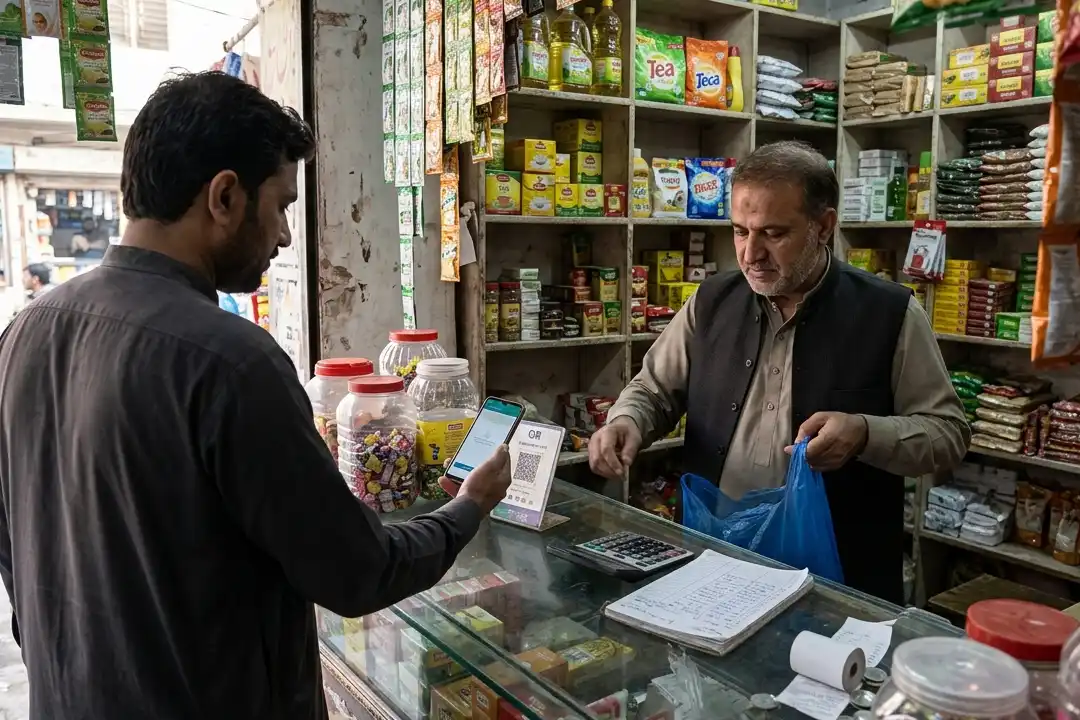
The number of QR-enabled merchants rose from approximately 1.09 million in June 2025 to about 3.84 million by June 2026.
The POS network expanded to 337,791 terminals, while the number of POS-enabled merchants reached 295,367. The network supported nearly 1.5 million card payments per day, compared with about 1 million daily payments in the previous fiscal year.
The number of e-commerce merchants registered with banks also increased from 9,584 to 23,356.
Account and wallet-based payments accounted for almost 96% of e-commerce transactions processed through banking channels during FY26.
The infrastructure expansion provides important context for the growth in digital payments, but the annual figures alone do not establish that merchant expansion caused the overall increase in transaction volume.
More banking activity is moving to smartphones
The number of registered users across major digital banking channels also increased during the year.
Branchless banking mobile-app users reached 99.1 million, while bank mobile-app users increased to 30.4 million. Internet banking users reached 17.5 million, while e-money wallet users increased to approximately 7.9 million.
These figures should not be added together to estimate the number of unique digital banking users in Pakistan. A single person can use multiple banking applications, wallets or financial services and may therefore appear in more than one category.
What the figures do show is the growing role of smartphone-based financial services within the formal payment ecosystem.
Pakistan is becoming more digital, not necessarily cashless
The 92% digital share is a significant measure of how payment behaviour is changing within Pakistan's formal financial system, but it requires careful interpretation.
It does not mean that 92% of all payments made throughout Pakistan are digital, nor does it mean that only 8% of payments involve cash.
The payment-system statistics measure transactions passing through formal banking and payment channels. Cash exchanged outside those systems is not comprehensively represented in the dataset.
The annual figures therefore provide strong evidence of rapid digitisation within the formal retail payment system, rather than proof that Pakistan has become a predominantly cashless economy.
The value data reinforce that distinction. Although digital channels handled 92% of recorded retail transactions by number, they accounted for only about 38% of their value during FY26.
What the FY26 numbers show
The annual review shows that Pakistan's formal payment system is becoming much more digital by transaction frequency. Retail payment volume increased 58% to 14.3 billion transactions, while digital transaction volume grew about 65% to 13.2 billion.
The shift is particularly visible in mobile payments and merchant infrastructure. Mobile-based channels processed more than 11.1 billion transactions, while the number of QR-enabled merchants rose to about 3.84 million by June 2026.
But the value data show that the transition is uneven. Digital channels accounted for 92% of recorded retail-payment volume while carrying only about 38% of its value. Over-the-counter channels continued to account for most of the value moving through the formal retail-payment system.
That gap is more informative than describing Pakistan simply as cashless. The FY26 data show a financial system in which digital payments have become dominant for transaction frequency, while higher-value payment activity remains substantially more concentrated in over-the-counter channels.