The Pasban Remittance Reward Scheme, inaugurated by State Bank of Pakistan (SBP) Governor Jameel Ahmad on 25 September, has been running since 1 October 2026, according to the scheme's terms and conditions. Its first draw is scheduled for 15 January 2027 and covers eligible remittances received between 1 October and 31 December 2026, SBP said in its launch release.
SBP says the scheme is funded entirely by the banking industry and does not burden the national exchequer. Rs4 billion in cash prizes will be awarded each quarter across 2,521 prizes, which makes Rs16 billion a year. The reward goes to the person who receives the money in Pakistan, not to the sender, and according to the scheme's terms, entry is automatic and free.
The scheme at a glance
- Who runs it: according to the terms, the Pakistan Banks Association (PBA) administers it for the participating banks, and 1LINK operates the technology that records eligible remittances and conducts the draws.
- Scheme period: from 1 October 2026 until further announcement.
- First draw: scheduled for Friday 15 January 2027, covering remittances received from 1 October to 31 December 2026.
- Prize pool: Rs4 billion per quarter; Rs16 billion a year.
- Cost to beneficiaries: none. SBP says there is no fee, ticket purchase, minimum balance or other payment.
Who qualifies
As described by PBA's chief executive in SBP's release, a beneficiary must receive home remittances equivalent to at least USD 100 in each month for three consecutive months within a quarter, into a bank account. For the first draw, that means a qualifying remittance in each of October, November and December.
The scheme's terms add detail on what counts:
- Remittances sent through a bank, an exchange company or a licensed money transfer operator qualify if they are credited directly, in rupees, to an eligible account at a participating bank.
- The USD 100 threshold is measured at the SBP daily exchange rate on the day the transaction is processed.
The terms say the following do not earn entries; the official 1LINK page lists the cash, Roshan Digital Account and company-account exclusions:
- Cash collected over the counter.
- Money credited to a Roshan Digital Account or any foreign-currency account.
- Money received into accounts held by companies or other entities.
- Remittances credited to banks that are not participating in the scheme.
Staff of the participating banks, PBA, 1LINK and SBP cannot win. SBP's launch release does not list these exclusions; Dawn also reported them from the terms.
The 1LINK page listed 26 participating banks on 4 October. The terms say the list can change, so the live list is the one to check.
For a sense of the dollar threshold in rupees: at an interbank rate of about Rs277.2 to the dollar, the midpoint of the Rs277.10 buying and Rs277.30 selling rates Business Recorder reported for 1 October, USD 100 comes to roughly Rs27,700. That is an Origin Pakistan calculation for illustration only. The scheme converts at the SBP daily rate on the processing date, so the rupee amount will vary.
How entries are counted
Each qualifying remittance earns entries, which the terms call tokens, for the account that received it. SBP says one entry is issued per USD 100, subject to the beneficiary receiving eligible remittances in all three consecutive months, with higher-value remittances earning proportionally more. The terms set out the slabs:
| Remittance value (USD) | Entries |
|---|---|
| Below 100 | None |
| 100 to 149 | 1 |
| 150 to 249 | 2 |
| 250 to 349 | 3 |
| 350 to 449 | 4 |
| Each further USD 100 | One more |
On those slabs, a USD 260 remittance earns three entries and a USD 1,000 remittance earns ten.
SBP's release gives two worked examples. A beneficiary who receives USD 100 in each of three consecutive months gets three entries for the quarter. One who receives USD 100 in October, USD 200 in November and USD 300 in December gets one, two and three entries respectively, six in all.
Entries belong to the receiving account and are valid only for the draw covering the quarter in which the money arrived. Under the terms, each account is treated as a separate entrant, and an account can win only one prize per draw.
How the prize pool breaks down
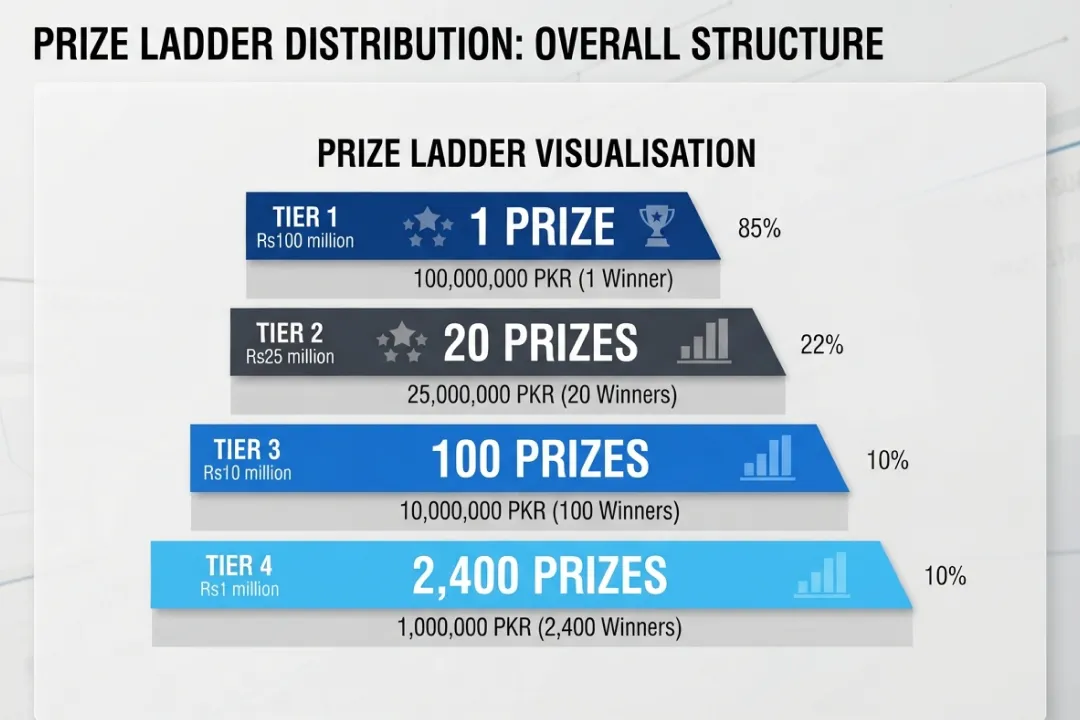
| Prize | Amount each | Number | Total | Share of pool | Share of prizes |
|---|---|---|---|---|---|
| First | Rs100 million | 1 | Rs100 million | 2.5% | 0.04% |
| Second | Rs25 million | 20 | Rs500 million | 12.5% | 0.79% |
| Third | Rs10 million | 100 | Rs1 billion | 25.0% | 3.97% |
| Fourth | Rs1 million | 2,400 | Rs2.4 billion | 60.0% | 95.2% |
| Quarterly total | — | 2,521 | Rs4 billion | 100% | 100% |
The amounts, counts and totals come from SBP's release and the scheme's terms. The two share columns are Origin Pakistan calculations.
They show how the money is distributed. Roughly 95 in every 100 prizes are Rs1 million, and the headline Rs100 million prize is 2.5 per cent of each quarter's pool. Origin Pakistan calculates the average across all 2,521 prizes at about Rs1.59 million before tax, a mean pulled up by the largest awards. SBP's release says Rs16 billion will be awarded each year; Origin Pakistan's count is 10,084 prizes over four quarters (2,521 × 4). The article counts prizes rather than winners because the terms treat each account as a separate entrant.
The terms say prize amounts are gross and that tax is deducted at source under the Income Tax Ordinance 2001. They do not state a rate.
For scale, Rs16 billion is about US$57.7 million at the same Rs277.2 rate, roughly 0.14 per cent of the record US$41.6 billion in workers' remittances SBP reported for FY26. That is an Origin Pakistan calculation for context only; it says nothing about the scheme's cost-effectiveness. Because the number of accounts and entries is not yet known, Origin Pakistan has not tried to estimate anyone's chance of winning.
How prizes are split by region
SBP says prizes are allocated across remittance regions, with 50 per cent for the GCC, 15 per cent for the UK, 15 per cent for Europe, 10 per cent for North America and 10 per cent for other countries. The first prize is open to beneficiaries receiving remittances from all regions.
The terms give exact counts for the second, third and fourth prizes:
| Region | Second | Third | Fourth | Total | Share of 2,520 |
|---|---|---|---|---|---|
| GCC | 10 | 50 | 1,190 | 1,250 | 49.6% |
| United Kingdom | 3 | 15 | 357 | 375 | 14.9% |
| Europe | 3 | 15 | 357 | 375 | 14.9% |
| North America | 2 | 10 | 238 | 250 | 9.9% |
| Other countries | 2 | 10 | 258 | 270 | 10.7% |
| Total | 20 | 100 | 2,400 | 2,520 | 100% |
The share column is an Origin Pakistan calculation. The small gaps against SBP's round-number percentages come from how the fourth-tier prizes are divided. The terms say these proportions apply to the first two draws and may be changed for later ones.
Against actual inflows, the GCC share of prizes sits slightly below its share of remittances. BR Research put Gulf inflows at around US$1.95 billion in August, more than half of the month's US$3.66 billion; Origin Pakistan calculates that at about 53 per cent, against 49.6 per cent of the regional prizes. This is an approximate comparison. The scheme's country-to-region mapping is not published, and the figures available do not allow the UK, Europe or North America to be compared.
What changed since July
The scheme follows the end of two earlier remittance incentives. SBP circulars, as reported by Dawn, stopped new Sohni Dharti Remittance Programme (SDRP) reward points and discontinued the Telegraphic Transfer Charges Incentive Scheme from 1 July 2026. Dawn reported that the incentives ended after their cost came under the International Monetary Fund's scrutiny; the circular text it quoted does not give a reason. Origin Pakistan has separately reported on the IMF's fourth review of Pakistan's loan programme.
- 1 July 2026: no new SDRP points; the transfer-charges scheme discontinued.
- 25 September: the Governor inaugurates Pasban.
- 1 October: the scheme period begins.
- 31 December: the first qualifying quarter ends.
- Friday 15 January 2027: first draw scheduled; results are to be announced on the day on the 1LINK page and on bank and PBA sites, without winners' personal details.
- 30 June 2027: last day to redeem existing SDRP points; SDRP stops functioning on 1 July 2027, according to the circulars as Dawn reported them.
The terms describe Pasban as a separate initiative that builds on systems used for SDRP; no SDRP points carry over.
PBA said, according to SBP's release, that Pasban builds on a remitter incentive banks have funded since July 2026, bringing the industry's annual commitment to close to Rs100 billion. PBA Chairman Zafar Masud also referred to banks taking over a Rs80 billion remitter incentive. The release does not say over what period or define the incentive in detail, so Origin Pakistan has not combined the figures. Masud said in the release that "Overseas Pakistanis are an equally important part of this story".
What the scheme says about itself
The scheme's FAQ addresses whether it is a lottery by answering no and calling it "a free, bank-funded rewards scheme". Its terms state that it is not a lottery and that nobody pays to take part or buys entries. Winning entries are chosen by a random draw run on 1LINK's automated systems, which the scheme says have been independently audited by a third party. The auditor is not named.
The scheme says it never asks for a fee, PIN or password to release a prize, and that winners are contacted by their own bank.
What is still unclear
- The status of the scheme's terms. The terms and conditions document on 1LINK's site, which this article uses for the entry slabs, regional prize counts and several exclusions, contains unresolved bracketed placeholders in places, mainly for processing timelines. Origin Pakistan has not used those items, and details may be revised.
- How several smaller transfers in one month are treated. The terms define a qualifying remittance by its own value of at least USD 100, while SBP's release describes the threshold in monthly terms. Readers should confirm with their bank.
- The tax rate that will apply to prizes.
- The identity of the independent auditor and the scope of the audit.
- Whether the regional split changes after the first two draws.
- Changes to the list of participating banks.
- The exact nature of the bank-funded remitter incentive PBA refers to.