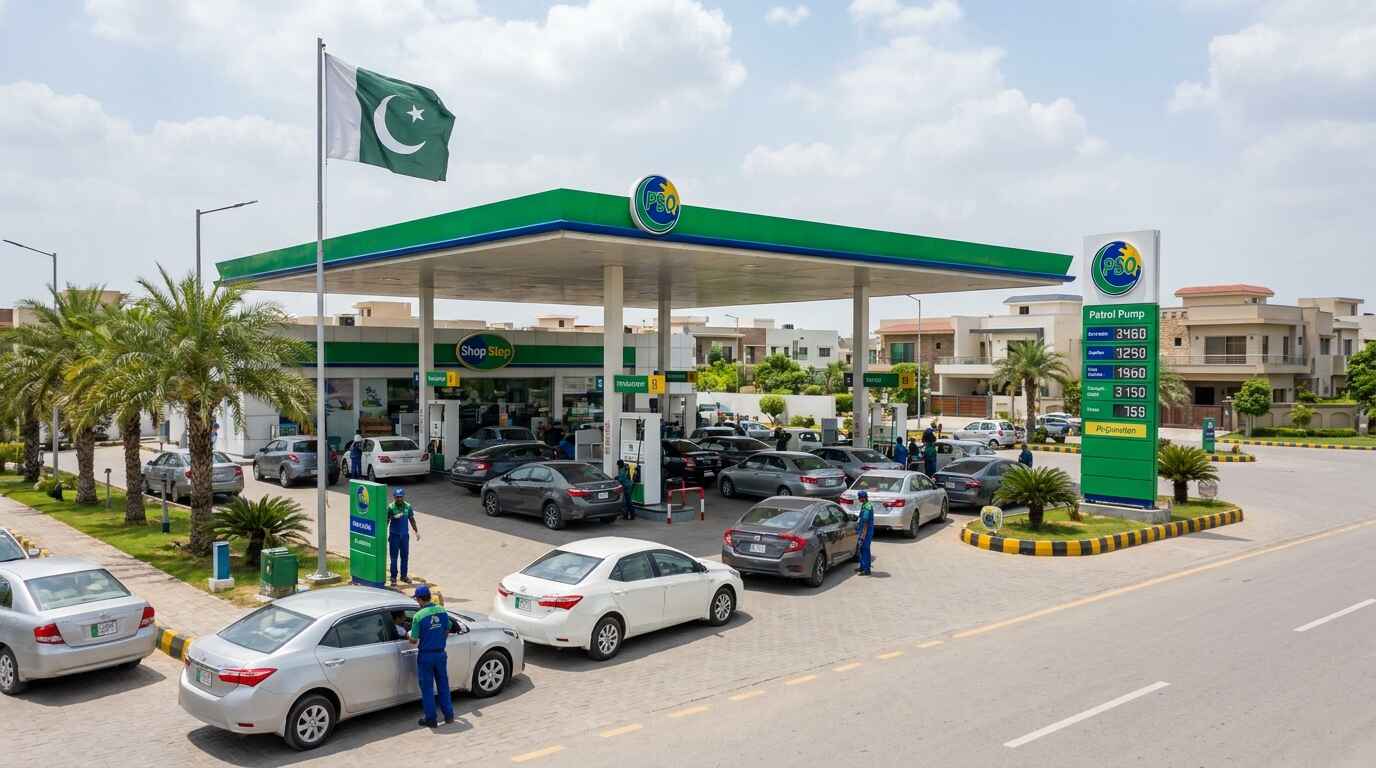
Pakistan's petroleum levy is a per-litre charge imposed under the country's 1961 petroleum levy law and reflected in the prices of petrol and diesel. In the Petroleum Division notification reported for September 15, 2026, the levy stood at Rs80 per litre on both petrol and high-speed diesel (HSD), alongside a separate climate support levy of Rs5 per litre. Jamaat-e-Islami (JI) is demanding that the petroleum levy be reduced or abolished, and it said its long march toward Islamabad would start from Karachi on September 20.
Who sets the levy
The levy is imposed under the Petroleum Products (Petroleum Levy and Climate Support Levy) Ordinance, 1961, and the Federal Government notifies the applicable rate. According to the consolidated text on the Pakistan Code website, companies, refineries and licensees must pay the levy at rates notified in the official Gazette from time to time.
The same text shows that the Ordinance's Fifth Schedule, which had prescribed maximum petroleum levy rates, was omitted through the Finance Act 2025. The version reviewed is dated July 2025 and therefore reflects that change but does not include any later amendments.
The climate support levy works differently. The same law provides for a rate of Rs2.5 per litre on petrol and HSD for FY2025-26, rising to Rs5 for FY2026-27. The Express Tribune reported that when the higher climate levy took effect on July 1, 2026, the government reduced the petroleum levy by the same Rs2.50 so pump prices would remain unchanged.
Under the daily pricing framework reported by Geo News, which cited a cabinet-approved document, changes to the petroleum levy require approval through the relevant federal process. OGRA publishes the notified ex-depot prices using the applicable international price and pricing inputs.
How the rate moved in FY2027
In a written reply to the National Assembly, reported by Business Recorder, Petroleum Minister Ali Pervaiz Malik gave the sequence. On July 1 the levy was Rs66.64 per litre on petrol and Rs79.54 on HSD. By July 4 it was Rs70.36 and Rs70.82. Petrol reached the budgeted Rs80 on July 11. HSD was raised in steps, reaching Rs78.28 on August 14 and Rs80 by August 20.
The minister said the levy had been reduced during a period of exceptional volatility in oil markets and was being restored in phases in line with the budget. He also said the Petroleum Division had carried out no separate assessment of the levy's impact on particular consumer groups.
What it adds up to in a litre of fuel
The September 15 notification, as reported by Business Recorder, lists the components of the ex-depot price. The table below uses those reported figures, in rupees per litre. The report also lists customs duty of Rs21.15 on petrol and Rs15.68 on HSD, but does not explain how those amounts relate to the other listed components, so customs duty is not shown as a separate row below.
Adding the reported customs duty separately would push the listed components above the reported ex-depot price. On that arithmetic, it appears to be incorporated in the ex-refinery figure rather than added again at the later stage. That is an Origin Pakistan observation from the reported figures, not a separate definition in the notification.
| Component (Rs per litre, September 15, 2026) | Petrol | HSD |
|---|---|---|
| Ex-refinery price | 269.78 | 302.56 |
| Petroleum levy | 80.00 | 80.00 |
| Climate support levy | 5.00 | 5.00 |
| Dealer margin | 9.98 | 9.98 |
| Oil marketing company margin | 7.87 | 7.87 |
| Inland freight equalisation margin | 7.61 | 4.02 |
| Reported ex-depot price | 380.24 | 409.42 |
By Origin Pakistan's calculation from these reported figures, the petroleum levy and climate support levy together account for Rs85 of a Rs380.24 litre of petrol, about 22 percent, and about 21 percent of a litre of HSD. The HSD components add up to Rs409.43, one paisa above the reported price, which appears to be a rounding difference.
Prices moved after September 15. The notified ex-depot prices for September 19 to 21 were Rs389.14 for petrol and Rs424.04 for HSD, according to Geo News. OGRA's current notified-price page also publishes the daily petroleum price information.
The revenue target behind the rate
The budget sets a petroleum levy target of about Rs1.68 trillion for FY2026-27, up from a revised estimate of Rs1.498 trillion for FY2025-26, Business Recorder reported when the budget was presented. The minister's reply says the target assumes an average levy of Rs80 per litre. The Nation reported that actual FY2025-26 collection was Rs1.567 trillion.
The IMF's staff-level report set a different benchmark. The Express Tribune reported a figure of Rs1.727 trillion. These numbers come from different documents and are not directly comparable. In June, BR Research argued that with annual sales assumed near 17 billion litres, meeting the budget target implied an effective levy close to Rs100 per litre. That was the newspaper's analysis, not an official calculation.
Business Recorder has also reported that the petroleum levy is not part of the divisible pool shared with the provinces, making it a direct federal revenue source.
The dispute over the levy
JI has held sit-ins in several cities and has held talks with a government team. Pakistan Today reported that by September 11 two rounds of talks had been held, that JI had presented six proposals, and that the government had asked for three more days. On September 15, JI rejected the prime minister's fuel relief scheme, The Nation reported, saying it could not replace abolition of the levy.
The fifth round ended without agreement on September 19, the Express Tribune reported. The report said the government delegation asked JI to postpone the march because of security threats, said Pakistan faced pressure from the IMF, and assured the party that practical measures giving significant relief would be taken soon. JI deputy emir Liaqat Baloch said the march would remain necessary until the levy was abolished.
According to a JI statement cited in the same report, the caravan would leave Karachi by train on the night of September 20, travel to Lahore by road on September 23 and extend the movement across Punjab from September 24.
The relief scheme offers Rs100 per litre on up to 20 litres a month for motorcycles, rickshaws and other two- and three-wheelers, and up to 30 litres for vehicles of up to 800cc, according to Business Recorder.
The government's stated position, in the minister's reply, is that the levy is a fiscal revenue measure set within the approved budget. Any reduction, he said, depends on fiscal space, commitments to international financial institutions, revenue requirements and international market conditions.
The figures quoted in the debate do not all measure the same thing. JI leader Hafiz Naeemur Rehman said the government collects Rs135 per litre, according to Daily Independent. Separately, the government has been reported as saying taxes and duties total Rs114 per litre on petrol and Rs100 on diesel for the September 19 to 21 prices, while the September 15 build-up above shows the petroleum and climate levies alone at Rs85 per litre. These figures therefore should not be treated as different names for the same charge.
What could change the rate
Any change to the petroleum levy would require the relevant federal approval process and a fresh notification. As of the fifth round of talks on September 19, no change had been announced, and the outcome of the September 20 march and any further talks was not yet known.