Pakistan's Federal Board of Revenue has finalised the rules it will use to calculate income earned through social media content, issuing three notifications on September 23, 2026, that set out who is covered and how income under the special procedure will be determined.
The notifications, SRO 1640(I)/2026, SRO 1641(I)/2026 and SRO 1642(I)/2026, establish separate rules covering resident and non-resident persons earning from remunerative social media content. The framework uses a formula based on audience activity and actual remuneration to determine income from platforms such as YouTube, Facebook, TikTok and Instagram. For Pakistan's growing population of monetised creators, the immediate questions are whether the rules apply to them and how their income will be calculated.
What's new this week, and what isn't
It is important to separate the new calculation rules from the withholding tax that was already introduced through the Finance Act 2026. Since July 1, 2026, Section 154B of the Income Tax Ordinance, 2001 requires banking and non-banking financial institutions to deduct tax when an amount credited to a person's account represents revenue received from social media platforms.
The statutory withholding rate for social media revenue is 5 percent. For resident persons, tax deducted under Section 154B is treated as minimum tax. For a non-resident person without a permanent establishment in Pakistan, it is treated as final tax on that income. Residents who are not on the Active Taxpayers List may also face the higher withholding treatment that applies under Pakistan's broader non-ATL tax rules, so the amount deducted can differ depending on the taxpayer's status.
What is new this week is the detailed procedure for determining income from remunerative social media content. FBR has now notified the formula, audience thresholds, expense limit and declaration requirements that apply under the special procedure. The framework follows draft rules issued earlier in 2026 but is now part of the notified tax rules.
Who is covered
The rules distinguish between resident and non-resident persons rather than treating every creator in exactly the same way. SRO 1641(I)/2026 establishes the special procedure for resident persons earning income from remunerative social media content. SRO 1642(I)/2026 establishes the corresponding procedure for non-resident persons where the relevant income constitutes Pakistan-source income through interaction with users in Pakistan.
The prescribed audience threshold is more than 50,000 users during a tax year, or more than 12,250 users during a quarter. These thresholds are used to determine whether the required level of systematic and continuous digital interaction has been reached under the special procedure.
SRO 1640(I)/2026 separately identifies persons earning income from remunerative social media content for the purposes of the framework.
Non-resident and overseas creators
For non-resident persons, the rules apply where income from remunerative social media content constitutes Pakistan-source income through interaction with users in Pakistan and the prescribed threshold is met. This means the non-resident rules should not be read as automatically applying to every overseas creator simply because their content can be viewed in Pakistan.
There is also an important difference in how withholding tax is treated. For a resident person, tax deducted under Section 154B is minimum tax. For a non-resident person without a permanent establishment in Pakistan, the deduction is treated as final tax on that income.
How the income is actually calculated
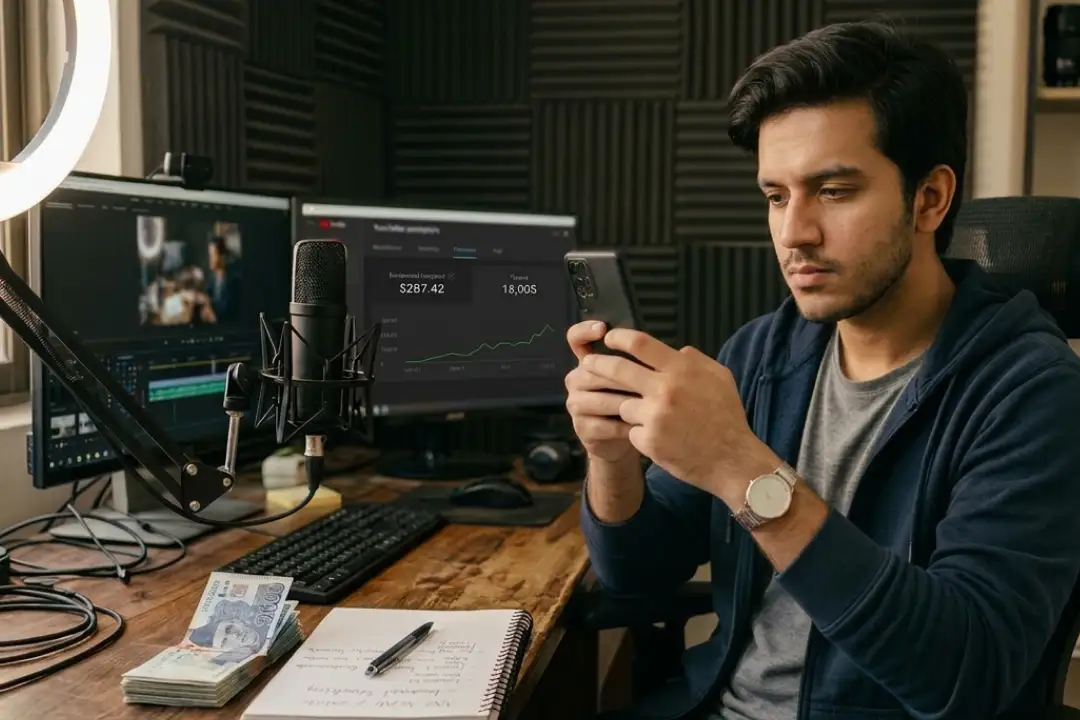
Once the special procedure applies, FBR first determines a creator's total remuneration from social media content. Under the rules, total remuneration is the higher of two figures: remuneration calculated using FBR's prescribed revenue-per-mille formula, or the actual remuneration received from social media content, whether received in cash or in kind.
For YouTube, the rules currently prescribe a revenue-per-mille figure of Rs195 per 1,000 video views. FBR may revise the prescribed RPM over time.
After total remuneration has been determined, allowable expenses are deducted to calculate minimum income under the special procedure. Expenses are limited to a maximum of 30 percent of total revenue.
Consider an illustrative example. The figures below are only intended to explain the calculation and are not an example provided by FBR. Suppose a resident YouTuber records five million views during the relevant period and actually receives Rs800,000 from social media content. Using an RPM of Rs195, the formula produces remuneration of Rs975,000, calculated as 5,000,000 divided by 1,000 and multiplied by 195. Because Rs975,000 is higher than the Rs800,000 actually received, Rs975,000 would be used as the total remuneration figure under the formula.
If the creator has Rs250,000 in allowable expenses, that amount remains below the 30 percent expense ceiling of Rs292,500. Deducting Rs250,000 from Rs975,000 would therefore produce minimum income of Rs725,000 under this illustrative calculation.
The rules also provide a mechanism for cases where a taxpayer can establish that the amount determined under the prescribed method does not reflect the amount that should apply. Supporting evidence may therefore become important where the formula and the creator's actual circumstances differ.
Filing and what happens if you under-declare
Persons covered by the special procedure are required to pay advance income tax on a quarterly basis in accordance with Section 147 of the Income Tax Ordinance. Income from remunerative social media content must also be declared in a special part of the income tax return for the relevant tax year.
If the income declared in the return is lower than the amount calculated under the special procedure, the relevant Commissioner may rectify the error or omission and proceed to recover the amount due under the Income Tax Ordinance. Creators covered by the rules therefore need to keep reliable records of platform remuneration, views, payments received and expenses claimed.
The new framework gives FBR a more structured method for bringing monetised social media activity into the income tax system. For creators, the practical impact will depend on factors including residency, Pakistan-source income, audience thresholds, actual remuneration, the prescribed RPM formula, allowable expenses and taxpayer status.