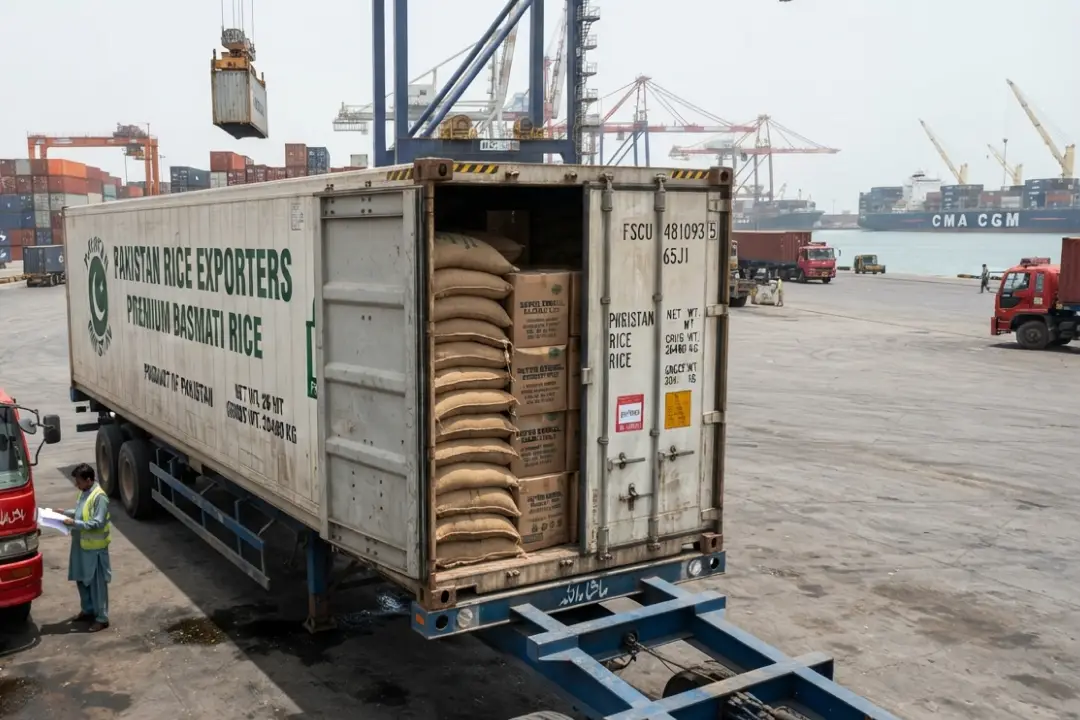
Pakistan's rice exports rose 24.68 per cent year-on-year in July-August, the first two months of fiscal year 2026-27, according to data compiled by the Pakistan Bureau of Statistics (PBS). The increase helped push the country's overall exports of raw food products up 7.68 per cent during the period, reversing a steep decline recorded in the previous fiscal year.
In FY26, Pakistan's raw food exports had fallen 29.49 per cent to $5.017 billion from $7.116 billion a year earlier. The rebound in July-August FY27 was driven mainly by rice, though meat, fish, tobacco and spice exports also posted gains during the two-month period.
Basmati Outpaces Non-Basmati in the Rice Rebound
The growth was not evenly spread across rice varieties. Basmati rice exports rose 53.03 per cent in value and 42.91 per cent in volume compared with the same period last year. Non-basmati rice exports grew more modestly, up 9.99 per cent in value and 14.74 per cent in volume.
| Category | Value change (YoY) | Volume change (YoY) |
|---|---|---|
| Basmati rice | +53.03% | +42.91% |
| Non-basmati rice | +9.99% | +14.74% |
Rice's overall share of Pakistan's total exports also grew, rising to roughly 7.1 per cent in July-August FY27 from about 6.2 per cent a year earlier, according to trade data cited by Bloom Pakistan.
Part of the push behind non-basmati rice came from government support. Pakistan's Ministry of Commerce extended the rice export subsidy scheme until September 30 and raised the Duty Drawback of Local Taxes and Levies (DLTL) rate for non-basmati rice, according to Dawn, as exporters faced weaker international demand for that variety.
Food Imports Climbed on Milk and Tea
The export rebound came alongside a rise in food imports. Pakistan's food import bill reached $1.503 billion in July-August FY27, up 2.23 per cent from $1.470 billion in the same period last year. The increase was driven mainly by higher purchases of powdered milk and tea rather than by staples such as palm oil.
Dairy product imports rose 20.41 per cent in value, while tea imports climbed 28.74 per cent. Palm oil remained the largest food import category by value despite a 1.41 per cent decline in its own import value and a 13.40 per cent drop in imported volume. Pulse imports fell 23.84 per cent during the same period.
A Reversal From Last Year's Slump
The current growth stands in contrast to the same period a year earlier, when Pakistan's rice exports had fallen sharply amid weaker global demand for the country's basmati variety. The Ministry of Commerce's decision to extend subsidy support and adjust the DLTL rate appears aimed at sustaining this year's recovery, particularly for non-basmati rice, which has grown more slowly than basmati.
Separately, the government has approved a plan to import wheat to cover shortfalls in local production, and has allowed the export of 200,000 metric tonnes of sugar in the current fiscal year, according to Dawn's reporting on the PBS data.
The Wider Trade Picture
The rice-led export gains have not been enough to narrow Pakistan's overall trade gap. According to PBS data reported separately across multiple outlets, Pakistan's trade deficit widened 18.11 per cent year-on-year to $7.12 billion in July-August FY27, as imports grew faster than exports. Imports rose 13.03 per cent to $12.58 billion during the period, while total exports increased 7.04 per cent to $5.46 billion.
On a monthly basis, the trade deficit actually narrowed in August compared with July, falling to $3.17 billion from $3.95 billion, though it remained higher than the deficit recorded in August last year.