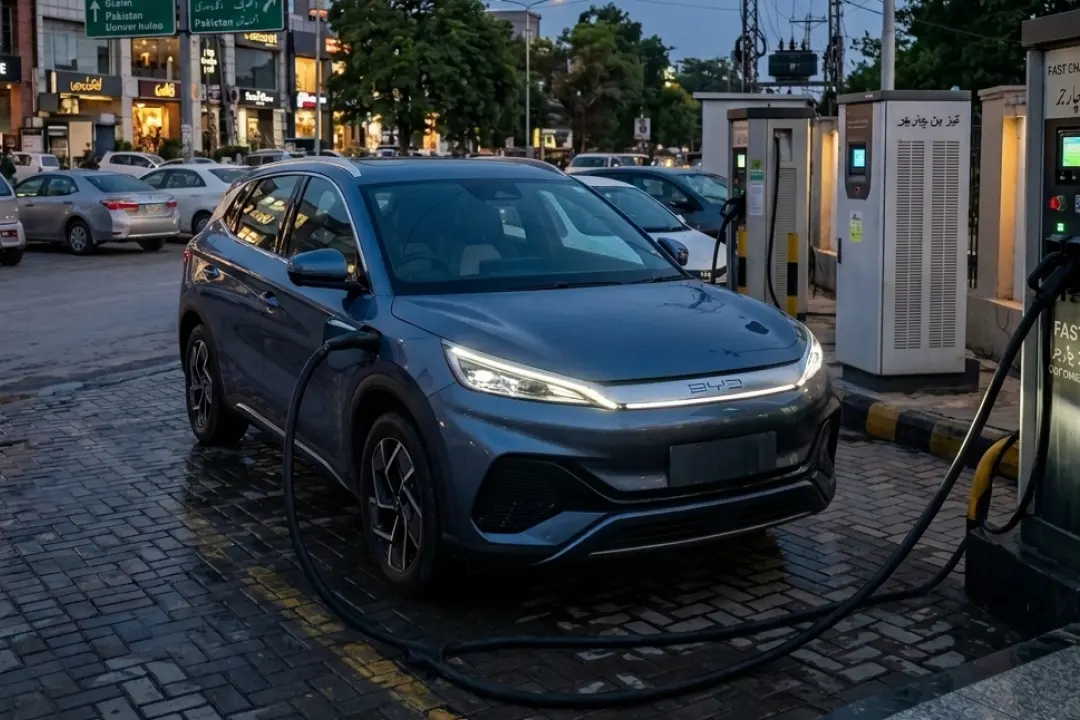
Chinese electric vehicle manufacturer BYD is in discussions with its Pakistani partner, Mega Motor Company (MMC), about introducing its Mega Flash Charging technology in the country, as the companies prepare to launch local vehicle assembly at Gharo in Sindh.
BYD Vice President Liu Xueliang confirmed the discussions in an interview published by Business Recorder on October 9, 2026. He said the technology could eventually become available to Pakistani customers, depending on infrastructure readiness, engagement with relevant stakeholders and future vehicle plans.
For drivers of compatible electric vehicles, the technology could significantly reduce the time spent charging. However, BYD has not announced a confirmed Pakistani rollout, charging station locations, prices or a launch date.
The discussions come as the company's Gharo assembly project approaches a revised launch target in the final quarter of 2026, following delays to an earlier timetable. Commercial production has not yet been confirmed.
BYD discusses Mega Flash Charging technology for Pakistan
In an interview with Business Recorder, Liu Xueliang, BYD's vice president and general manager of its Asia-Pacific auto sales division, discussed the company's plans for electric vehicle technology, local manufacturing and future investment in Pakistan.
Liu said BYD and Mega Motor Company were examining how the company's latest charging technology could eventually serve Pakistani customers.
He identified infrastructure readiness, discussions with relevant stakeholders and future product planning as factors that would determine whether the technology could be introduced locally.
The initiative forms part of BYD's wider expansion in Pakistan's new-energy vehicle market, which includes battery-electric and plug-in hybrid vehicles.
According to Liu, BYD entered Pakistan in 2024 and began delivering new-energy vehicles to customers in February 2025.
He reported that the company had delivered more than 10,000 vehicles in Pakistan in less than 18 months. BYD-MMC also announced a 10,000-vehicle milestone in September 2026.
These are company-reported delivery figures, rather than independently audited national vehicle registration or sales statistics.
The growing vehicle business provides context for BYD's charging discussions, but the company has not confirmed an investment decision or construction programme for Mega Flash Charging stations in Pakistan.
How does BYD's Mega Flash Charging technology work?
BYD's Mega Flash Charging system is designed to deliver high-power electricity to compatible electric vehicles, reducing the time needed to recharge their batteries.
According to Liu, the technology works with BYD's second-generation Blade Battery platform, which the company says offers significantly faster charging performance.
Unlike conventional lower-power charging systems, ultra-fast charging requires vehicles and charging equipment capable of handling higher electrical power safely.
The actual charging speed depends on the vehicle's battery design, maximum supported charging power, battery temperature, charging equipment and battery management system.
That means a vehicle connected to a high-power charger will not necessarily receive the charger's maximum advertised output.
BYD says its newest technology is intended for next-generation vehicles equipped with the second-generation battery platform.
Liu also indicated that existing BYD vehicles would remain compatible with the charging infrastructure, although charging speeds would differ.
Actual compatibility in Pakistan would depend on the charging equipment installed, connector standards and the specifications of individual vehicle models.
BYD has not identified which vehicles currently available in Pakistan, or which future locally assembled models, would support the system's highest charging speeds.
No guaranteed Mega Flash Charging time has been announced for Pakistani customers.
When could BYD introduce ultra-fast charging in Pakistan?
BYD has not announced a timetable for introducing Mega Flash Charging stations in Pakistan.
Its October 9 comments indicate that the company is assessing the conditions required for a possible introduction rather than proceeding with a publicly confirmed deployment programme.
Potential implementation would depend on suitable charging locations, access to sufficient electrical power, commercial arrangements and the availability of compatible vehicles.
The company has not disclosed how many stations might be installed, which cities would receive them first or how much customers would pay to use the technology.
These details would require a separate announcement before a rollout could be considered confirmed.
What infrastructure would ultra-fast charging require in Pakistan?
Very high-power charging infrastructure places different demands on electrical systems compared with conventional home chargers and many existing public charging units.
Potential sites would require appropriate grid connections, sufficient power capacity, electrical safety equipment and systems capable of managing demand when multiple vehicles are charging.
Reliable maintenance, accessible locations, compatible vehicles and convenient payment arrangements would also influence the usefulness of any future network.
These are general technical and commercial considerations. BYD has not publicly identified specific Pakistani sites where such requirements have prevented deployment.
Pakistan already has a developing network of public DC fast-charging stations, although these should not be confused with BYD's proposed Mega Flash Charging system.
In a July 23 report, Business Recorder described charging infrastructure development associated with BYD-MMC and HUBCO Green, including a Karachi-to-Peshawar corridor.
A later September 6 report by Dawn stated that HUBCO Green had 24 operational DC fast-charging sites, with chargers installed at approximately 200-kilometre intervals along the Karachi-Peshawar motorway network.
According to that report, the company planned to reduce the spacing between charging locations to approximately 100 kilometres.
These figures describe the charging network reported at the time, not the number of BYD Mega Flash Charging stations operating in Pakistan.
The possible introduction of BYD's newer technology would require separate confirmation of equipment specifications, locations and operating arrangements.
BYD's Gharo assembly plant targets operations in late 2026
Alongside the charging discussions, BYD and Mega Motor Company are developing a new-energy vehicle assembly facility at Gharo in Sindh.
In the October 9 interview, Liu described the project as nearing launch in the second half of 2026.
Earlier reporting provided a more specific timeline. Dawn reported on September 10 that the facility was expected to come online during the final quarter of 2026.
Both statements describe planned operating dates, not confirmation that commercial vehicle production has started.
The project previously missed an earlier deadline. Dawn reported on September 6 that the Gharo facility had not become operational within its earlier expected timeframe.
The company subsequently described equipment validation, production trials and quality testing as necessary steps before commercial manufacturing could begin.
According to Liu, the facility is planned to have an initial annual production capacity of approximately 25,000 vehicles, with the potential to expand to 50,000 vehicles annually.
He also described it as BYD's sixth facility outside China.
The production figures refer to the plant's planned capacity rather than the number of vehicles already manufactured or sold.
The Special Technology Zones Authority's project profile identifies the Gharo development as a new-energy vehicle manufacturing project involving assembly, testing, training and advanced industrial systems.
The next significant milestones will be completion of commissioning, confirmation of the first locally assembled models and the formal start of commercial production.
What could BYD's investment mean for Pakistan's EV industry?
BYD's local assembly plans and possible charging technology expansion could support the development of Pakistan's new-energy vehicle industry, although the scale of the benefits will depend on implementation and consumer demand.
Domestic assembly may create opportunities for employment, technical training, manufacturing services and local component suppliers.
BYD estimates that the Gharo project could generate more than 1,100 jobs and contribute to avoiding approximately 165,000 tonnes of carbon dioxide emissions by 2034.
These figures are company projections, not verified employment totals or emissions reductions already achieved.
Actual environmental benefits would depend on factors including electricity generation, vehicle adoption, manufacturing processes and the extent to which electric vehicles replace petrol or diesel vehicles.
For Pakistani drivers, the practical appeal of electric mobility will also depend on vehicle purchase prices, charging costs, access to reliable infrastructure and after-sales service.
If introduced with suitable vehicles and infrastructure, ultra-fast charging could make longer journeys and public charging stops more convenient.
However, the commercial impact cannot yet be established because BYD has not announced a Pakistani deployment timetable, charging tariffs or the specific vehicles that would support its maximum charging performance.
Liu also described Pakistan as a potential future regional manufacturing and export base for new-energy vehicles, provided a consistent long-term policy environment supports further investment.
That remains a strategic ambition rather than confirmation of an export programme or signed international vehicle supply contracts.
What happens next for BYD in Pakistan?
The next major developments will be confirmation of commercial production at the Gharo assembly plant and any formal announcement concerning Mega Flash Charging deployment.
For the manufacturing project, confirmation of locally assembled vehicle models, production commencement and initial output will provide a clearer picture of progress against the revised 2026 timetable.
For charging infrastructure, the key unanswered questions concern station locations, investment commitments, supported vehicles, charging specifications, customer prices and the expected launch schedule.
BYD's latest comments indicate that the company is considering advanced charging technology alongside its local manufacturing expansion.
For now, Mega Flash Charging remains under discussion in Pakistan, while the Gharo assembly project continues towards its stated late-2026 operating target.