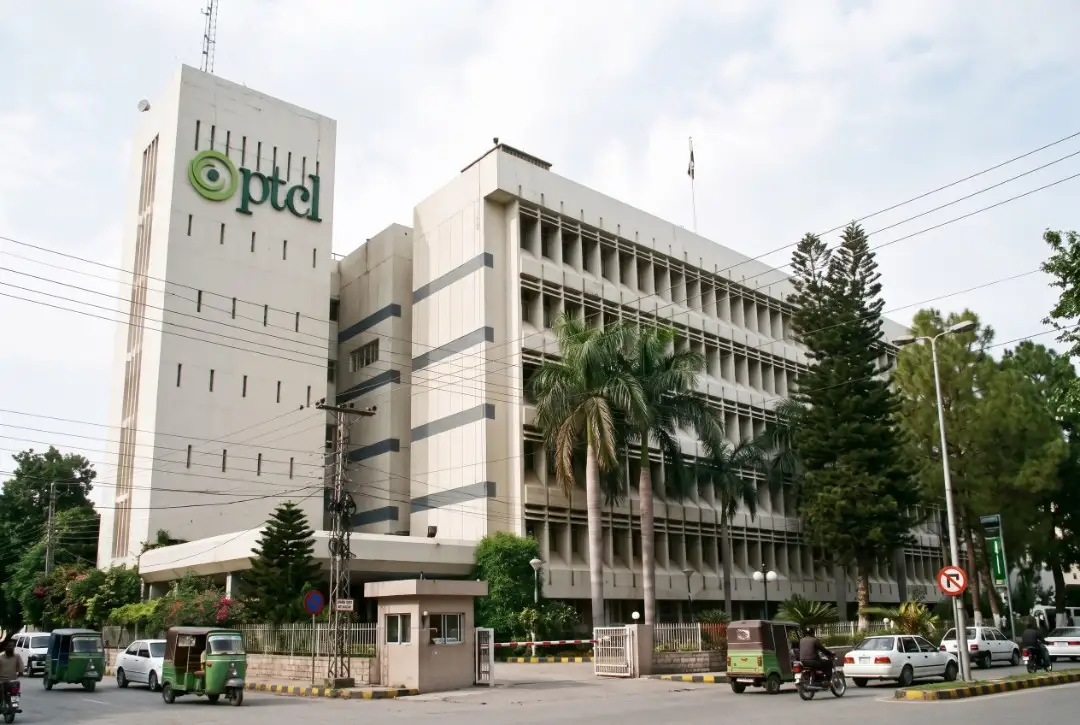
PTCL Group reported a 61.6% increase in consolidated revenue to Rs 304.4 billion for the first nine months of 2026, returning to a net profit of Rs 4.73 billion after recording a loss of Rs 11.18 billion during the corresponding period last year.
However, the latest quarterly figures reveal a significant difference between the group's rising revenue and its final earnings. During July–September 2026, PTCL Group generated Rs 102.73 billion in revenue but reported just Rs 62.34 million in consolidated net profit.
The standalone PTCL business also recorded a third-quarter net loss of approximately Rs 671.16 million, according to reproductions of its corrected financial announcement. It remained profitable over the full January–September period.
PTCL announced the unaudited results on October 22, 2026, following its acquisition of Telenor Pakistan at the end of 2025 and the subsequent legal integration of Telenor's operations into Pak Telecom Mobile Limited (PTML), the company behind Ufone.
The results highlight both the enlarged scale of Pakistan's combined telecom business and the continuing challenge of converting higher operating revenue into sustained net profit.
How much did PTCL Group revenue increase in 2026?
According to PTCL's financial-results announcement on the Pakistan Stock Exchange, consolidated revenue reached Rs 304.397964 billion for the nine months ended September 30, 2026, compared with Rs 188.322400 billion during the same period in 2025.
That represents an increase of approximately Rs 116.08 billion, or 61.6%. The company rounded the growth rate to 62% in its public statement.
Gross profit increased from Rs 62.35 billion to Rs 101.90 billion, while operating profit rose from Rs 15.94 billion to Rs 44.78 billion, an increase of approximately 181%.
After accounting for pension-related expenses, other income, financing and other costs, and taxation, the group reported a net profit of Rs 4.730464 billion.
This compared with a net loss of Rs 11.175579 billion in the previous nine-month period. Earnings per share improved from a loss of Rs 2.19 to positive earnings of Rs 0.93.
The figures are consolidated, meaning they include PTCL's subsidiaries rather than only the parent company's own operations.
The detailed figures are also reported in Mettis Global's October 22 income-statement analysis.
The period covers January to September 2026 and should not be described as PTCL's full-year financial performance.
Why did Telenor Pakistan's acquisition have such a major impact?
A central factor behind the revenue increase is that PTCL Group's 2026 accounts include Telenor Pakistan, which was not included in the corresponding nine-month consolidated results for 2025.
PTCL completed the acquisition of Telenor Pakistan and Orion Towers on December 31, 2025, obtaining full ownership of both businesses.
Telenor Group confirmed the completion in its official transaction announcement.
PTCL subsequently confirmed in its first-quarter 2026 report that Telenor Pakistan's financial results were incorporated into the group accounts from January 1, 2026.
This changed the size of the business being compared. The 2026 revenue figure includes Telenor Pakistan's operations, whereas the 2025 comparison did not.
As a result, the 62% growth rate cannot be treated as wholly organic growth generated by the businesses that PTCL already owned in 2025.
The group reported expansion in some existing services, including fixed broadband and enterprise connectivity, but its published headline results do not provide a complete like-for-like breakdown separating every rupee attributable to the acquisition from underlying growth.
This distinction is important for investors and customers because the acquisition expanded PTCL Group's revenue base immediately, while the longer-term benefits depend on operating performance, costs and successful network integration.
Why did PTCL Group earn only Rs 62.34 million in the third quarter?
The most striking figure in the October announcement is the group's much smaller profit during July–September compared with its nine-month earnings.
Consolidated third-quarter revenue increased from Rs 63.723 billion in 2025 to Rs 102.733 billion in 2026, representing growth of approximately 61.2%.
Operating profit more than doubled, reaching Rs 12.777 billion compared with Rs 6.114 billion a year earlier.
But the group's net profit for the quarter was only Rs 62.338 million. The same quarter in 2025 had produced a net loss of Rs 1.278 billion.
The figures are recorded in the corrected financial announcement reproduced by FinHisaab.
The nine-month profit of Rs 4.730 billion, less the third-quarter Rs 62.338 million, indicates that PTCL Group had earned approximately Rs 4.668 billion during January–June.
In other words, almost all the reported nine-month net profit had been generated in the first half of 2026.
The third-quarter statement shows that the combined finance costs and other expenses line reached approximately Rs 16.86 billion, compared with Rs 10.65 billion a year earlier.
This is a combined accounting category, not a figure that can accurately be described entirely as interest expense. Its individual components require a more detailed financial breakdown.
The group's quarterly net profit represented only about 0.06% of its revenue, illustrating how little remained after the other income-statement items and tax.
These figures do not show a collapse in operating activity: both quarterly revenue and operating profit increased year on year.
They instead show that strong operating earnings translated into very limited bottom-line profit in the latest quarter.
The available figures do not establish that Telenor integration expenses were the sole cause of the pressure. Detailed information on financing, taxation and other costs would be needed for that conclusion.
How did PTCL Group reverse its previous nine-month loss?
The group's return to profitability was supported by higher revenue and operating earnings, but important accounting and cost changes also contributed.
One of the largest differences was a sharp decline in the allowance for expected credit losses.
This is an amount recorded in the accounts to reflect the possibility that customers or other parties will not pay money they owe to the company.
According to the detailed income-statement comparison, PTCL Group recorded Rs 288.454 million in expected credit-loss allowances during January–September 2026, down from Rs 10.975 billion a year earlier.
That reduction materially supported operating profit. It should not, however, be interpreted as proof that an equivalent amount of overdue customer payments was collected in cash.
Pension-related past-service costs also declined significantly, falling from Rs 5.890 billion to Rs 355.144 million.
Other income increased from Rs 11.859 billion to Rs 12.488 billion.
At the same time, several expenses rose. Administrative and general expenses reached Rs 38.85 billion compared with Rs 25.10 billion a year earlier, while selling and marketing expenses increased to Rs 17.98 billion from Rs 10.33 billion.
The combined finance costs and other expenses line climbed from Rs 36.13 billion to Rs 47.35 billion, an increase of approximately 31%.
After these items, PTCL Group reported profit before tax of Rs 9.566 billion, compared with a pre-tax loss of Rs 14.225 billion in the corresponding nine-month period of 2025.
Following an income-tax charge of Rs 4.836 billion, consolidated net profit stood at Rs 4.730 billion.
The results therefore reflect more than a single acquisition benefit. Changes in the revenue base, expected credit-loss allowances, pension expenses, financing and other financial items all affected the reported outcome.
Did standalone PTCL's profit really jump by 343%?
PTCL's October 22 company statement described the standalone business's performance as a 343% year-on-year improvement.
The wording needs context because the comparison begins with a loss rather than a positive profit.
Standalone Pakistan Telecommunication Company Limited reported a net loss of Rs 1.217192 billion during January–September 2025, followed by a net profit of Rs 2.959476 billion in the same period of 2026.
The change from a loss to a profit represents an improvement of approximately 343% when measured against the absolute value of the previous loss.
However, this is not conventional 343% profit growth from an already profitable year. It is a turnaround from negative to positive earnings.
The standalone business's revenue grew from Rs 89.596 billion to Rs 97.263 billion, an increase of approximately 8.6%.
Despite that increase, gross profit fell slightly from Rs 26.208 billion to Rs 25.848 billion. Operating profit declined from Rs 12.913 billion to Rs 10.923 billion.
Thus, the nine-month improvement in standalone net earnings occurred despite a reduction in operating profit.
The July–September quarter was weaker. Reproductions of PTCL's corrected announcement report a standalone net loss of Rs 671.157 million, against a net profit of Rs 2.048 billion during the corresponding quarter in 2025.
The same quarter's standalone revenue was Rs 33.511 billion, while operating profit remained positive at Rs 2.381 billion, down from approximately Rs 5.056 billion a year earlier.
This is an important distinction: standalone PTCL reported a positive operating profit but a final net loss after accounting for other financial items and tax.
The corrected announcement figures reproduced by KseAlert show the Rs 671.157 million loss. This amount also reconciles with the reported nine-month profit after deducting the first and second quarters.
There is a source discrepancy. The PSX website's standardised quarterly financial table shows a different standalone loss of about Rs 1.404 billion, although the table states that standardised data can differ from issuer-reported accounts.
The Rs 671.157 million figure is used here because it is supported by the corrected announcement reproductions, the nine-month reconciliation and the reported negative Rs 0.13 quarterly earnings per share. Direct inspection of the signed corrected PDF remains unavailable.
The 343% company-described improvement applies to the nine-month net result, not to standalone operating profit or to the latest quarter.
How did the combined Ufone and Telenor mobile business perform?
PTCL reported that Pak Telecom Mobile Limited, or PTML, recorded 139% growth in mobile-business revenue during the nine months ended September 2026.
The company attributed the increase to the consolidation of Telenor Pakistan, alongside growth in corporate and retail mobile services.
PTML reported operating profit of Rs 33.5 billion, up approximately 181% year on year, according to the company's nine-month performance announcement.
This is operating profit for the mobile subsidiary, not consolidated net profit for the entire PTCL Group.
The 139% mobile revenue increase is also affected by the inclusion of Telenor's business and should not be described as a like-for-like increase in the previously existing Ufone operation.
The company said PTML gained approximately 1.5 million subscribers during the third quarter, taking its combined subscriber base above 76 million.
It also reported improvement in average revenue per user and continued work to align mobile packages, customer systems and network operations.
PTCL said network integration had progressed across 25 districts by the end of September and that the combined mobile operation was expanding its 5G footprint in major cities.
These are company-reported operational developments. They do not independently establish that every Ufone and Telenor customer has experienced better coverage, faster speeds or lower service prices.
What happened to Flash Fiber, business services and Ubank?
PTCL's fixed-line and enterprise operations also showed growth during the reporting period.
The company reported a 26% increase in Flash Fiber revenue, reflecting growth in its fibre broadband business.
Business Solutions revenue rose by 15%, supported by demand for enterprise connectivity and services such as cloud infrastructure, cybersecurity, data centres and managed technology solutions.
Carrier and Wholesale revenue increased by 13%, while international business revenue grew by 11%.
These figures show that previously existing PTCL activities also contributed to growth, although their reported rates were considerably lower than the increase in the enlarged consolidated group's revenue.
The group's banking subsidiary, U Microfinance Bank, known as Ubank, reported Rs 18.3 billion in revenue.
PTCL said Ubank recorded an operating profit compared with an operating loss in the previous-year period and described an 84% improvement in its bottom-line result.
The Rs 18.3 billion figure represents Ubank's revenue, not its net profit. Its precise net earnings cannot be determined from that figure alone.
The separate figures for fixed-line, mobile and banking operations should therefore be interpreted according to their stated revenue and profit measures.
When did PTCL acquire Telenor Pakistan and merge it with Ufone?
The transaction progressed through several distinct milestones.
On October 1, 2025, the Competition Commission of Pakistan approved PTCL's acquisition of Telenor Pakistan and Orion Towers, subject to conditions designed to protect competition and consumers.
PTCL completed the acquisition on December 31, 2025, obtaining ownership of both businesses.
Telenor Pakistan's operating results began entering PTCL Group's consolidated financial accounts from January 1, 2026.
The subsequent legal amalgamation was a different event. In July 2026, following the required statutory and court approvals, Telenor Pakistan's operations were formally amalgamated into PTML, the company behind Ufone.
Associated Press of Pakistan reported the formal July amalgamation following the relevant approvals.
These events should not be confused. PTCL completed the acquisition in December, began consolidating Telenor's financial results in January and proceeded with the legal amalgamation in July.
The January consolidation date is the relevant accounting milestone when explaining the nine-month revenue comparison.
What could the merger mean for telecom customers?
PTCL expects the combined Ufone–Telenor operation to make better use of a larger subscriber base, mobile spectrum, network infrastructure and investment resources.
The group has identified future network improvement, 5G expansion and operating efficiencies as priorities.
However, a larger telecom business does not automatically guarantee better services or prices for consumers.
The Competition Commission reviewed the acquisition's likely effects on market concentration, infrastructure access and competition before approving it with conditions.
Under the regulator's official announcement, PTCL and the merged entity must maintain separate boards and independent management arrangements.
The conditions also require non-discriminatory access to certain interconnection and infrastructure services, while restricting anti-competitive cross-subsidisation, pricing practices and related-party arrangements.
An independent third-party reviewer is required to monitor compliance and submit quarterly reports for five years.
The Competition Commission also requires the companies to demonstrate that claimed efficiencies are passed on to consumers through improved services, pricing or infrastructure investment.
These safeguards provide an oversight framework. They do not, by themselves, establish that consumers have already received all the benefits PTCL expects.
What financial challenges remain for PTCL Group?
PTCL Group's October results show significantly higher reported revenue and stronger nine-month operating earnings, but the latest quarter raises questions about the consistency of its net profitability.
The group reported Rs 47.35 billion in combined finance costs and other expenses for the first nine months, compared with Rs 36.13 billion a year earlier.
The small Rs 62.34 million net profit in the third quarter illustrates the effect of expenses and other financial items on the group's final earnings.
Standalone PTCL's quarterly loss is another important indicator, even though the parent company remained profitable over the full nine months.
The group is also continuing the integration of Telenor's network, customer services, operational systems and commercial products with Ufone.
Although PTCL has reported integration progress, the financial disclosures do not establish the final amount of savings that may result or guarantee stronger profits in future quarters.
Subsequent financial statements will be important for assessing whether higher revenue and operating profits can translate into a stronger and more stable net margin.
For customers, the main measures will be service quality, reliable coverage, fair pricing and compliance with regulatory conditions.
What do the latest PTCL financial results really show?
PTCL Group's nine-month figures reflect a significant expansion in its reported business after the Telenor Pakistan acquisition. Revenue reached Rs 304.4 billion, while consolidated net profit improved to Rs 4.73 billion from a substantial loss a year earlier.
But the revenue comparison includes a business that was not part of the group in the corresponding 2025 period. Lower expected credit-loss allowances, reduced pension expenses and other financial changes also contributed to the earnings turnaround.
The third-quarter figures present a less comfortable picture: strong revenue and operating profit were accompanied by just Rs 62.34 million in group net profit, while standalone PTCL reported a quarterly loss in the corrected filing reproductions.
The results do not establish that the merger has failed, nor do they demonstrate that all expected benefits have already been delivered.
They show a substantially larger telecom group that has returned to nine-month profitability but still needs to demonstrate sustained net earnings and tangible improvements for customers.