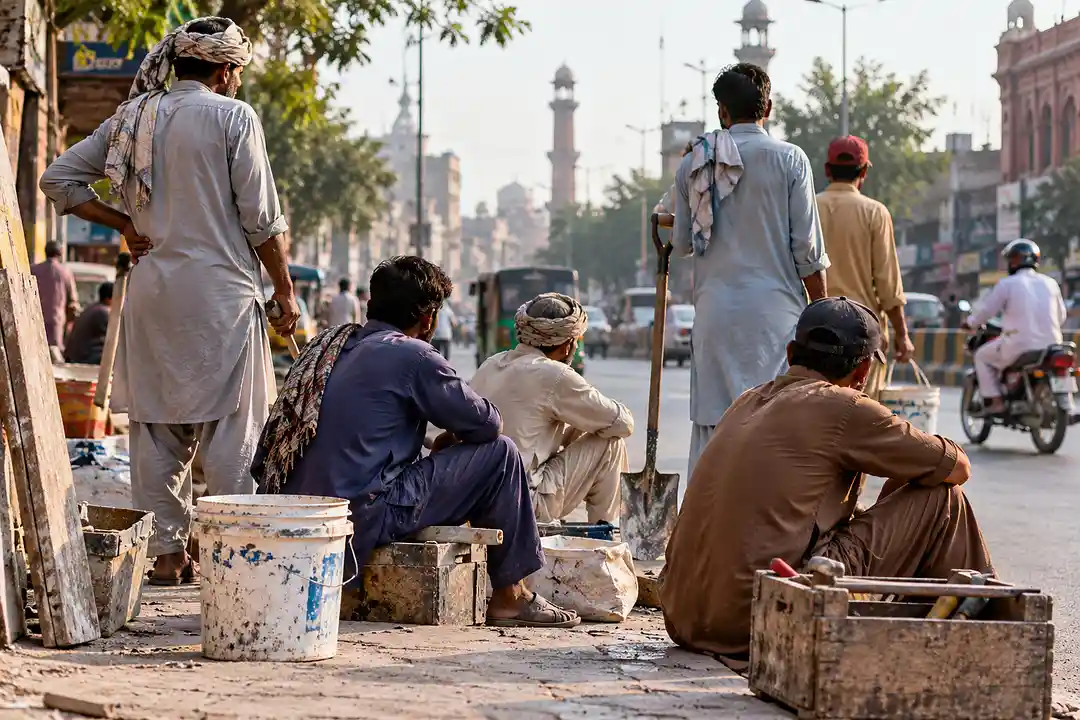
Pakistan's economy is forecast to grow more quickly over the next two fiscal years, but the recovery has not yet generated enough quality jobs for its expanding workforce or reversed a substantial rise in poverty, according to a new World Bank assessment.
The World Bank's Pakistan Development Update: Attaining Escape Velocity, released on October 22, 2026, estimates economic growth of 3.7% in fiscal year 2025–26 and projects 3.8% in FY2027 and 4.2% in FY2028.
Yet the report also highlights a major employment challenge: approximately 3.6 million Pakistanis reach working age every year, while the growth of productive job opportunities has failed to keep pace with the expanding labour force.
The Bank estimates that roughly one in six new labour-force entrants has been left without work since 2018. Its national poverty figures show a rise from 22% in 2018–19 to 29% in 2024–25, despite periods of economic growth.
The findings raise a difficult question for Pakistan: how can improving national economic indicators translate into better-paying jobs, stronger household incomes and a lasting reduction in poverty?
What does the World Bank forecast for Pakistan's economy?
According to the World Bank's original October 2026 Pakistan Development Update, real GDP growth at factor cost reached an estimated 3.7% in FY2026, compared with 3.2% in FY2025.
The Bank forecasts growth of 3.8% in FY2027, the fiscal year running from July 2026 to June 2027, and 4.2% in FY2028, running from July 2027 to June 2028.
The 4.2% figure is a future forecast, not Pakistan's current growth rate or an economic outcome already achieved.
The report acknowledges meaningful progress in restoring macroeconomic stability after years of inflation, external financing problems and fiscal pressures.
Pakistan's consolidated fiscal deficit narrowed to an estimated 2.6% of GDP in FY2026, while the primary fiscal surplus reached 2.9% of GDP. The primary balance excludes interest payments on government debt.
Strong remittances, reserve accumulation and improved international confidence have supported the recovery. The World Bank notes credit-rating upgrades and Pakistan's return to international bond markets, including a US$3 billion Eurobond issuance in September 2026.
However, stability does not automatically translate into sustained high growth. The World Bank warns that low investment, structural weaknesses and limited productivity improvements continue to restrict the economy's ability to generate better livelihoods.
The Bank's baseline projections show growth rising gradually rather than accelerating sharply. By FY2030 and FY2031, its forecast reaches approximately 4.5%, assuming continued economic discipline but limited progress on deeper reforms.
Why does Pakistan need millions of additional job opportunities?
Pakistan's employment challenge begins with the rapid growth of its working-age population.
In the executive summary of its October 2026 report, the World Bank states that approximately 3.6 million Pakistanis reach working age each year.
On page 6, the report separately states that Pakistan's labour force has expanded by around 3.6 million people annually since 2018.
These are two different measures, even though the rounded numbers are similar. Reaching working age does not necessarily mean that someone is working or looking for employment. The labour force includes people already employed and those actively seeking work.
Neither figure means that 3.6 million young Pakistanis are currently unemployed.
The Bank's employment analysis finds that job creation has grown more slowly than the labour force, leaving roughly one in six new entrants without work over the period examined.
The report says the shortfall has been especially significant among women and young people. It records an unemployment rate of 7.0% in 2024.
Without sufficient new opportunities, people entering the labour market may face unemployment, irregular work or prolonged dependence on family incomes.
The World Bank's Pakistan country overview also uses a rounded estimate of about 3.5 million people entering the workforce annually. That broader figure is consistent with the scale of the challenge but should not replace the specific measures and definitions in the October report.
The policy question is not simply how many people enter working age, but whether Pakistan's economy can create productive opportunities quickly enough for those seeking work.
Pakistan created 17.7 million jobs. Why are wages still under pressure?
The World Bank estimates that Pakistan created approximately 17.7 million net new jobs since 2018.
That figure shows that employment has increased. However, the Bank says many of those jobs are in low-paid, low-productivity sectors rather than activities that provide strong and sustained earnings.
Its country overview also identifies informal employment and self-employment as significant features of the jobs created.
Informal work can provide vital income, but it may offer limited contractual protection, unpredictable earnings and fewer opportunities for training or advancement.
In such circumstances, a worker may technically be employed while still struggling to meet basic expenses.
The World Bank estimates that economy-wide labour productivity grew by only 0.4% annually between 2014 and 2024.
Labour productivity broadly describes the economic output generated through work. When productivity barely increases, businesses have less scope to sustain large improvements in wages and living standards.
Meanwhile, real wages declined by an average of approximately 3.4% a year between 2018–19 and 2024–25, according to the Bank's country assessment.
Real wages account for changes in prices. A salary may increase in rupee terms while still buying less food, transport, electricity or housing if inflation rises more quickly.
This explains why employment growth and improvements in national GDP can occur without comparable progress in the living conditions of ordinary households.
The Bank's warning is therefore about both the quantity and quality of jobs. Pakistan must create opportunities for new workers while making existing employment more productive and better paid.
How far has poverty increased in Pakistan?
Pakistan's national poverty rate rose from approximately 22% in 2018–19 to 29% in 2024–25, according to the World Bank.
The finding is documented in the Bank's October 2026 Poverty and Equity Brief and repeated in the Pakistan Development Update.
The World Bank's country overview estimates that approximately 70 million Pakistanis now live in poverty under the national poverty measure.
The deterioration followed a series of economic and environmental shocks, including the COVID-19 pandemic, the devastating floods of 2022, high inflation, currency depreciation and a prolonged period of economic adjustment.
Households with little financial protection or savings were particularly vulnerable as essential expenses increased and real earnings declined.
The Bank's poverty assessment says the increase occurred across provinces and in both rural and urban areas.
It also reports that more than half of the increase reflected a worsening distribution of household consumption. This means that changes in how consumption was distributed among households contributed to the deterioration, alongside broader economic pressures.
A country's economic output can grow without every income group benefiting equally. The World Bank's findings highlight the importance of looking beyond average GDP growth when assessing poverty and living standards.
The 22% and 29% figures use Pakistan's national poverty measure. They should not be confused with estimates calculated using an international dollar-based poverty threshold.
Why does Pakistan account for 48% of the region's extreme poor?
An earlier World Bank assessment, released during the first week of October 2026, estimated that Pakistan accounts for approximately 48% of people living below the international US$3-a-day poverty threshold in the Middle East, North Africa, Afghanistan and Pakistan region, known as MENAAP.
The finding appeared in the World Bank's separate regional report, From Divide to Opportunity: AI, Jobs, and Growth, and was reported by Dawn on October 7.
This statistic refers to Pakistan's share of the total number of people living in extreme poverty across MENAAP. It does not mean that 48% of Pakistan's own population is living below the US$3 threshold.
The World Bank's regional assessment also found that Afghanistan, Syria and Yemen together accounted for another approximately 47% of the region's people below that threshold.
The international US$3 poverty line is calculated using purchasing-power-parity adjustments, which account for differences in living costs across countries. It should not be interpreted as a simple conversion into Pakistani rupees at the current exchange rate.
Pakistan's large population is an important reason for its substantial share of the regional total. However, the World Bank also identifies a worsening poverty trend within Pakistan itself.
The two findings measure different things: the national 22%-to-29% increase concerns Pakistan's domestic poverty rate, while the 48% figure concerns the distribution of extreme poverty within a specific international region.
The regional statistic was not first announced with the October 22 Pakistan Development Update. It provides additional context to that report's employment and poverty findings.
How has the Pakistani government responded to the findings?
Pakistani officials have emphasised the recovery in macroeconomic stability while challenging some interpretations of the World Bank's regional poverty statistics.
Khurram Schehzad, adviser to the finance minister, argued in early October that Pakistan's inclusion in MENAAP was an administrative and statistical reclassification.
According to Business Recorder, Schehzad said that moving a large-population country into a regional grouping changes the region's aggregate figures and should not be confused with a sudden shift in the country's actual economic condition.
He also argued that meaningful comparisons should use consistent poverty thresholds, reference years and country-level data.
That distinction is relevant when interpreting the regional 48% share. It does not, however, negate the separately measured rise in Pakistan's national poverty rate between 2018–19 and 2024–25.
Finance Minister Muhammad Aurangzeb separately acknowledged the poverty challenge in remarks during the October IMF-World Bank meetings.
As reported by Arab News Pakistan on October 16, Aurangzeb discussed cash support, targeted assistance and efforts to create employment and improve economic opportunities.
He pointed to programmes including the Benazir Income Support Programme and emphasised the need for sustainable investment- and export-led growth.
Following the release of the October 22 Pakistan Development Update, Schehzad highlighted the World Bank's acknowledgement of better fiscal discipline, rising remittances, improved confidence and progress on structural reforms.
Those comments were carried by Associated Press of Pakistan.
The government's responses address different aspects of the situation: how regional statistics should be interpreted, how poverty should be tackled and what progress Pakistan has made in restoring economic stability.
The World Bank's assessment recognises that progress, while maintaining that further reforms are needed to improve productivity, wages and job creation.
Why does the World Bank raise IMF and election-related fiscal risks?
The October report discusses how Pakistan can preserve its economic stabilisation gains as its current IMF programme approaches its final phase and the country moves towards its next scheduled national election period.
The World Bank refers to the Extended Fund Facility programme as ending in September 2027 and identifies early 2029 as the timetable for national elections in its fiscal planning discussion.
The IMF's own documents provide a more precise distinction between the final scheduled programme review and the arrangement's formal expiration.
The IMF's published EFF review and purchase schedule lists September 15, 2027 as the availability date for the sixth and final scheduled review-related purchase, subject to the review's conditions and approval.
Separately, the IMF's official lending commitments record lists October 24, 2027 as the EFF arrangement's formal expiration date.
These are different milestones. September 15 is not a guaranteed payment date, and it is not the formal October expiration date.
The World Bank recommends developing, publishing and effectively implementing a credible medium-term fiscal plan consistent with keeping public debt sustainable.
It projects Pakistan's fiscal deficit widening from an estimated 2.6% of GDP in FY2026 to 3.5% in FY2027 and 4.0% in FY2028.
The Bank expects some increase in public spending as inflation persists and the country moves towards its next election cycle, reflecting historical spending patterns. However, its 4.2% FY2028 GDP forecast should not be described as growth artificially created for electoral purposes.
Early 2029 is the timetable used by the report, not a guarantee that an official polling date cannot change.
Could Pakistan achieve economic growth of 6.2% to 6.9%?
The World Bank's report also considers how a more ambitious reform programme could improve Pakistan's long-term economic performance.
Under its baseline scenario, medium-term real GDP growth settles at approximately 4.5%, assuming macroeconomic stability but only limited progress on major structural reforms.
The Bank then models stronger outcomes if Pakistan improves the quality of its policies and institutions towards the standards seen in the average upper-middle-income economy.
Its analysis associates closing half of that institutional and policy gap over seven years with annual growth rising from 4.5% to around 6.2%.
In a faster scenario, closing half of the gap over five years is associated with growth of around 6.9%.
Both scenarios involve major improvements in governance, business regulations, trade openness, the labour market, investment and productivity.
Crucially, the World Bank states that the estimated growth dividends should be interpreted as associations rather than forecasts.
They are not promises that Pakistan will reach 6.2% or 6.9% growth, and they do not replace the much lower official near-term forecasts for FY2027 and FY2028.
At the October 22 report launch, World Bank officials also described how sustained reforms could substantially increase income per person by 2050, potentially reaching income levels currently seen in economies such as Viet Nam.
According to Associated Press of Pakistan's coverage, the Bank stressed private investment and continued policy implementation as central to the opportunity.
The long-term scenarios are intended to illustrate what substantial reform could make possible, rather than predict an automatic economic transformation.
Which reforms does the World Bank recommend?
The Bank argues that Pakistan must move beyond short-term stabilisation and address structural obstacles that prevent businesses from investing and creating productive employment.
Energy-sector reform is a central priority. High electricity costs, weak efficiency and financial problems in power distribution increase business expenses and place pressure on the national budget.
The World Bank recommends greater efficiency and private participation in energy transmission and distribution, alongside measures to reduce losses and improve the sector's financial sustainability.
It also calls for simpler business regulations, a more predictable investment environment and steps to strengthen competition and private-sector participation.
Tax reform is another priority, including broadening the revenue base, improving administration and addressing weaknesses in agricultural and property taxation.
Trade reforms could make it easier for Pakistani firms to compete in export markets, obtain financing and meet international quality standards.
Education, professional qualifications and better labour-market information are important for aligning workers' skills with employers' requirements. Improved opportunities for women and young people would also help the country make better use of its growing workforce.
Other recommendations include stronger public institutions, improvements in access to business finance, and more effective management of state-owned enterprises.
The report argues that expanding government spending or easing monetary policy alone cannot generate sustainable growth. Productivity-enhancing reforms are needed to raise investment, competitiveness, exports and incomes over time.
What risks could weaken Pakistan's economic outlook?
Despite expecting continued growth, the World Bank identifies major risks from the Middle East conflict, international energy prices, external financing needs and climate conditions.
A longer or more intense regional conflict could keep oil and gas prices high, increase Pakistan's import bill and place additional pressure on inflation and foreign exchange reserves.
Disruptions to shipping routes and export demand could further increase costs for businesses and reduce economic activity.
The report identifies a stronger-than-expected El Niño as another risk, particularly for agriculture. Unfavourable weather and weaker crop production could increase food prices and reduce rural incomes.
In one conditional scenario, zero growth in crop output would reduce the FY2027 GDP growth forecast by 0.2 percentage points, from 3.8% to 3.6%. This is a risk scenario, not the Bank's baseline forecast.
Higher food prices would be particularly difficult for poorer households, which spend a larger share of their income on basic necessities.
Pakistan's debt obligations and continuing need for external financing also leave limited room for responding to repeated economic shocks.
These risks make the challenge of simultaneously maintaining stability, protecting vulnerable families and funding reforms more difficult.
Why does higher GDP growth not automatically mean lower poverty?
Pakistan's economic recovery contains two different realities: national indicators have improved, but many households continue to struggle with limited job opportunities and weakened purchasing power.
GDP growth measures the expansion of the economy's output. It does not automatically show whether people can find secure work, whether their wages keep up with prices or whether the benefits of growth reach low-income households.
The World Bank acknowledges Pakistan's progress in restoring stability. It also finds that employment growth has been insufficient for the expanding workforce, much of the work created is low-paid and the national poverty rate has risen.
The Bank is not predicting that 4.2% growth in FY2028 will create no jobs. Its warning is that the present pattern of growth is not sufficient to deliver the scale and quality of employment needed for sustained improvements in living standards.
Whether Pakistan can convert its recovery into wider prosperity will depend on productive investment, better skills, stronger institutions and businesses capable of creating jobs that pay more.
For millions of Pakistani households, the most meaningful measure of economic progress will be not just the next GDP percentage, but whether secure employment becomes more available and everyday earnings can cover the cost of living.