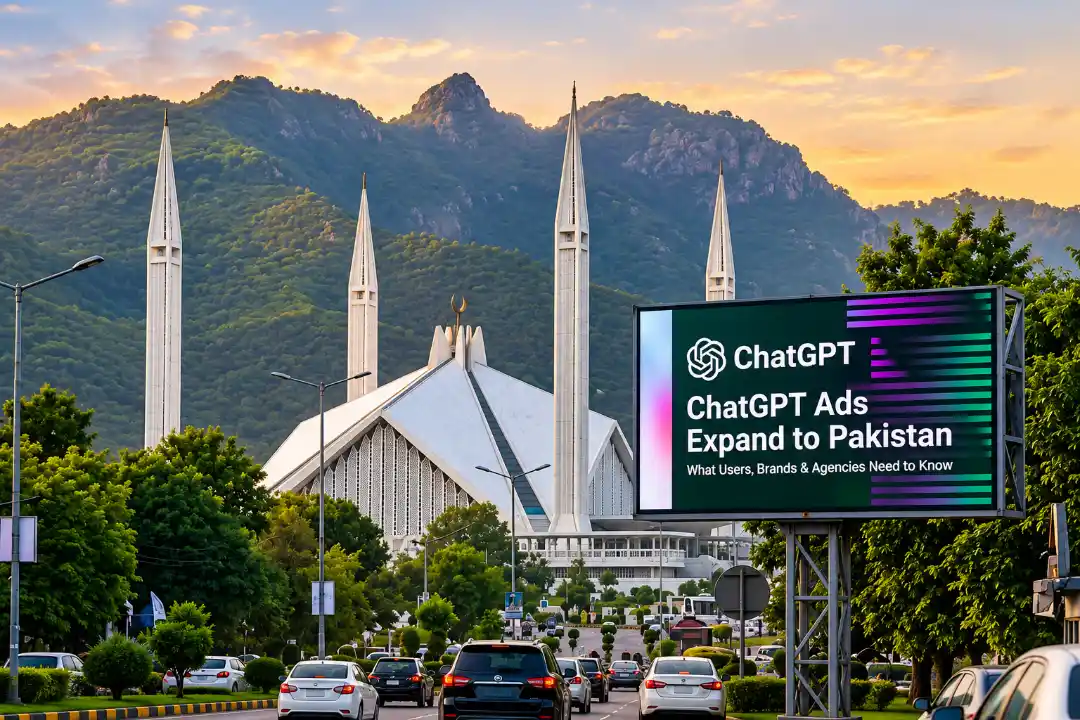
OpenAI has expanded advertising in ChatGPT to Pakistan, creating a new advertising opportunity for eligible local businesses while gradually introducing sponsored placements to users of its artificial intelligence chatbot.
The company announced on October 21, 2026, that Pakistan was among 26 additional countries joining the ChatGPT advertising programme, increasing the number of supported markets worldwide to 89.
The development could give Pakistani brands and digital marketing agencies another way to reach potential customers as they research products, compare services and consider purchases. But it does not mean that every Pakistani ChatGPT user will immediately see advertisements, or that businesses can pay to influence the answers generated by the chatbot.
OpenAI says advertisements are clearly labelled and separate from ChatGPT's responses. It also states that advertisers cannot read users' private conversations or purchase favourable treatment in the assistant's answers.
What did OpenAI announce about ChatGPT advertising in Pakistan?
In its official announcement on October 21, 2026, OpenAI confirmed that ChatGPT Ads was expanding to 26 additional countries across Asia, Africa, Europe, the Middle East and Latin America.
Pakistan was specifically included alongside countries such as Bangladesh, Cambodia, Nigeria, South Africa, Serbia and Ukraine.
The company said this expansion brought ChatGPT advertising to 89 countries. It also reported that more than 100,000 advertisers had run campaigns since its advertising programme began earlier in 2026.
OpenAI reported that more than 1.2 billion people use ChatGPT each week globally. These figures describe worldwide usage and advertising activity, not the number of people receiving ChatGPT advertisements in Pakistan.
The expansion follows earlier launches in the United States and other international markets. OpenAI says advertisers in supported countries can access its advertising programme through technology partners or self-service Ads Manager.
For Pakistan, the announcement is significant because the country is now explicitly recognised as an eligible advertising market, rather than simply a country where people can use ChatGPT.
Does this mean everyone in Pakistan will now see ChatGPT ads?
No. Pakistan's inclusion does not mean advertisements will immediately appear in every conversation or on every account.
According to OpenAI's official advertising FAQ, the company began testing advertisements in the United States on February 9, 2026, and has been gradually extending the experience to eligible users in supported regions.
Advertisements may appear on ChatGPT's Free and Go plans. Plus, Pro, Business, Enterprise and Edu accounts remain ad-free under the current policy.
OpenAI also says it does not show advertisements to accounts identified as belonging to people younger than 18.
Temporary Chats are excluded from advertising. The company also offers an ad-free option for eligible Free users with additional usage restrictions, although availability can vary by region.
This means two people using ChatGPT in Pakistan may have different experiences. An eligible Free or Go user could encounter a sponsored placement, while someone using an ad-free subscription would not receive those advertisements.
The October 21 announcement did not establish the number of Pakistani users included in the initial rollout, how many have already seen advertisements or when every eligible local account might receive them.
Where will advertisements appear inside ChatGPT?
OpenAI's documented advertising experience allows an advertisement to appear below a ChatGPT response, separately labelled as a paid placement.
The advertisement may include an advertiser's name, a product or service description, an image and a link to a relevant destination.
OpenAI is also testing a multi-image advertising format during image generation. This is a separate experimental format and should not be understood as a feature already available to every Pakistani advertiser or user.
Unlike a conventional website banner, ChatGPT advertising can use the context of a person's current conversation to assess which commercial offer may be relevant.
For example, someone comparing equipment for a home office might be shown an advertisement for a suitable computer accessory or related service. That is an illustration of the advertising system's intended approach, not evidence of a specific campaign already operating in Pakistan.
OpenAI says its delivery system considers multiple signals, including the conversation's topic and intent, the advertisement's landing page and content, advertiser-provided context hints, targeting settings and advertiser bids.
However, a sponsored placement is not guaranteed to appear simply because a user mentions a particular brand, product or keyword.
Can companies pay OpenAI to influence ChatGPT's answers?
No. OpenAI explicitly states that advertisers cannot shape, rank or alter the answers generated by ChatGPT.
According to the company, advertisements operate through a separate system from the model that produces conversational responses. Paid placements are clearly labelled and displayed independently of the answer.
A business therefore cannot purchase an advertisement and require ChatGPT to recommend its product, describe it as the best option or place its brand first in an ordinary response.
OpenAI also says that displaying an advertisement does not mean it endorses the advertiser or the product being promoted.
This is an important distinction for consumers. A company may pay for visibility near a relevant conversation, but that sponsored placement should not be mistaken for an independent recommendation by the assistant.
For advertisers, it also means that purchasing ChatGPT Ads is different from improving a website's content, reputation or visibility in other digital channels. There is no documented purchasing option that guarantees favourable placement within ChatGPT's generated answers.
Can advertisers read private ChatGPT conversations?
OpenAI says advertisers cannot access users' private ChatGPT conversations, chat histories, memories or personal details. The company also states that it does not sell users' data to advertisers.
Advertisers receive aggregated, non-identifying reporting about advertising performance, such as the number of views and clicks recorded by a campaign.
There is an important difference between using conversation context internally to select a relevant advertisement and giving that conversation to the business paying for the advertisement.
OpenAI says its advertising system may consider the topic of the current discussion, along with broad context such as language and general location. The advertiser does not receive the user's private chat transcript.
If a user chooses to contact a business directly through a supported advertising interaction, the advertiser can see the messages the user deliberately sends to that business. This is different from receiving access to the person's conversations with ChatGPT.
OpenAI also restricts advertising placements near certain sensitive discussions, including personal health, mental health, political topics and other circumstances in which advertising could be inappropriate.
For Pakistani users concerned about privacy, the key questions are how advertisements are selected, what information is used internally, what controls are available and whether those controls match their personal preferences.
What is ad personalisation, and can users turn it off?
OpenAI provides settings that allow eligible users to control whether advertisements are personalised using information from their broader ChatGPT experience.
When personalisation is enabled, the advertising system may consider selected signals from previous chats, memory and past advertising interactions, depending on the user's settings.
For example, a person's earlier discussions about a hobby or product category may help the system identify relevant commercial offers, where those signals are permitted for personalisation.
When personalisation is disabled, OpenAI says other chat threads, advertising history and saved topics are not used to personalise advertisements. However, ads may still be selected according to the subject of the current conversation.
Users can open ChatGPT's Settings and find Ads Controls, where available, to adjust personalisation, hide or report advertisements, review why an advertisement appeared and clear data used for advertising.
According to OpenAI, advertising data that a user clears stops being used for ad selection, while the underlying retained data may take up to 30 days to be removed from the company's servers.
The company also describes a free, ad-free option with reduced usage limits and fewer available features, alongside its ad-free subscription plans. Availability can depend on region and account eligibility.
Turning off personalisation and removing advertisements are therefore different choices. The first changes the information used to select an ad; the second requires an eligible ad-free experience.
Can Pakistani businesses advertise directly through ChatGPT?
Yes. OpenAI's official Ads Manager availability list explicitly marks Pakistan as available for self-service advertising.
The list states that the legal entity responsible for advertising and billing must be based in a country supported by the self-service system.
Eligible Pakistani businesses can begin account registration through OpenAI's advertising website.
Ads Manager Beta allows advertisers to create campaigns, organise ad groups, prepare advertisements, choose supported objectives and control budgets.
However, country availability does not automatically guarantee that an advertiser's account will be approved or that every proposed advertisement will run.
Businesses must meet applicable account verification, billing, campaign readiness and advertising-content requirements. OpenAI also reviews advertisements and their destination pages against its policies.
Some new self-service accounts may initially be limited to advertising in their home country. According to OpenAI's campaign guidance, access to other supported countries may depend on approved identity verification and reaching the required advertising spend in the home market.
Businesses should also check the available geographic and platform targeting controls in their own accounts. Supported options can vary by campaign type and advertising product.
This means Pakistan's inclusion is a confirmed opportunity to access the advertiser platform, not a guarantee of unrestricted international targeting or automatic approval for every business category.
How much will ChatGPT advertising cost in Pakistan?
OpenAI has not published a verified average cost per click, cost per thousand impressions or customer acquisition cost specifically for Pakistan in the public documents reviewed for this article.
Its advertising platform currently offers three principal campaign objectives, with different billing and optimisation methods.
Views: Paying for impressions
Under the Views objective, advertisers use CPM billing. This means the cost is calculated for every 1,000 advertising impressions served.
CPM campaigns are generally designed to increase exposure and awareness rather than directly optimise for website visits.
Clicks: Paying for valid clicks
Under the Clicks objective, advertisers use CPC billing, meaning they pay for each valid click on the advertisement.
This approach may be useful for businesses seeking visits to product pages, service pages or other approved destinations.
Conversions: Optimising for selected actions
Under the Conversions objective, the system aims to deliver advertisements to people more likely to complete a supported action, such as making a purchase, submitting a lead form or registering for a service.
According to OpenAI's campaign documentation, eligible advertisers can use oCPC, which bills for valid clicks, or oCPM, which bills per 1,000 impressions.
A Conversions campaign is not automatically billed for each completed conversion. The selected action guides optimisation, while billing follows the available click-based or impression-based method.
What is the minimum advertising budget?
OpenAI's official minimum-spend table currently lists a minimum daily budget of US$25 for advertising accounts billed in US dollars.
That amount is not the price of a single click, an established Pakistani campaign cost or a confirmed minimum denominated in Pakistani rupees.
The published table does not provide a separate PKR minimum. Advertisers should confirm the billing currency, payment method and minimum amount available in their own accounts before making a spending decision.
The system supports campaign-total budgets and daily budgets.
A campaign-total budget sets the overall amount available to spend throughout the campaign. A daily budget is an average over the account's seven-day budget week, rather than a strict limit for each individual day.
Under the documented rules, a campaign can spend up to twice its selected daily budget on a particular day. The applicable seven-day spending limit is generally seven times the daily budget, with adjustments when budget changes occur.
The budget week runs from Sunday to Saturday according to the advertising account's timezone. An advertiser who needs tighter control over the campaign's overall expenditure should examine the campaign-total budget option.
Pakistani advertisers should consider payment-processing requirements, accounting treatment and any applicable currency conversion costs separately from the advertising platform's stated minimum budget.
How does ChatGPT advertising differ from Google and Meta ads?
ChatGPT offers an advertising environment built around conversations. Users can explain their needs, ask follow-up questions, compare options and refine their decisions over several messages.
Google Search advertisements commonly reach people expressing their interests through searches, while Meta advertisements reach audiences across social feeds, videos and other placements using the company's own targeting and delivery systems.
ChatGPT's advertising system can assess the context of an ongoing conversation and consider whether a product or service may be relevant to the user's current research.
For instance, a person exploring software for a small business might ask about inventory management, bookkeeping, integrations and pricing in the same conversation. A suitable software advertisement could be relevant during that research.
This environment may offer advertisers another way to introduce products during evaluation, rather than only when someone searches for a particular keyword or browses a social media feed.
However, this does not establish that ChatGPT advertising will be cheaper or more effective than Google Ads or Meta Ads in Pakistan.
No independently verified Pakistan-specific comparison of average click costs, lead quality, sales or advertising returns was established in the available public reporting.
The commercial value of the new platform will need to be measured through actual campaigns rather than assumptions based on the behaviour of users on other services.
What opportunities does this create for Pakistani digital marketing agencies?
For agencies already managing online advertising, the expansion provides another channel to assess for eligible clients.
Potential services include account setup, campaign planning, advertising-copy development, creative testing, landing-page optimisation, conversion measurement and performance reporting.
One feature agencies will need to understand is context hints.
According to OpenAI's official guidance, these hints provide additional information about a product, the type of customer it serves and the circumstances in which it may be useful.
For example, an accounting software company could explain that its product is designed for retailers who need to reconcile online and in-store sales.
That information may help the advertising system understand when the product is relevant to a conversation, but it does not guarantee that an advertisement will appear whenever a user asks about retail accounting.
Context hints are not exact-match keywords, strict targeting controls or instructions requiring an advertisement to appear in a particular conversation.
Agencies should therefore avoid promising clients guaranteed visibility for specific prompts, a particular ranking within ChatGPT responses or predetermined advertising results.
The quality of the destination website will also matter. Clear product information, accurate pricing, fast loading and a working enquiry or checkout process can affect what happens after a visitor clicks an advertisement.
Agencies may be able to offer useful campaign services as the market develops, but the size of demand and likely profitability in Pakistan have not yet been established by independent performance data.
How can businesses measure leads, purchases and other results?
OpenAI's Ads Manager provides reporting for advertising impressions, clicks, spending and common performance measures such as click-through rate, average CPC and average CPM.
Businesses can also configure conversion measurement to evaluate supported actions after users click their advertisements.
According to OpenAI's conversion measurement documentation, advertisers can create a data source and send eligible events through the OpenAI Pixel, the Conversions API or both.
These events can represent actions such as a purchase, registration or lead submission.
For an event to be attributed to a campaign, it must match the advertiser's configured conversion event, fall within the applicable attribution window and be connected to an eligible ad click through available measurement signals.
This means that simply installing tracking code does not guarantee that every website sale will be attributed to ChatGPT advertising.
Differences between Ads Manager and website analytics may also arise because of technical implementation, consent settings, browser behaviour, measurement windows and other reporting factors.
Businesses should comply with applicable privacy requirements when collecting and sharing conversion information from their websites.
For meaningful assessment, advertisers should compare not just impressions and clicks but also lead quality, actual sales, revenue and the complete cost of running campaigns.
Which types of businesses are restricted from ChatGPT advertising?
Pakistan's inclusion in Ads Manager does not mean that every product and service can be promoted through ChatGPT.
OpenAI's advertising policies describe an initial focus on consumer categories such as household goods, local services, travel, entertainment, digital products and education.
The platform currently prohibits political advertising and advertisements involving gambling, tobacco, alcohol, counterfeit goods, fraudulent offers and other disallowed categories.
Financial-services advertising outside the United States is generally prohibited under the documented policy.
Advertising for regulated healthcare services outside the United States is also generally prohibited, while legal-services advertising outside the US is currently prohibited.
OpenAI describes case-by-case approval processes for certain sensitive or regulated advertiser categories. However, businesses should not assume that any particular exception is available in Pakistan without confirmation.
Some products such as general budgeting software, educational courses or wellness items without medical claims may be treated differently from regulated financial or medical services.
The policies also prohibit misleading claims, impersonation, deceptive landing pages and advertisements that attempt to exploit sensitive circumstances.
Individual housing or employment listings are subject to additional restrictions, even though broader listing platforms may be allowed under specified conditions.
For marketing agencies, verifying a client's category eligibility should come before proposing campaign budgets, creative work or promised launch dates.
What is still unknown about ChatGPT ads in Pakistan?
The October 21 announcement establishes that Pakistan is an officially supported advertising market. It does not answer several important questions about local performance.
OpenAI has not disclosed the number of Pakistani users currently eligible to see advertisements, how many are receiving them or an exact schedule for expanding their delivery.
The company has also not established public local benchmarks for average CPC, CPM, customer acquisition cost or return on advertising spend.
There is no independently verified Pakistan-specific evidence showing whether Urdu-language advertisements perform better or worse than English-language campaigns.
Similarly, the results that advertisers might achieve in Lahore, Karachi, Islamabad or other Pakistani cities cannot be assumed from the company's global user figures.
Payment methods, billing currencies and specific geographic targeting options must be confirmed in the relevant Ads Manager account.
It is also too early to establish whether the expansion will significantly shift advertising expenditure away from established search and social media platforms.
These uncertainties matter because being eligible to advertise and achieving a profitable campaign are not the same thing.
What happens next for Pakistani users, brands and agencies?
OpenAI says it plans to develop additional advertising formats, campaign objectives, buying options and measurement tools as ChatGPT advertising expands internationally.
For users in Pakistan, the immediate change is that eligible Free and Go accounts may begin encountering clearly labelled sponsored placements, while ad-free accounts remain excluded under the current policy.
The company continues to state that advertisements do not influence ChatGPT's answers and that private conversations remain inaccessible to advertisers.
For businesses, the expansion opens self-service advertiser access, subject to account verification, billing and advertising-policy requirements.
For agencies, the opportunity is to understand the platform, identify suitable clients and evaluate campaigns using measurable results without promising unverified outcomes.
Pakistan's inclusion marks a notable step in the growth of advertising inside AI assistants. Its long-term importance for the local advertising industry will depend on actual user rollout, advertiser adoption, costs, privacy protections and campaign performance.