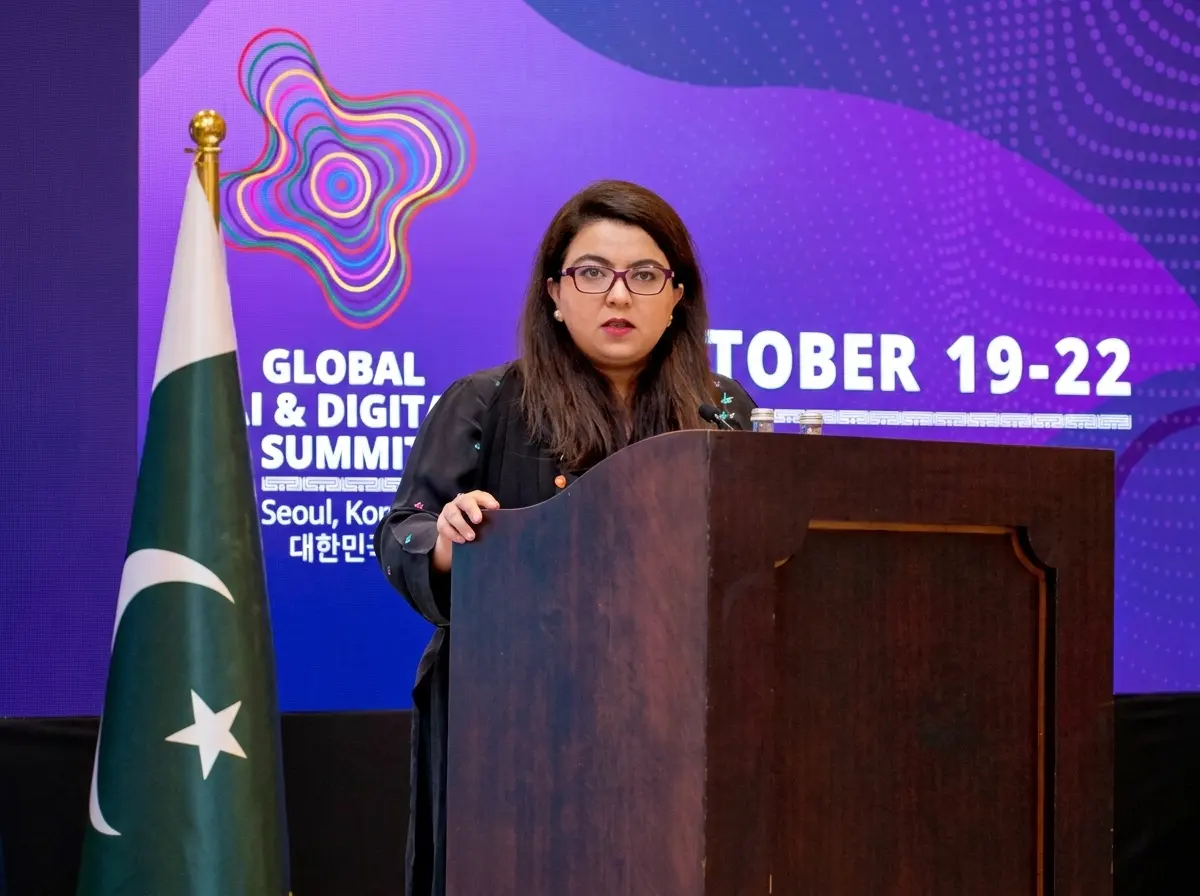
Pakistan is developing an artificial intelligence language model called Buraq for Urdu and regional languages, Federal Minister for Information Technology and Telecommunication Shaza Fatima Khawaja has told an international summit in Seoul, South Korea.
The project is part of a wider government strategy that places digital identity, instant payments, secure data exchange and rules for handling public information at the centre of future AI-assisted government services.
But Buraq has not been confirmed as a publicly launched product. The government has not announced a verified release date, published independently testable performance results or demonstrated an operational connection between the proposed model and Pakistan's existing payment and identity systems.
The Seoul announcement therefore sets out a development plan rather than confirming the arrival of a finished national AI platform.
What did Pakistan announce about Buraq at the Seoul summit?
Shaza Fatima discussed Buraq during a panel titled "Enabling Digital Government Service Delivery through DPI and AI" at the Global AI & Digital Summit 2026, according to an October 21 report by Associated Press of Pakistan.
The summit took place in Seoul from October 19 to 22. According to the World Bank's official programme, it was hosted by the World Bank Group together with South Korea's Ministry of Finance and Economy and Ministry of Science and ICT.
The event focused on how countries can use digital technology and artificial intelligence to improve public services, create economic opportunities and build systems that people can trust.
During the October 21 discussion, the minister identified Buraq as part of Pakistan's National Artificial Intelligence and Emerging Technologies Development Programme, or NAIEDP.
She described two components of the programme. The first involves procuring and providing domestic AI computing capacity, while the second concerns developing Buraq as a large language model focused on Urdu and regional languages.
The computing initiative is intended to improve Pakistan's ability to process data within the country and retain more of the economic benefits associated with domestic AI development.
However, the minister's remarks did not establish that all the planned computing resources had already been purchased, installed or made operational.
The Buraq discussion followed a separate October 19 keynote address in which Shaza Fatima presented Pakistan's broader digital and AI ambitions under the theme "Digital and AI Compacts: From Ambition to Action".
The two appearances addressed related issues, but the October 21 panel report is the direct source for the details about Buraq and the four foundations of AI-assisted public services.
What is Buraq, and can people use it yet?
Buraq is described as a large language model, commonly called an LLM. This type of artificial intelligence is developed to process human language and generate responses to questions or instructions.
Depending on its training and design, a language model may help users understand information, summarise documents, write text or navigate digital services.
The government's stated aim is to make AI more accessible to people who primarily communicate in Urdu or other Pakistani languages rather than English.
That goal could be useful in a country where language remains a barrier to accessing some online information and services.
For example, an Urdu-speaking person might eventually be able to ask an AI assistant to explain the documents required for a government application or the steps involved in completing an official process.
Such an application would depend on the model's eventual abilities and on its integration with an authorised service. It is not an example of an existing Buraq deployment.
The October 21 reporting did not identify a public Buraq website, downloadable model, mobile application or developer API. Nor did it announce a verified date when ordinary users would be able to access the technology.
Important technical details also remain undisclosed, including the development team, model size, architecture, training sources, supported regional languages and independent performance evaluations.
Without that information, it would be premature to claim that Buraq is more accurate than existing AI systems, fully trained on Pakistani data or ready for use in sensitive government services.
Why is Pakistan putting digital infrastructure before AI?
The central argument presented in Seoul was that an AI model is only one part of a functioning public-service system.
A chatbot may explain how a person can apply for a government benefit, but answering questions is different from confirming someone's identity, checking confidential government records or authorising the transfer of public money.
Those activities require trusted institutions, secure technology, lawful access to information and procedures that make people accountable for decisions.
Shaza Fatima outlined four foundations for such services: digital identity, digital payments, secure data exchange and data governance.
In the government's proposed approach, these systems would allow future digital services to identify users, retrieve permitted information, support authorised transactions and keep records of how data has been handled.
There is an important technical distinction. NADRA, Raast and WASL are not required to train every AI language model or operate a standalone chatbot.
They become relevant when AI is connected to public institutions and asked to help with services involving personal records, eligibility decisions, fees or financial assistance.
That is why the minister presented AI as a later layer built on top of the supporting digital systems, rather than a replacement for them.
How does NADRA's digital identity system fit into the plan?
Digital identity is the first foundation. It allows an online service to establish that the person using it has been authenticated through an approved process.
Pakistan already has established identity registration and verification services through the National Database and Registration Authority, or NADRA.
At the Seoul panel, Shaza Fatima said NADRA had provided verified identities to more than 100 million Pakistanis. That figure is attributed to the minister and does not mean the same number of people have activated every feature of a newer Digital ID service.
NADRA's existing verification infrastructure is separate from its broader digital identity development work.
According to NADRA's official Digital Identity information, the authority is developing an ecosystem involving secure digital credentials, identity authentication, access to online services and consent-based handling of personal information.
NADRA has also introduced additional identity-verification services and features, while elements of the broader digital identity ecosystem remain under development.
For a citizen, the intended benefit is straightforward. Instead of repeatedly submitting physical documents to different government offices, a person could potentially verify their identity online through an authorised system.
An AI assistant might guide the applicant through a service, but the underlying identity checks would still need to be performed by the trusted verification system rather than inferred from the AI's conversation with the user.
The availability of existing NADRA services should not be taken as proof that every planned digital identity feature is already integrated across all government departments.
What is Raast, and how could it support AI-assisted public services?
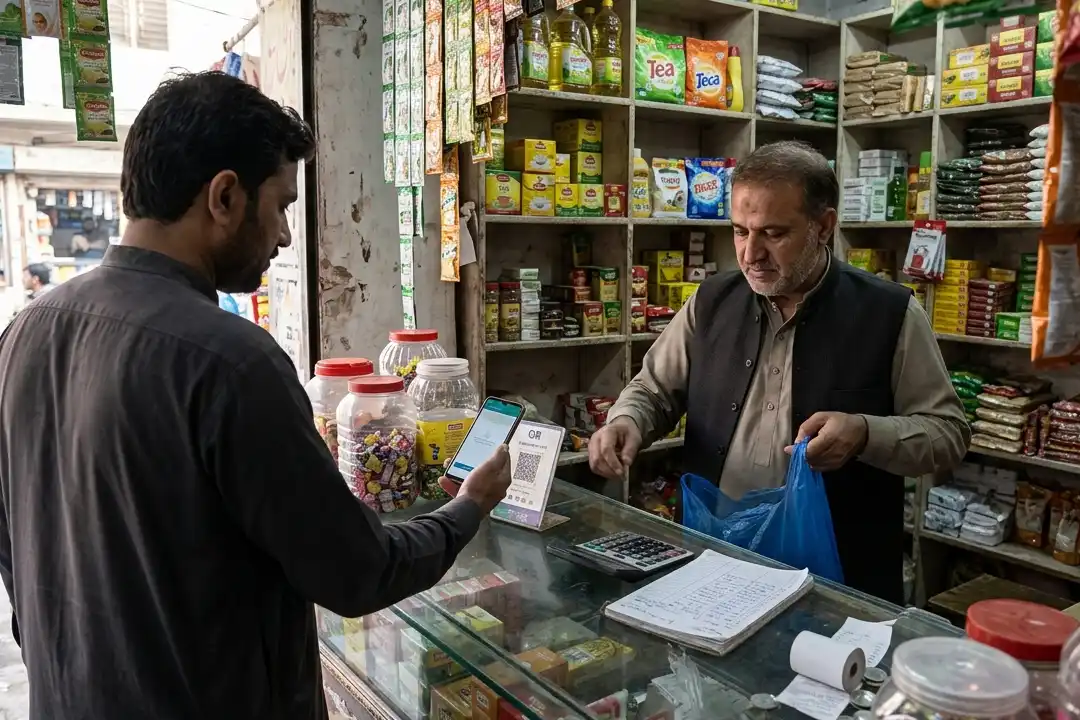
The second foundation is digital payments, where Pakistan already operates a national instant payment network.
Raast, operated by the State Bank of Pakistan, enables digital transfers involving individuals, businesses and government entities through participating financial institutions.
It supports different payment arrangements, including transfers between individuals, payments to merchants and institutional payment use cases.
Unlike Buraq, Raast is not a future technology awaiting its initial launch. It is an existing part of Pakistan's financial infrastructure.
During the Seoul discussion, the minister highlighted the importance of payment systems for services involving government fees, social protection transfers and subsidies.
Consider a future digital service for a household seeking financial assistance. An AI assistant could potentially explain eligibility requirements and help the applicant understand the process.
The appropriate government institution would still be responsible for checking the application, applying the relevant rules and approving any assistance.
Once a payment had been authorised, a suitable channel using Raast could help transfer the money through the participating institutions.
That example illustrates a possible relationship between AI-assisted services and established payment infrastructure. It does not mean Buraq currently assesses benefits applications, independently decides who qualifies or sends money to bank accounts.
Any actual integration would require technical safeguards, financial authorisation and clear institutional responsibilities.
What is WASL, and why does government data exchange matter?
WASL is the third foundation. It is Pakistan's national data exchange initiative, designed to enable authorised government systems to communicate without placing every institution's records into one central database.
Public information is currently held by different authorities. Identity records, taxation information, land records, educational details and other government data are maintained by separate institutions with different responsibilities.
When these systems cannot exchange information efficiently, citizens may have to provide the same documents to multiple offices.
WASL is intended to make approved information exchanges easier and more secure.
The official WASL website describes a federated architecture. In this design, an institution retains custody of its records while another authorised institution can request verified information through a controlled connection.
The published architecture says WASL is an exchange layer, not a central database designed to collect every citizen's personal information.
It also describes consent verification, authentication, encryption and records of data exchanges as features of the system.
These are the safeguards described in the official design. Their publication does not independently establish that every security feature is operating across every participating institution or that the entire government has completed integration.
For example, a citizen applying for a public service might eventually authorise one department to verify a particular record held by another department.
Instead of requesting the same paper document again, the receiving institution could obtain the permitted information through the connected systems, provided the relevant legal conditions and technical arrangements were in place.
An AI assistant could help the person understand the process, but it would still be subject to the access controls imposed by the underlying service.
At the Seoul summit, Shaza Fatima connected WASL with the World Bank-supported Digital Economy Enhancement Project, or DEEP.
She also described plans for a citizen Super App and a National Open Data Ecosystem, known as NODE.
The proposed Super App is intended to make public services easier to access, while NODE is meant to support lawful access to appropriate public datasets for researchers, startups and AI developers.
Neither the summit report nor the published WASL architecture establishes that WASL, the proposed Super App or NODE has completed a nationwide rollout.
What protections will govern citizens' personal information?
The fourth foundation is data governance: the rules and responsibilities that determine how information is collected, classified, accessed, shared and protected.
These rules become especially important when AI-assisted services handle identity records, financial details or decisions affecting access to government benefits.
During the October 21 panel, Shaza Fatima described the National Data Governance Policy as a framework issued by the Pakistan Digital Authority.
According to the APP account of her remarks, the framework addresses consent, records of data access and the principle that AI should assist human decision-making rather than independently determine citizens' rights or entitlements.
However, the status of the policy requires an important clarification.
As checked on October 22, 2026, the Ministry of Information Technology and Telecommunication's official policy register still labels Data Governance Policy 2026 as "Draft".
The ministry's policy information page also describes the document as having been released for public consultation.
In an August 5 update, the Pakistan Digital Authority said consultation had concluded but stakeholder feedback would still be incorporated before finalisation.
These official records do not independently establish that a final, legally operative version of the policy has been notified and implemented throughout government.
It would therefore be inaccurate to describe every proposed safeguard in the draft as an existing and enforceable legal protection.
The distinction does not remove the importance of the proposed principles. Citizens need clarity about who can access their personal records, on what legal basis information may be shared, when consent is required and how incorrect data can be challenged or corrected.
People also need to know who remains accountable when AI contributes to a decision that affects access to financial assistance or another essential service.
The minister's stated approach is that AI should support human officials rather than make final decisions about individuals' rights by itself. Applying that principle would require effective human review, clear responsibility and practical mechanisms for addressing errors.
Related questions about AI accountability are also being debated in Pakistan. Origin Pakistan previously examined proposed AI-related criminal laws and privacy concerns surrounding chatbot conversations, a separate issue that shows why clear safeguards matter.
Is Buraq Pakistan's first Urdu AI language model?
The available evidence does not support calling Buraq Pakistan's first Urdu language model.
Urdu-focused language-model research was already under way before the October 2026 summit.
For example, researchers published a paper on Qalb on January 13, 2026. It describes an Urdu model developed through continued training of an existing foundation model followed by additional fine-tuning.
The paper also refers to earlier Urdu AI work, including the Alif model, against which the researchers evaluated their results.
That research provides evidence of Urdu-language model development before the government's Buraq announcement.
It does not establish whether Buraq will have the same design, training approach, capabilities or intended users.
Buraq could eventually be different because of its language coverage, public-sector purpose or development arrangements. But no responsible technical comparison can be made until the government releases specifications and independently testable results.
The description of Buraq as a Pakistani or sovereign AI initiative also does not prove that every component is being trained from scratch or developed entirely from domestic technology.
What is still unknown about Buraq?
The announcement leaves several technical and operational questions unanswered.
- Which institution or team is responsible for developing the model?
- Will Buraq be trained from scratch or adapted from an existing language model?
- What are its architecture, parameter count and training data sources?
- Which regional languages will it support, and how well will it perform in each?
- Will the government publish independently testable benchmarks and safety evaluations?
- Will the model be offered through a public chatbot, developer API or downloadable release?
- Will any version be open-source?
- What is its expected launch date and the budget allocated specifically to its development?
The reviewed October 21 announcement did not provide independently verified answers to these questions.
The wider computing programme also needs further details about procurement, operational readiness, security arrangements and which research or public institutions will be permitted to use its resources.
These issues matter because support for a local language is only one measure of whether an AI system is suitable for real public services.
A model handling important information must also be accurate, secure, appropriately tested and subject to meaningful oversight.
What happens next for Pakistan's AI strategy?
The next major development would be a verifiable Buraq demonstration or release, supported by technical documentation and evidence of how it performs in Urdu and regional languages.
Progress on domestic computing capacity, confirmed WASL integrations, broader digital identity services and the government's proposed public-service platforms will also help show how far the wider initiative has advanced.
An authoritative update on the National Data Governance Policy will be particularly important, given the difference between the minister's description and the draft status currently shown in official records.
For Pakistan, an effective Urdu and regional-language AI system could eventually make digital services easier to understand and use, particularly for people who are less comfortable with English-language technology.
It could also create opportunities for universities, researchers and software developers working with Pakistani languages.
But an AI model alone would not make government services trustworthy. The surrounding systems must still verify identities, protect records, authorise payments and ensure that people remain accountable for decisions affecting citizens.
For now, Buraq remains a government development initiative. Its real significance will depend on the capabilities, evidence and safeguards delivered after the Seoul announcement.