
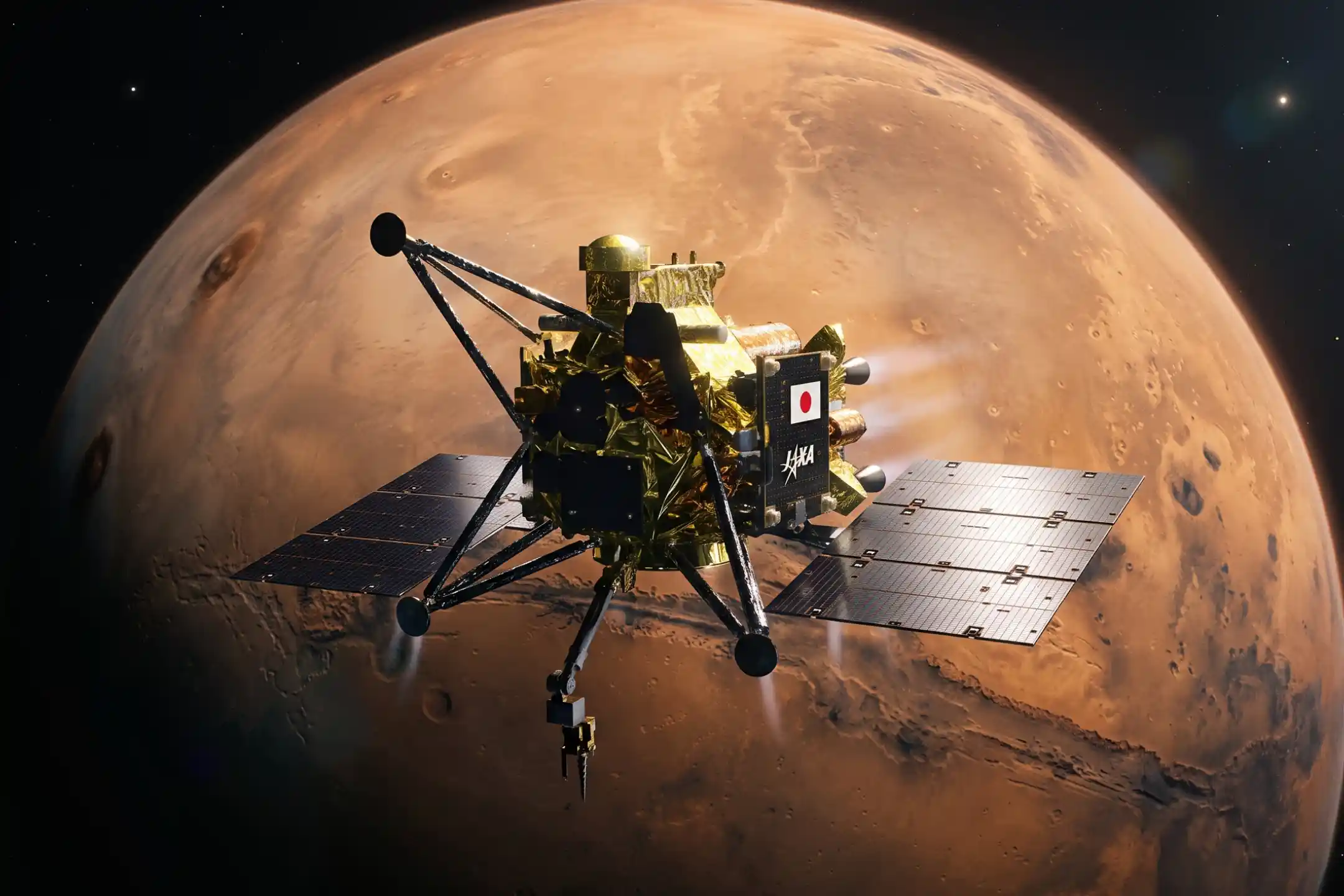
Japan is preparing to launch a spacecraft on a historic round-trip mission to one of Mars's two moons, with plans to collect surface material and return it to Earth for detailed scientific analysis.
The uncrewed Martian Moons eXploration mission, known as MMX, is scheduled to lift off on Tuesday, October 20, 2026. Led by the Japan Aerospace Exploration Agency (JAXA), the spacecraft will travel to Phobos, the larger of Mars's two moons, and attempt to return at least 10 grams of material to Earth in 2031.
If successful, MMX would become the first mission to bring back samples from the Martian system. Scientists hope the material will help answer a fundamental question about Mars: were its moons formed from debris after a giant collision, or were they asteroids captured by the planet's gravity?
When Will Japan Launch the MMX Mission?
JAXA has scheduled the launch for October 20 at 4:41:03 a.m. Japan Standard Time. In Pakistan, that corresponds to 12:41:03 a.m. on Tuesday, October 20.
The spacecraft will be carried aboard Japan's H3 Launch Vehicle Flight No. 10 from the Yoshinobu Launch Complex at Tanegashima Space Center.
In an updated announcement issued on October 18, JAXA confirmed the planned launch time and extended the reserve launch period to October 21 through November 9. An earlier notice had listed November 7 as the final reserve date.
Weather conditions, technical readiness and final launch checks could still affect the schedule. The spacecraft has not yet launched, and no successful deployment should be assumed before JAXA confirms it.
JAXA has also shared mission-related updates through its official English-language X account:
Readers can follow further announcements through the official MMX mission website.
Why Is the Mission Considered Historic?
Scientists have explored Mars for decades using orbiters, landers and rovers. But no spacecraft has successfully collected material from either of its two natural moons and returned it to laboratories on Earth.
MMX aims to accomplish that goal by studying Phobos at close range, making two brief landings to collect samples and then sending a return capsule home. It will also observe Deimos, Mars's smaller moon.
According to the European Space Agency, MMX would achieve several important firsts if its operations succeed. These include close operations in a quasi-satellite orbit around Phobos, collecting samples from a natural moon other than Earth's Moon and returning a spacecraft from the Martian system.
Each milestone involves considerable technical challenges. MMX must travel to Mars, operate close to a small moon with extremely weak gravity, retrieve material and safely return it across interplanetary space.
Japan has previously recovered material from asteroids through its Hayabusa and Hayabusa2 missions. MMX builds on that experience but involves a longer journey and the additional difficulty of operating around Mars.
How Will MMX Reach Phobos and Return to Earth?
After launch, MMX is expected to spend approximately one year travelling to the Martian system. The spacecraft is scheduled to arrive near Mars in August 2027 and begin detailed observations around Phobos from September that year.
Rather than immediately attempting to land, mission controllers will first use cameras and scientific instruments to study Phobos's shape, surface, composition and gravity.
The spacecraft will follow an orbit associated with Phobos's movement around Mars. This arrangement, known as a quasi-satellite orbit, will allow it to observe the moon repeatedly and identify promising sampling locations.
In early 2029, a small rover named IDEFIX is expected to reach the surface to investigate local conditions ahead of the main spacecraft's landing attempts.
ESA's October 2026 mission overview places the main spacecraft's Phobos landing and sampling phase in 2030. NASA has separately described sampling as occurring no earlier than December 2028. These descriptions reflect different levels of scheduling detail and should not be treated as separate confirmed sampling dates.
The JAXA mission plan calls for two soft landings to collect material. After completing its scientific work, MMX is expected to depart the Martian system in 2030.
The return journey should take approximately another year. In 2031, the spacecraft is expected to release a protected capsule containing the Phobos samples into Earth's atmosphere.
The capsule is planned to land in Australia, after which the material will be transferred to Japan for cataloguing, preservation and scientific study with international partners.
Why Do Scientists Want Samples From Phobos?
Mars has two small, irregularly shaped moons, Phobos and Deimos. Their origins remain uncertain, and researchers have developed competing explanations for how they became part of the Martian system.
One possibility is that the moons were once asteroid-like objects orbiting the Sun before being captured by Mars's gravity.
Another theory suggests they formed after a massive object struck ancient Mars, sending debris into orbit. Over time, some of that material may have gathered into the moons seen today.
These ideas would imply very different histories. If Phobos formed from impact debris, its material might preserve information linked to ancient Mars. If it was captured from elsewhere, its composition could reveal more about the early Solar System and the movement of material between regions.
Remote observations can measure surface features and chemical signatures, but samples collected directly from the moon would allow far more detailed laboratory analysis.
Scientists could examine minerals, chemical elements and individual grains to investigate where the material came from and what processes affected it.
The mission could also help researchers understand how water-bearing minerals and carbon-containing compounds were distributed during the Solar System's early history.
These questions are relevant to studies of how potentially habitable environments developed. However, MMX is not a mission to confirm the existence of extraterrestrial life.
How Will the Spacecraft Collect at Least 10 Grams?
JAXA's minimum sample objective is approximately 10 grams of Phobos material. Although that amount is small, sensitive laboratory equipment on Earth can extract substantial information from individual particles.
The spacecraft carries two complementary sampling systems.
JAXA's C-Sampler is designed to use a coring mechanism to collect material from approximately two centimetres below the surface. A robotic arm will position the equipment and help secure the collected sample.
NASA's Pneumatic Sampler, known as P-Sampler, will use bursts of pressurised nitrogen gas to lift loose particles into a collection container.
These different methods are intended to gather material from slightly different surface environments, providing scientists with useful samples for comparison.
According to NASA's October 15 briefing, the US agency expects to receive and preserve approximately 15% of the returned material for scientific research.
Sampling is particularly challenging because Phobos has extremely weak gravity. The spacecraft must make controlled contact with the surface without bouncing away or losing the opportunity to collect material.
JAXA's technical mission description says the two planned surface visits are expected to last only a few hours each.
What Is the IDEFIX Rover?
MMX will carry a small rover called IDEFIX, developed jointly by the French space agency CNES and the German Aerospace Center (DLR).
The rover has a mass of approximately 25 kilograms and is designed to examine the texture, composition and physical properties of Phobos's surface.
Its observations will help engineers prepare for the larger spacecraft's sampling touchdowns and provide additional scientific information about the moon.
Moving across Phobos requires specialised engineering. The moon's gravity is so weak that ordinary approaches to driving and maintaining traction cannot be applied in the same way as on Earth.
IDEFIX is scheduled for deployment in early 2029, according to ESA's mission overview. It will remain on Phobos rather than returning to Earth with the samples.
How Are NASA and European Space Agencies Involved?
Although MMX is led by Japan, the project is an international scientific collaboration involving NASA, ESA, CNES and DLR.
NASA has contributed the MEGANE instrument, designed to measure gamma rays and neutrons associated with Phobos's surface. Those measurements will help scientists determine its elemental composition.
The US agency has also provided its pneumatic sampler and will support the mission through the Deep Space Network, which helps track and communicate with spacecraft operating far from Earth.
CNES and DLR jointly developed the IDEFIX rover. European researchers are also preparing for possible scientific access to samples returned by the mission.
Together, the participating agencies are contributing instruments, robotic systems and research expertise needed to investigate the Martian moons.
Will MMX Land on Mars or Search for Life?
MMX is not designed to land on the surface of Mars. Its sampling destination is Phobos, a separate natural moon orbiting the planet.
The mission will also observe Mars and Deimos from space, but the material it aims to return will be collected from Phobos.
Some grains on the moon may have originated from impacts on Mars. However, scientists will need to analyse the returned material before determining where individual particles came from.
The findings could improve understanding of Mars's early environment and the movement of water-related materials through the Solar System. They would not automatically provide evidence that life once existed on Mars or Phobos.
Beyond its scientific objectives, MMX will test technologies for long-distance navigation, robotic operations, surface sampling and returning material from the Martian system. Those capabilities could support future exploration missions.
What Happens After the October 20 Launch?
If JAXA's latest schedule holds, the MMX spacecraft will begin its journey on October 20, with arrival near Mars expected in 2027 and its return to Earth targeted for 2031.
Successful launch and spacecraft deployment will be only the first milestones. Mission controllers will still face years of navigation, observations, rover operations, difficult sampling manoeuvres and the final return of the capsule.
For now, Japan is preparing to attempt a journey no space mission has successfully completed: retrieving material from a moon of Mars and bringing it back for detailed scientific examination on Earth.
Sources and Further Reading
- JAXA: Updated MMX launch notice, October 18, 2026
- JAXA: Original English launch announcement
- JAXA: Official MMX mission overview and schedule
- JAXA: MMX scientific instruments and sampling systems
- NASA: Scientific cooperation and sampling technologies
- ESA: Rover, mission timeline and sample-return objectives
- Associated Press: Japan's upcoming Mars moon mission
- JAXA: Official X post shared with this report