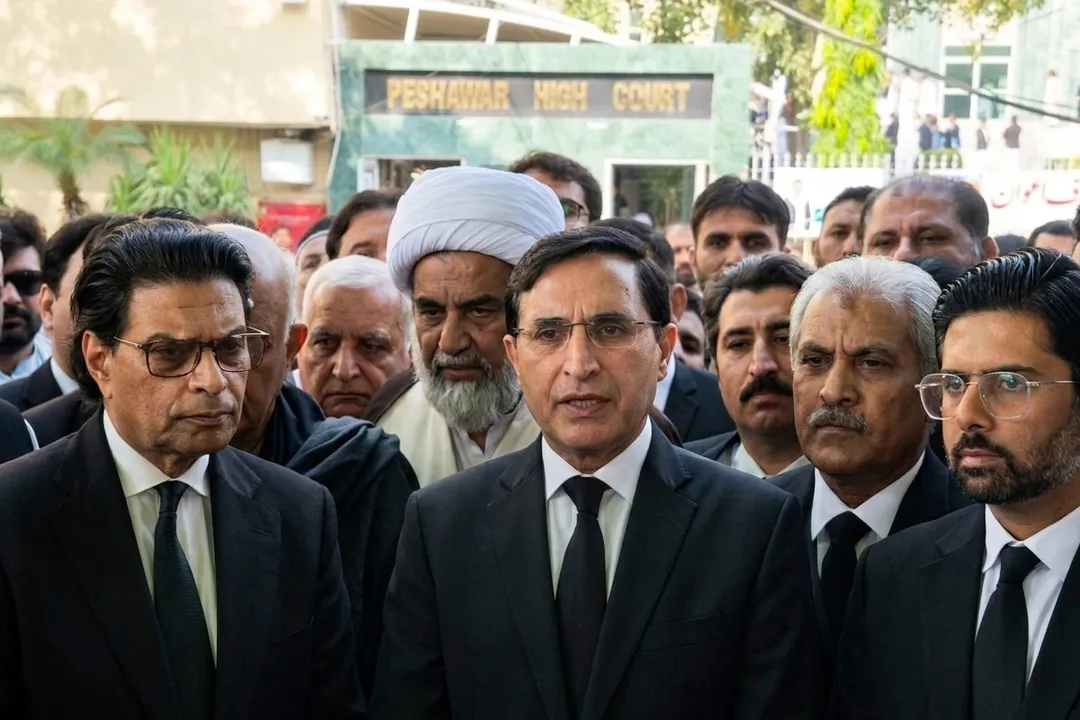
PESHAWAR — The Peshawar High Court (PHC) on Tuesday issued notices to federal and provincial authorities over petitions challenging the imposition of emergency and governor's rule in Khyber Pakhtunkhwa, bringing the federal government's October 11 intervention before the judiciary.
A two-member bench comprising Justice Ijaz Anwar and Justice Muhammad Faheem Wali heard preliminary arguments on October 20 before adjourning the main constitutional petitions until November 10, 2026.
The court sought responses from the federal and KP governments, with notices also directed to Attorney General Mansoor Usman Awan, the provincial advocate general and other relevant authorities, according to Dawn's report on the proceedings.
The petitioners are seeking to overturn the presidential proclamations that introduced emergency measures and governor's rule in KP. However, the court has not delivered a final ruling on whether the measures comply with the Constitution.
What Happened During the PHC Hearing?
The bench took up several petitions, including one filed by Pakistan Tehreek-e-Insaf (PTI) Chairman Barrister Gohar Ali Khan.
Other petitioners include PTI leader Shandana Gulzar, the Khyber Pakhtunkhwa Bar Council, representatives of the Tehreek-i-Tahafuz-i-Ayin-i-Pakistan (TTAP) alliance and National Democratic Movement (NDM) leaders Mohsin Dawar and Bushra Gohar.
Barrister Sameer Khosa and PTI Secretary General Salman Akram Raja appeared on behalf of Barrister Gohar. Other lawyers also challenged the procedure and grounds used to impose the measures.
Khosa argued that the provincial administration had not lost its ability to govern and that the circumstances did not justify extraordinary constitutional action.
He told the court that the KP Assembly had not passed a resolution approving an emergency based on internal disturbance. Raja also maintained that the constitutional conditions for imposing governor's rule had not been met.
The petitioners argued that the provincial chief minister and cabinet had been prevented from exercising their responsibilities despite their continuing constitutional status, as asserted by counsel.
Khosa referred to the Supreme Court's earlier Pir Sabir Shah case in support of his argument concerning provincial executive authority during an emergency.
According to The Express Tribune's courtroom coverage, the lawyers sought the restoration of provincial legislative and executive functions and raised concerns about political figures whose whereabouts were disputed.
These were arguments presented by the petitioners, not findings adopted by the judges.
Why Articles 232 and 234 Are Central to the Challenge
The petitions involve two distinct constitutional mechanisms.
Article 232 allows a proclamation of emergency under specified circumstances, including war, external aggression or serious internal disturbance beyond the power of a provincial government to control.
For an emergency based on internal disturbance, the provision refers to a resolution from the affected provincial assembly. It also contains a separate procedure requiring approval by both houses of Parliament within 10 days when the president acts on his own.
The petitioners argue that the KP Assembly's approval was mandatory and that the government did not meet the constitutional requirements.
The relationship between those two procedures, and their application to the October 11 proclamation, is disputed.
Article 234 concerns a different situation: when provincial government cannot be carried on in accordance with the Constitution.
Under that provision, the president may act after receiving a report from the provincial governor and reaching the required constitutional satisfaction. The president may assume specified provincial government functions or direct the governor to exercise them on the president's behalf.
The petitioners dispute whether the necessary conditions for invoking Article 234 existed in KP. Their objections also raise questions about the material on which the federal decision was based.
Article 236(2) contains an express restriction on questioning the validity of proclamations and orders issued under the Constitution's emergency provisions in court. How that restriction interacts with the pending petitions remains a question of constitutional interpretation; the PHC has not resolved it in the reported proceedings.
For a more detailed explanation of these separate mechanisms, see Origin Pakistan's earlier report on governor's rule and emergency powers.
Parliamentary Approvals Also Face Legal Challenge
The petitioners are challenging not only the original presidential action but also the subsequent parliamentary approvals.
On October 14, the National Assembly and Senate separately approved resolutions endorsing the emergency proclamation. A joint sitting of Parliament adopted two resolutions on October 15, approving the emergency under Article 232 and governor's rule under Article 234.
The National Assembly's official resolution register records the October 14 approval by the lower house and the October 15 joint-sitting approval of the emergency proclamation.
Barrister Gohar sought permission to amend his pending petition to challenge the parliamentary resolutions and related government notifications.
His argument is that subsequent parliamentary approval cannot remedy an original presidential action if the constitutional conditions for issuing it were not satisfied.
Although the measures have received parliamentary approval, the petitioners dispute whether those approvals answer their objections to the original proclamations.
The PHC has not determined the legal effect of those resolutions.
Why Did the Centre Impose Emergency and Governor's Rule?
The federal government introduced the measures on October 11 after President Asif Ali Zardari approved the advice of Prime Minister Shehbaz Sharif.
Federal Law Minister Azam Nazeer Tarar announced that Articles 232 and 234 had been invoked, citing deteriorating law and order and what the government described as insufficient cooperation by the PTI-led provincial administration in counterterrorism operations.
According to Radio Pakistan's report on the official announcement, executive responsibilities previously exercised by the chief minister and provincial cabinet were transferred to Governor Faisal Karim Kundi.
An 11-member advisory council was established to assist the governor in managing provincial affairs.
Federal officials maintain that the security situation justified extraordinary intervention.
PTI disputes that explanation. Barrister Gohar argued during the hearing that his party had supported action against terrorism and rejected the allegation that the provincial administration had failed to cooperate.
The federal government's assertions about security and the petitioners' objections remain competing positions. Their constitutional significance has not yet been determined by the court.
Separate Petitions Over Sohail Afridi and Other PTI Figures
In separate proceedings, the PHC sought responses from authorities over petitions concerning the whereabouts and recovery of political figures following the October 11 measures.
Justice Arshad Ali heard a petition concerning Sohail Afridi, whose executive functions as KP chief minister were affected by the imposition of governor's rule. The court directed the provincial government, police and other relevant authorities to respond within two days.
Another bench, comprising Justice Arshad Ali and Justice Farah Jamshed, heard petitions concerning KP Assembly Speaker Babar Saleem Swati and PTI provincial president Junaid Akbar. Responses were sought within 10 days.
These directions were reported by The News on October 20.
PTI representatives have alleged that several elected representatives and party figures were detained or taken away following the federal intervention.
Federal ministers previously acknowledged that Afridi and some provincial cabinet members had been taken into preventive custody.
However, their current circumstances and the legality of any individual detention require official clarification and, where challenged, judicial determination.
The recovery proceedings are separate from the main constitutional challenge. Notices seeking government responses do not themselves establish that a particular detention was unlawful.
What Happens at the November 10 Hearing?
The main constitutional petitions are scheduled for further hearing on November 10, 2026.
The court has sought responses to objections involving the constitutional procedure, the federal government's stated grounds and the effect of parliamentary approval.
The petitioners have also sought interim relief while the cases remain pending.
According to The Express Tribune, the bench said it would examine the interim-relief request and issue an order. The reports available at the time of writing did not establish that a signed order suspending either proclamation had been issued.
Important legal questions remain unresolved, including whether the conditions for invoking Articles 232 and 234 were fulfilled and how the court will address constitutional provisions governing challenges to emergency proclamations.
For now, the October 20 hearing marks a step in the judicial proceedings over the federal government's actions, not a judgment overturning or validating them. The next developments will depend on the authorities' responses and further court orders.