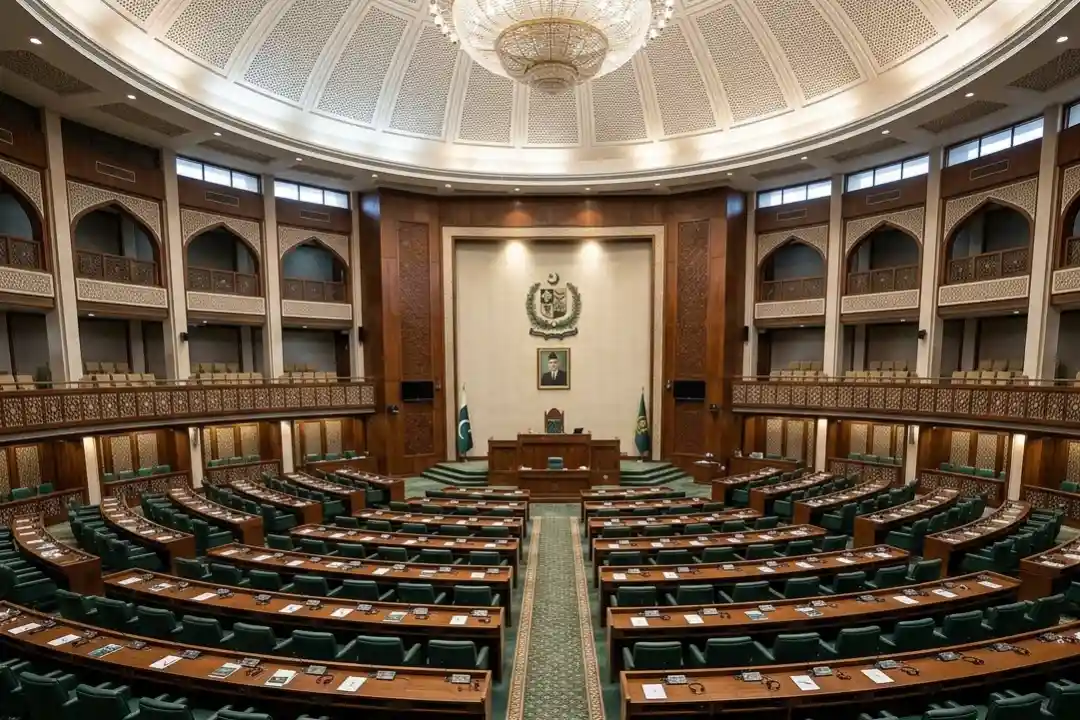
The National Assembly's official bills-laid register lists the Privatisation Commission (Amendment) Bill, 2026, as laid on 22 October 2026. Dawn reported on 26 October that the proposal would bring privatisation work and the functions of the Public-Private Partnership Authority (P3A) into a proposed Privatisation and Public-Private Partnership Commission (PPPPC). Dawn also reported proposed legal and investigative protections for current and former personnel. The National Assembly entry confirms that the bill was laid, but the full draft could not be opened for this review. The exact wording of the reported protections therefore remains unverified against the bill itself.
At 3:25 pm Pakistan Standard Time on 26 October 2026, the National Assembly's passed-bills listing did not include the measure. The Assembly's official website said the House was scheduled to meet again at 5:00 pm that day. This check was made before that sitting, so it cannot establish what happened later.
What does the reported merger involve?
Dawn describes a plan to bring the Privatisation Commission and P3A together in a proposed new commission. It reports that the government sees the current division of responsibilities as duplicative. The proposed bill would amend the Privatisation Commission Ordinance, 2000, and repeal the Public Private Partnership Authority Act, 2017. These are reported proposals, not an implemented merger.
According to Dawn, the proposed commission would advise on, assess, structure, facilitate and monitor public-private partnership (PPP) projects. The National Assembly register verifies that a bill was laid, but the detailed functions reported by Dawn have not been checked against the draft itself.
What legal protection does Dawn report?
Dawn says the draft would offer legal and investigative protection to serving and former chairmen and secretaries, board members, other officials and consultants. It describes the protection as covering acts or omissions carried out in good faith and in a personal capacity. The report also says public funds could be used to defend cases covered by the proposed provisions.
The full draft could not be opened in the official material accessed for this review. Its exact conditions, all beneficiaries and any exceptions therefore remain unverified. The available evidence does not establish that the protection is unconditional or covers every kind of conduct. Calling it blanket legal immunity as a settled legal conclusion would go beyond the verified evidence.
What does the existing P3A Act provide?
The version of the Public Private Partnership Authority Act, 2017 published on P3A's official website includes a good-faith indemnity provision in section 26. It covers the Federal Government, the Board, the Authority and certain officers acting on their behalf for relevant functions carried out in good faith under the Act or its rules and regulations.
This provision is relevant background: the P3A Act version examined already contains protection linked to good-faith conduct. It does not prove that the October bill repeats the same wording or leaves the scope unchanged. The official PDF includes references to amendments in 2021 and 2022. Whether later amendments affect these provisions has not been established.
What does the Act say about public access to PPP agreements?
Section 24 of the same Act sets out a public-disclosure rule for PPP agreements. It provides that an agreement is a public document and that an interested person may obtain a copy under applicable laws. That rule already appears in the version examined, so the accessible text does not support saying that public access would be created for the first time by the October bill.
Dawn reports that the proposed bill also addresses PPP agreements. Without the draft text, it is not possible to confirm whether section 24 would remain unchanged, be amended or be replaced.